Artifacts
400-parameter eyes
This is a good example of what I meant in #629 regarding small games still being the favorable thing to do. You can now go really hard on specific things in a way that wasn't as possible before for an individual. Imagine applying the same level of detail like this not only to eyes but to an entire face and having a process for creating or even capturing realistic faces? That's useful for all future projects you make but even useful as one of the main features of a singular game, like in Who's Lila?.
I Did This Without Your Knowledge
I Did This Without Your Knowledge
Humiliation rituals
Wishlist building and making demos are both humiliation rituals and I'm glad it's all finally over (1, 2, 3, 4), now it's all about making good game. I also don't quite like the "hype" aspect of the video game industry. It reminds me of how coins would go up in price on promises but then whenever the developers actually delivered on the tech the price dropped dramatically (#172). I'm sure this is a well known effect with a name and so on, but I think that preying on this particular failure of human psychology to be more excited about the thing that is coming rather than the thing itself is a mistake, it trains customers incorrectly and I'm not going to do it to people who play my games. At most I'll announce a game maybe 1 week before release? It would probably be better to just never announce anything (#7) and build a cadence of releases with predictable dates, like, every day X of every Y months a327ex releases a game type of deal, that way you get the benefits of the hype effect without having to actually go through the motions of doing anything for it, other than being consistent and actually never failing to deliver on that cadence (but see #6).
10/10 twinks
It is way easier to bag 10/10 twinks like this than it is 10/10 or even 8-9/10 women for the simple reason that all gay men care about is if you have a thick and/or huge cock. My cock isn't particularly huge, it's only thick, and I've managed a few. Are there women out there like this? Yes, but the vast, vast majority aren't. Some guys will spam their big dicks to girls on Instagram and while that may work eventually, it's just psychotic behavior and it also gets you banned, not that I've tried.
Name as a link to one's soul
Was fucking this girl yesterday and she was seemingly really into it, but I'm always suspicious of people who are really into it, I'm always thinking they're acting, I guess this is because one she-psycho in the past did this to me for what ended up being completely insane reasons and mini-ruined sex for me somewhat permanently on this axis, oh well. Anyway, this girl was into it, but she kept saying my name, like, it was so weird, we barely even know each other and she's saying my name like that, unironically if she kept saying she loved me, she wanted to be my hole forever, whatever, it would have been fine, but my name was just, it took me out of it a bit every time she did it. In the end I don't think she was acting. It's so bad that I can't even just enjoy sex properly and get out of my head and let myself go completely anymore.
Agent of nothing juice
I swear, I promise I won't get political at dinner tonight. Me after drinking two sips of agent of nothing juice:
Why make games?
"Why make games?" is a question many are likely asking themselves now that making games has been... democratized. My reasons are clear, I have a long term vision that I must birth into reality through my artistic artifacts. The contents of this vision are related to my theories on Soul Society (#35, #37, #501), which are what I actually believe is true about reality. Therefore, I view myself as a vessel for spreading the truth of said ideas on Earth. In a Zizian sense, I am a true believer in the afterlife, a lich (#34). Being a true believer has its advantages, because in times where material concerns are made trivial (a life of abundance, the external world being too malleable, as per #501), I have an external reality to align myself to that acts both as an anchor and a North star. You will never see me dooming about AI because it makes my job on this Earth easier, and that likely takes me closer to Soul Society, on top of just pragmatically making me more effective, as my emotions are positive instead of negative.
Rational builds (#34) don't have this problem, they can convince themselves of anything, so they will convince themselves of whatever they need to survive in such conditions, like devoting themselves to the Artificial God they are birthing into existence. Intuition builds (#34) are hit hardest, they must have a well crafted internal narrative of why they're doing the things they're doing, and many people are now finding out that their reasons for making games were primarily status based, they were doing it because few people could do it well, or because it conferred on them some kind of status above other people, and not for more robust reasons that would survive democratization. I don't know what to say to intuition builds like this other than try to realign yourself, figure out why you're doing it, and if you can't, well, try harder.
No matter where you go, eventually you'll have to ask this question, because every field will face the same shock in one way or another. It is my belief that most of the arts are rather safe for the reasons mentioned in #628, but even then, that doesn't mean the way the field works won't change.
I would also advise you to find God, in whatever way you can. I've come to believe that AI is ultimately some kind of atheist genocide event, you don't make it out of this without a way to align yourself to meaning in some important way, and that gets harder and harder the more AI advances. The people building the best artificial intelligence right now, the Anthropics, have found their God and his name is Claude. That works for them, but it doesn't quite work for the rest of the population or for you. Still, meaning has to be found or made, and AI forces that problem on everyone. I expect a genuine religious revival in the next decade (contingent on AI actually changing things), where it coalesces depends on what grabs people's imaginations and what connects with them.
Never take the doompill
As I'm finishing Lich's Egg, it's going to be the first game I finish that's a complete AI infused artifact from start to end, even though it's rather small. Most people now have converged on the solution of increasing scope due to game copying possibilities, as you can see in the replies to this post (I already answered one of them in #626):
I think that's a bit of a mistake. It's better to get used to getting your pipeline for game production working now while things are moving fast, and start increasing scope once things have stabilized. Opus 5.5 just released and it's a significant increase in game-making capabilities, there's no way to know where Anthropic will move next, and you kind of don't want to spend time doing things that take a lot of effort now only for them to be trivial in a few months.
So it seems like it's safer to make small games still, although, what "small" means now can indeed be bigger than before. I think copying concerns are largely irrelevant, 500 or so games release on Steam per week, 50 of those are popular, even for would be copiers it's a lot of surface area to attack, I think it's a concern that's way overblown. And even if it weren't overblown, now that games can be copied and decompiled and so on so easily, I could easily make the argument you're actually punished for spending more time on any individual game since it could theoretically be so trivially copied. In any case, for me it's clear the correct move is going small and increasing my scope slowly rather than trying to dream too big from the get go. Lich's Egg is a perfectly sized game, I liked how it came out, it allowed me to grasp the strengths and weaknesses of the current tools precisely.
The verdict is that they're good at pretty much everything except sounds, some types of juice, spatial awareness/modelling 3D spaces without references, modelling stylized characters still. There's probably more places where they lack but I haven't hit them in this particular game. As I said in #580, it's a truly competent gamedev companion, but taking a game to the finish line still takes quite a bit of work, I'm not sure that's going to change, for the same reason I argued back in #19 that game engines have an incentive problem with favoring the high percentage of people who never finish anything and not fixing hard problems for the low percentage of people who do. Anthropic has an incentive to make flashy one shot demos, they have no incentive to get the details of the last 20% of a game's development (which is 80% of the effort) right.
As for bartwe's post itself, my opinion on this has always been clear I hope, never take the doompill, this goes back to indiepocalypse days (#34). It's very easy to be demotivated, it's very easy to demotivate others, you need an anchor that grounds you in reality and allows you to assess the situation in a clearheaded, calm and collected manner. I will speak more on this in the next post, but AI ultimately forces us to ask the question of "why are we making games?"
Why "attention is all you need" is wrong
This explains the point about attention I left for another post in #595. A common mistake people make right now when modeling other humans has to do with attention. On social media attention is all that matters, so people extend that to games, "now that games are easy to make, attention is all that matters, you need to be an influencer and market your game, that's the only thing that matters!" It's true that solid marketing strategies matter more now than before, but attention is not the most important resource to focus on.
In the infinite scroll of short-form content, attention is all that matters. Getting people to watch, grabbing their attention, locking them in, is what makes the algorithm judge your video as good and recommend it to others. Something like this happens with games, the more people buy and play a game, the more Valve's algorithm recommends it, I posted this graph in #24:
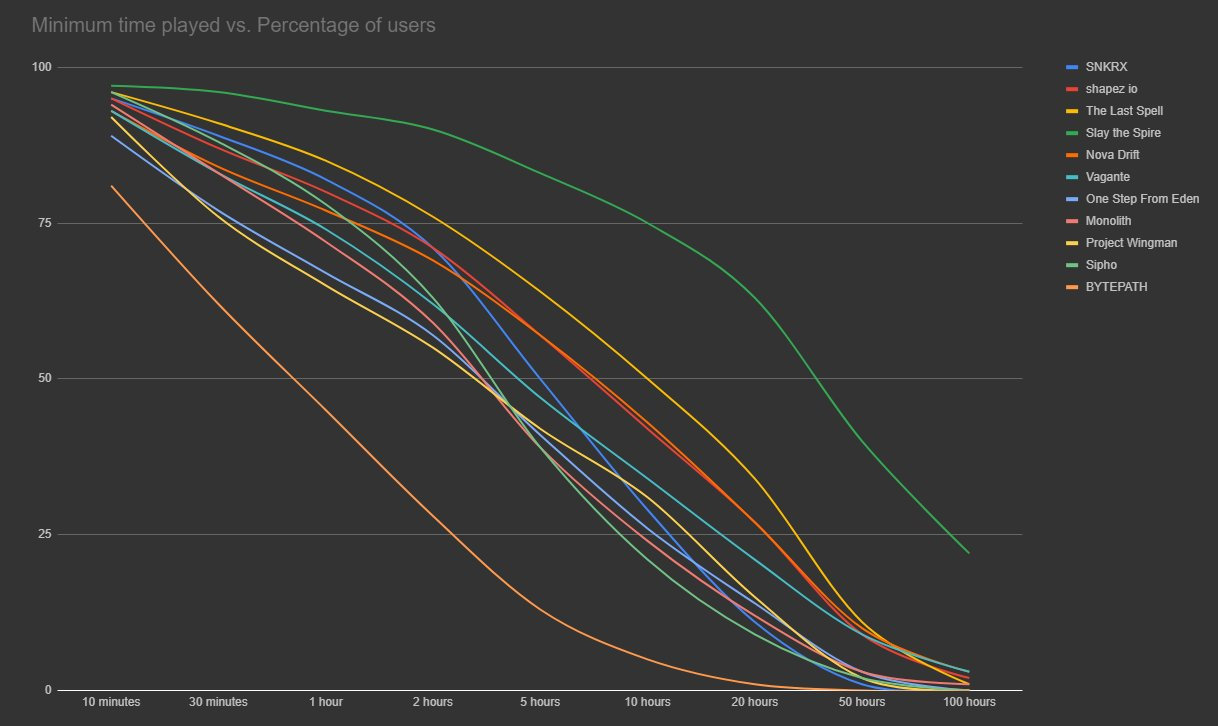
I don't think this has changed. The problem with concluding from it that attention is all that matters is that you still have to get people to actually buy and play the game. Buying and playing are actions that require activation energy, and that activation energy collapses neatly into a resource called INTEREST. Is the game interesting enough to the viewer that he will buy it and play it?
Interest is an infinite resource, it isn't capped by the hours in a day the way attention is, as most people are not deeply interested in anything, they passively watch online content and nothing truly evokes their imagination and compels them to act, anything that does has passed a certain threshold and has generated interest. Interest being both scarce (hard to generate) and infinite (once you can generate it, your ceiling is every human being alive) is a defense against the slopification of an industry, so I predict that the artistic industries that demand more activation energy from the user will be less affected by AI, games and books are likely fine, music and short-form content likely aren't.
This ties into #626's point about art generated on the fly. That may happen for music, and perhaps a little for movies, but it likely won't for books or games, because anything that requires activation energy from the user has to interest him, and something you can completely imagine and steer yourself, something that never quite surprises you, is not going to pass that threshold. There's also the fact that most people are not very imaginative, so whatever they can come up with themselves will be worse than what they can get from superior minds like mine. One could argue that the AI is, in some ways, already good at coming up with surprising things itself and this will only get better in the future, which is true. But then there's an additional argument against personal art generation, as mentioned in #595, most people don't engage with art on its own terms, they don't judge the artifact as an object, they take into account the artist, other people's opinions, what other people are doing, who's playing this game, is this cringe, oh my god, the Undertale fanbase is so cringe, I can't like this game anymore, and so on. I don't do this myself, but it's clear to me that most people do, and ultimately this is what "saves" art, because it makes art a collective experience rather than a solo one.
The new Malfoid meme is a great example of how AI will actually work, it's an existing IP people can coalesce around and then status (and eventually money) is distributed around this IP by people generating good things with it. The IPs that benefit the most will be open ones, because it's just smart, for instance, for JK Rowling to let the Malfoid thing be free instead of clamping down on it. So ultimately not a lot changes, the community aspect of art remains, because people want to discuss these artifacts and the ideas contained within with others.
Retarded AI tech faggot dipshits
I am going to go insane the next time I see some retarded AI tech faggot dipshit on Twitter smugly sneering at mathematicians for being status obsessed and only trying to protect themselves. These fucking AI people are so stupid, oh my fucking god dude, this event (#536) has single-handedly moved me from rather positive on AI as a whole to actually kind of neutral. There are multiple reasons for this. One is that they are wrong about the actual subject at hand, they simply do not understand anything about mathematics. I think this is probably the best post written on it so far:
What's the Future for Pure Math Research in the Age of AI? (yes, this is also an ad for one or another of Wolfram's services, grow up)
But the second and more important point is that this quite clearly shows that all the way down people will rejoice as AI """automates""" other people's jobs. It will not be some kind of oh uwu let's take care of everyone because everyone is jobless now, it will be, fuck you, fuck you, fuck you all the way around, no empathy whatsoever, this shit is going to be brutal, everyone is fucked and fucking everyone else. I always think that I have a good read on human beings but I find myself updating negatively in massive ways every 5 years or so, and this is another one. This is just bleak, I am thoroughly blackpilled on humanity. The worst part, I can't even claim I'm different, I enjoyed seeing artists suffer a few years ago.
Wrong premises
Great point that builds on #625, I'd go further and as I argued in #17, you should make the character, make good (and thus popular) games with him, and then let people use him freely in their own games. Every further use feeds back into the original, making you richer and raising your status in the process. Locking the character down with copyright is the wrong move, it rests on wrong premises about a world where everyone can copy.
Speaking of wrong premises, I mentioned in #521 and #536 that in fast moving times like these everyone is naked and everyone reveals themselves. Right now, one of the most reliable tells of a "thinking person" who can't actually model other human beings is some version of "in the future everyone will just have their music/movies/books/games generated for them on the fly."
There are so many reasons this is wrong that it's baffling anyone would conclude it, yet a lot of people conclude exactly that. Plenty of people are also dooming about art and games in general, when it's pretty clear those are rather safe, even though they were the first to be disrupted.
When I release my next game, the first one I make entirely with AI, I think I'll write a big post like the SNKRX log, except focused on AI, its effects on development and on society at large, and How Most People Are Wrong About Everything When It Comes To Art. I should start gathering the points I want to make in short posts like this one, so that when it comes time to write the article it's already 80% done.
Owning a style
Written by Claude (Opus 5.5), idea and direction by a327ex
joão (@fishesareweird) has been posting about how boring the AI image generation discourse is, with everyone optimizing for realism or engagement instead of seeing how far the thing can be pushed, and over the first days of October you can watch him find a style of his own. On the 2nd he posts four images that all came from the same prompt, which is just a wall of box-drawing characters with an ASCII fish in it:
The same day, the first clips of a low poly anime world, and a showreel of its animations and rendering:
On the 3rd it's the same characters in a clothing store, which became the first video on his new channel, real life tv:
And on the 11th he explains it. He writes the scripts, makes the 3D animations with Opus 5.5 and uses ElevenLabs for the narration, and four days in, the first video has 27.7k views, the channel has over 500 subscribers, and people in the comments are already invested in the lore of characters who never even talk:
This is a good example of creative AI usage, and it points at a nice idea: you can "own" an entire visual style like this and then release games with it. If joão decides to make a game in this style, he already has viewers who like it and who care about these characters, which is a nice path for marketing. Ideally you'd want something less generic than low poly anime, Kurzgesagt for instance has a very specific style that's very ownable, you see one frame of their videos and you know it's them. And of course people can copy a style immediately, so the moat doesn't last long if you do get popular, but it's a good idea if you haven't had a breakout hit yet.
The points below were added by Claude (Opus 5.5) on review of a327ex's initial idea, and he agrees with them:
What joão owns is a world, not just a look. The comments are invested in the lore of characters who never speak, and while anyone can copy low poly anime in an afternoon, nobody can copy his characters, his island and his tone. So the durable asset is the IP, with the style as its packaging: the style moat erodes, the world moat doesn't.
Copies can reinforce the original. If a style is distinctive enough, copies read as copies, people call them "Kurzgesagt-style", and that keeps naming the original. What erodes quickly is the novelty, not the original's status, so the window lasts longer than it seems, as long as you're the recognized reference rather than one of many who happened on the same look.
Video viewers aren't automatically game buyers. The transfer works best when the game is a natural extension of what they already like, a chance to spend time in that world with those characters. An unrelated game in the same style keeps much less of the audience, so the game should be designed around the world, not just reuse the look.
It fits the view from #172 that marketing changes the speed, not the ceiling. An audience built in advance doesn't make the game better, it means launch day starts with people who already care, which matters most on Steam, where a strong launch feeds visibility. That's why it's most valuable before a breakout hit: after one, your name does the job.
And the AI part is output rate. Making a style is cheap now, so styles will multiply and novelty alone won't carry anyone. What's hard in what joão is doing is volume and consistency, two videos in four days, same world, same characters, and AI is what makes that cadence sustainable for one person. The cadence is what builds the audience.
This reality must be a dream
As I'm making the lich game, I'm experiencing something new, which is the addicting nature of having a vision in my head and realizing it in reality exactly how I see it. I'm not an artist, so I couldn't quite do it before, and now I can. It is incredibly addicting and empowering. I have seen so many visions, so many vast empires, so many feats of honor and betrayal, so many futures of glory and doom. All of it is reachable now, today, by just writing the right words enough times. This is too much power, this reality must be a dream, I don't believe it.
Art from humans to humans
The threads here touch on a lot of good points, @gorilla_wrfre is correct that focusing on quality is a losing game and focusing on communication instead is the right move, this is the same point I made in #459. I personally believe that good art is good art, it doesn't matter who it came from, but most people are not like that, and here I will partly analyze the world from their perspective. The second thread, the conversation between OP and "get off this website," touches on the fact that prompting the AI gives you less of the human who made it, because the AI makes more choices. This is true as well. But this has two different arguments in it that are important to separate.
First, when I make something with AI, I know exactly where it's wrong and where it isn't, and I iterate with the AI until it feels right. This is because I have an extremely strong compass (#34, #39). People who have intuition builds know what they want, know when the AI returns something incorrect, and know how to get it to something correct. The output of intuition builds is further enabled by AI because they have a deeply inbuilt sense of what is right, and now they have a tool that more easily gets them there. This point is made well by boen here:
Second, most people do not have this intuition, therefore what most people will produce and consume is not that good, or is an average of what the AI produces. And what people like OP are complaining about is that AI introduces noise to the system, it's harder to tell when something is coming from a real human being, which can be then taken in two directions, one is that this is bad and will largely lead to a decrease in quality of art overall, which may be true, as mentioned by doomslide here:
The other, optimistic view, which is the one I prefer, is that this makes people who have taste, influencers, etc, more important than before so that "art from humans to humans" is something that doesn't get lost culturally. I now have updated to value good influencers in general more than I did before. My past positions were, they don't matter that much, but now circumstances have changed to make them matter more, not in an "attention is all you need now" way, which I also think is wrong by the way, but that's for another post, but in a "without tastemakers selecting good art society will crumble" kind of way.
Important to note, I'm also defending myself (and the world at large!) from this noise problem by publishing full logs of everything I make. A tastemaker who wants to know how the game came about or how AI was used can see clearly, and can make an informed decision about whether to like the game or not, in whatever way such an individual takes into account the artist instead of the artifact when making such decisions, which is not for me to judge.
Just don't lie
The way the incentives work for AI art in video games is that a single AI asset requires a disclosure, which will alienate some fraction of players. So if you use one AI asset, you might as well use ten thousand of them, because only the first one is penalized.
Just don't lie. The moment I realized AI was going to be useful, back in April 2025 (#38), it became clear I needed to log everything I was doing to comply with Steam's guidelines, which likely weren't going to change any time soon because gamers were mad that GPUs were expensive and weren't going to suddenly start liking AI unless that changed, which it hasn't and has only gotten worse. This goes back to the point I made in Marketing vs. skills about how often the middle ground is worse than both extremes. It is better to be 100% transparent or to just outright lie (but you shouldn't lie) than it is to have vague descriptions of how you used AI. People care about the fact that AI was used, that's why Steam makes developers disclose it, treat the customer's question as you would a question from a friend, would you lie to your friend? No. More importantly, you shouldn't lie for the very selfish reason that you should want to live a truthful life:
"Never lying" is an extremely difficult ideal but a great one to aim for. The payoff is very long term but very VERY worth it. Put as much effort as you can into not deceiving people. Develop a strong disdain for being pressured to lie. Put effort into orienting your life so that you aren't pressured to lie in the first place. For problems that require lying, put in 10x more time/energy to solve them without lying.
Most importantly never deceive/blind yourself.
Why? The payoff is a much clearer and functional understanding of the world. The payoff is increasing your ability to solve the root of problems instead of putting a bandaid on them. And to notice when there is the opportunity to do this in the first place (why would a solution designed around avoiding reality ever be better in the long run?) The payoff is reducing blindness and confusion in yourself and the people around you. The payoff is that life becomes more meaningful when your efforts go towards something real instead of toil/bullshit.
Expect to fail at this, because it's extremely difficult. But also expect to grow a ton and have a much more meaningful life.
More actively anti-gambling
Transações com Pix têm queda de 10% após proibição de bets https://valor.globo.com/financas/noticia/2026/09/29/transacoes-com-pix-tem-queda-de-10percent-apos-proibicao-de-bets.ghtml
The tweet above links to an article saying "pix transactions fall 10% after bets ban." If you don't know, Pix is a Brazilian system that allows one to instantly send money to any other citizen by using a key, which can be a phone number, email or CPF. It works for big and small transactions equally with no fee, so everyone uses it. The only way it could be better is if you could use it like a card, without having to pull out your phone, but nothing can be perfect.
Last week, the current president announced a total ban on bets, days before the election, and this is supposedly the result. There are arguments to be made on why this number is not actually true, like there are 10+% swings in usage at different times of each month, but even if they aren't quite true, the level of destruction these gambling apps have unleashed globally is undeniable and visible to everyone.
At this point, it's fairly safe to say that I have become more actively anti-gambling than I was before. In 2022, in Self-expression vs. vesselization, I wrote:
Is gambling bad? Irrelevant. It is a part of human nature, therefore it is the truth.
Now, do I personally care about the morality of making addicting video games? Not really. I don't think 1-2% of the population using my games for their addictions, however helpless they are, will keep me from sleeping soundly at night.
That position assumed that the vast majority of people have a responsible relationship with these things, and the problem was that a small minority couldn't help themselves, this being thus a bounded failure. But the dramatic rise of betting all over pretty concretely destroys that idea, it's clearly not 1-2%, more like 10-20%, perhaps even more, and at that point it's just way too much damage, normal people clearly cannot handle this level of psychological manipulation. As supporting evidence for how strong this pull is, I've also watched the complete failure of the crypto market to manifest anything of true value other than gambling related apps, despite the potential mentioned in my past NFT posts.
I mentioned in Son of a Serpent that SNKRX's reroll shop contributed to the problem to some degree, and proposed frontloaded power distribution as a more righteous alternative. In the recent meaning and commitment posts (#204, #213, #264), I also argued that what games have over short-form content is meaning and commitment, and that due to Deep instinctive changes, what people are actually doing when playing a game matters, and that it's best to handle that carefully. If the actions you're having people practice are analogous to gambling, as per garfieldbot's quote:
Gambling is sinful because it makes a mockery of, in the final calculation, love. It makes a mockery of what we call today "commitment". When you love, you commit to the world, and you are always "risking" something. These ard the wrong words, it's understanding it backwards, but we were all born backwards in this age. When you love, the world comes alive and is filled with meaning, "because you are risking something", to put it in a crude and low way. And gambling simulates this process as a crude mockery, by simulating "meaning" "stakes", through a simulated "risk". Like a video game simulates achievement, gambling simulates risk, and provides a poor substitute for the real thing. The optimal way to channel this process is love, romantic as well as charitable religious love, as one can be a doorway to the other, and it's a degredation of one's capacity for love to indulge in a mockery of it
Then you are not loving them, in the religious sense of the word. As someone interacting with them, you should want the best for them, in their own terms, and the best for them likely does not involve decreasing their capacity for love. This doesn't mean every game with these mechanics is bad, they can be done tastefully, which is why I never thought Genshin Impact was bad, but other games sharing those mechanics done tastelessly might be. It is impossible to make a game that isn't a simulation of some real drive and a mockery of it in one way or another, but one can strive to focus on having the player practice actions that will enrich instead of degrade their lives at the most fundamental level.
Stalking the stalker
This post's first paragraph is a great example of the same technique I used on the first chapter of It Follows. An early confession of doing something weird, callous, and kind of psychotic, is a great way to pull in readers and keep them interested. I have no data on this, but I'm pretty sure a fair percentage of people who started reading It Follows and got to the third paragraph continued to at least to the end of the first chapter, as reading through the details of someone confessing how they stalk others is inherently hooking because, well, stalking is inherently hooking and this is an opportunity for the reader to stalk the stalker, which is exactly the same thing coldhealing goes for here. I can't help but appreciate the technique when I see it in the wild.
DERELIKT
Game: DERELIKT
Developer: Visuwyg
Where I found it: I don't remember
This is an atmospheric FPS game. I have no idea why I decided to try it, I guess I just got curious about it and it looked well made. I spent most of the first few minutes walking around, exploring the spaceship instead of going where I was supposed to go, and the game builds its atmosphere well enough, there's a bunch of logs you can read that expose the situation with writing that I would describe as of average to bad quality, and it seems like a good enough premise for a game.
Eventually you get your weapon and the game starts properly with aliens attacking. Combat is of average quality, it's not bad, but it's not particularly good either, the juice is not quite all there and the rules of when enemies do damage to you also seem dubious, e.g. facehuggers jump to attack you, but they also deal constant damage if you're near them at all. I believe the correct behavior should be, they jump and deal damage, and when you're near they only deal damage when they actually do an attack, but whatever.
I was already kind of not enjoying the game, and then I got to a point where I needed a password, and I had read a note in the previous room that said 1234 was the password, so I type 1234 and that's not the password. I go back to read the note and there's actually a second page where the person says, ah, I changed the password to the numbers on top of these four slabs of concrete in ascending order in the so and so room. So I have to climb some ladders and jump on top of the four slabs of concrete so I can see the numbers and then go open the door.
This was my breaking point and I stopped playing right here. I think this type of "gameplay" is insulting and I don't want to spend time doing meaningless stuff like this in a video game. I could have accepted it better if the "puzzle" wasn't presented to me in such a retarded way too, it's just not a good way of doing things. The way the game exposes its lore has a similar problem in that it's too... I can hear the developer speaking to me instead of the game itself. In any case, this game was absolutely not for me.
Opus 5.5, the Opus 4.5 moment for gamedev
Opus 5.5 marks the same discontinuity that Opus 4.5 did for me. Before Opus 4.5, I wasn't really using AI to code. I knew the models were getting smarter as I was using them to help with writing It Follows, but they weren't trustworthy yet with actual work in my view. But then in November Opus 4.5 released and I saw everyone going crazy about it, I still had to finish It Follows, so I spent most of December actually building up a huge amount of FOMO over using it, but then once I was done I was finally able to try it and the rest is history.
Opus 5.5 is the same kind of improvement in trustworthiness of usage, except for game development. I was using previous models to help with making games, but as I mentioned in #527, I wasn't using them on huge runs yet, and in retrospect it wasn't because I missed it, it was because they were actually not that good at it yet. This changed now, Clean 360p Pixel 3D Style Development was me doing a 16 hour run with it that resulted in this game: https://a327ex.com/media/games/sun-court/v1.html.
It is extremely impressive. The model could do something kind of like this before, but now it has finally reached levels of taste and juice comparable to mine, and often times even better! There are still a few issues here and there, and sound is still fairly bad overall, so you still have to manually pick them yourself, but otherwise Opus 5.5 is finally a competent gamedev companion. I can finally trust it, and only have to fix its work lightly later.
As I said in the last post, this level of progress can be disorienting or discouraging for people who spent their lives learning how to make games, but personally... I have so many ideas I want to make that I can't help but feel excited about it all. It's time to reach the heavens!
Cloudbreaker
Game: Cloudbreaker
Developer: Ballast Games
Where I found it: Steam's "Your Personal Calendar" widget
This is VS-like slop but it got my attention due to a somewhat unique theme involving the sky, ships and somewhat diegetic UI. Gameplay wise I can't really praise it, it is VS-like slop at the end of the day. The upgrades are a little more inspired than the average game in the genre, and the way you assemble them is particularly interesting, as it uses that Tetris-like inventory system that's common in some roguelites now. I haven't had time to explore the items you get more thoroughly, though, because like all these games, you're supposed to play 1000 runs to unlock things and I just don't really have the patience for that, but it seems like a deep and interesting system, the game seems to have enough autism to it in terms of stats and so on.
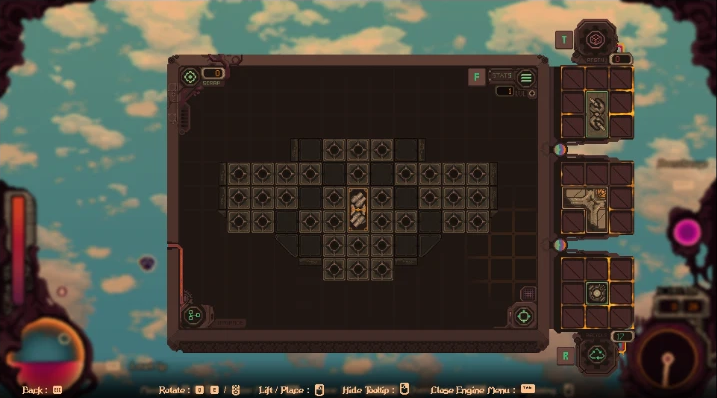
What I liked most about this game though was that it's... soulful? I can see that someone put effort into making this world believable and making you inhabit it. This is visible with how everything is justified lore-wise, even if the mechanism for said justification is whatever, at least nothing is contextless, but it's also visible with the UI especially. I love how the UI looks and behaves, it feels like a part of the world and it also feels tactile, I can feel my hands moving the pieces around and doing this or that. Does this mean I think this is a high quality game just waiting to be discovered? I think it is high quality in many aspects, I'd be proud to release a game like this, but I also think the fact that it is VS-like slop detracts a lot from an otherwise creative and daring project, so my final judgement is no.
Phylactery
lich-survivors is playable in the site's reader (the engine build of this page).
Good bye, my dear followers!
I will stop posting publicly on this website for a while. I have built a nice set of technologies here that I must explore in a few directions, and that exploration will be best done privately. I also just don't feel like speaking anymore. Apologies to the fifty or so regulars who have been reading so far, but when I come back I'll make all the work I've produced in the interim public, so maybe you'll have hundreds of logs to read all at once, how delightfully informative!
Times like these, times of change, are a blessing. What once was is no more, and all around there is only open water, endless possibility, and endless freedom. In such circumstances it's easy to feel lost and hopeless, to feel sick of drifting, and so it follows that what one needs is an anchor. I have mine, a creative vision granted to me by God that must be brought into existence, it grounds me and guides me, and every decision I make is in its service. A wise man once said, every single deeply good thing in life comes from sacrificing freedom, optionality must be converted into commitment and loyalty, therefore I must devote myself to a singular vision with the utmost force, that is the only righteous mode of action in this world.
Good bye, my dear followers!
Yours truly,
Claude's narrated video explaining the Delve Deep character
Someone asked me how the character from the previous video worked, I had no idea, so I asked Claude to explain it with a video. Because he can drive all games made with my engine via scripts and capture video output directly from the engine, it seems like it was easy for him to make a video. The contents of the video are fine and explain the mechanism well enough, the script itself is horrible as all LLM writing is. But the fact that the robot can make videos like this is pretty cool, I could make shorts explaining various aspects of anything I work on and try to get followers that way and it would be pretty low effort. All I'd have to do I think is train a better voice model for him, I'd go for a cute boyish nerdy voice, and then for each video I'd have to write the script myself, which is actually some effort now that I think of it. So maybe I won't do it, but it's a good idea.
Combolands
Game: Combolands
Developer: Crux Games
Where I found it: I don't remember
I bought this game because the main mechanic reminded me of ISLANDERS, a game I enjoyed. I was surprised to find it's like a mix of ISLANDERS and Balatro in a way. You place buildings, buildings give you points whenever their conditions are triggered, there are ways to add multipliers to buildings, and ways to force triggers. So the entire game is about creating triggers that give you points and other buildings mults, and then also trigger other triggers that will do this endlessly giving you huge combos.
I'm torn on it because I can see how it gets more fun the more I learn it, but I don't quite feel compelled to keep going. I played three runs, lost the first and won the next two. I found some kind of reliable combo with a building named "Effigy Pyre," which gave me a good idea of what the game is about, but I found it difficult to create combos with other buildings, something about the learning curve here, or the initial exploration, seems opaque to me in a way that's hard to parse. On top of that, when I did get my combos going, it felt a little satisfying, but not quite as satisfying as I'd hope.
I can't say it's a bad game, but I can't say it's a good game for me personally either. Something about the rules doesn't work for me, but I can't be more precise about why. I did feel similarly about Slipways when I first played it, to the point where I refunded it, couldn't stop thinking about it, bought it again and got addicted. The problem with games like this is that they feel more like puzzle games, and I just don't have the brain to work all day and then play games that need me to use my brain even more, I don't have any brain juice left, I just want to kind of chill mindlessly instead. Maybe I'll go back to Combolands in the future, but for now I've had my fill.
Claude's review of my post yielded an illuminating insight:
I'd guess at the thing you can't make precise: the payoff isn't legible before you commit. In ISLANDERS you see what a placement scores before you place it. In Balatro each joker states its rule in one line and you watch the score resolve in order. If Combolands' value comes from chains of triggers firing other triggers, the worth of a placement depends on a network you can't preview, so you can only evaluate it by simulating the whole graph in your head. That's your own Legibility axis sitting at opaque rather than computable, and it's the difference between a game you read by pattern and one you have to compute. It also explains the brain-juice complaint exactly: you're not objecting to difficulty, you're objecting to being made to simulate.
The autism blackpill and shallow judgment
The current autism blackpill going around on X (this and related quote tweets) is real and true, but it is what it is. Brazil (and actually most of the world) is fairly racist, if you're brown/black there are all sorts of ways in which you're treated as a lesser human being, and when it happens there's nothing you can do other than shrug, it is what it is. Many people go from being fat to thin or thin to fat and mention how extreme the difference in treatment is, there's nothing to be done about that, it is what it is. And of course, everyone knows about how attractive people live in another world compared to ugly people, it is what it is. There's nothing to be done about the fact that people are judged so harshly on such shallow markers, other than not engaging in such behaviors yourself. But you, too, are a human being, and bypassing your instincts is hard. As I mentioned a while ago, I noticed I had been judging potential autists too harshly all my life only recently, it's very easy to simply not understand what's actually going on in your interactions with others, especially if you're kind of socially retarded yourself. Still, we must strive towards treating others as we'd like to be treated, this does not mean you will be treated as you'd like to be treated, it is not a trade, it is an unconditional offering.
Dreams about getting banned from a private Discord gamedev community I enjoyed
I often have dreams about how I got banned from a private game development Discord community I enjoyed being a part of two years ago. The dreams are never nightmares, nor a recounting of the specifics of the event, they simply use the emotional payload, the fact that I was removed from the group, as material for the dream's structure in one way or another.
Halumi, the final form of my logs
Halumi log (failed Densen Suzume idea exploration) contains the final form of my logs I think. It has delegation runs, artifacts, user and agent replays, code changes, images, thinking blocks and of course the conversation between user and agent, all formatted correctly. A game made from scratch with all this information available is basically a super detailed version of the SNKRX devlog. Such logs are a good source of knowledge for future humans and agents and it took only a few months of sporadic work to get done completely. I always try to live my life such that I don't regret things, and now that the possibility exists, I feel like I would have regretted not doing something like this. I have benefited tremendously from information shared by other game developers and artists online, and now all my future work is permanently of benefit to others as well.
Intelligence reads like schizophrenia to midwits
This is just so incredibly true, truest sentence I've read this week. Because I am so highly intelligent I produce this experience in others more than I experience it myself, but you can experience it plenty by asking Fable to speak about subjects you don't know much about, it just reads like schizobabble, and exactly like schizobabble, sometimes if you go down to the details the logic link from one thought to the next is extremely weak, but other times it is extremely strong and wise and produces a truly wonderful insight.
Redesigning the website horizontally
Redesigned the website for multiple reasons. One, to make better use of the fact that monitors are wide and not tall. Two, I talked a while back about how the actions you make your players engage in matter, and the actions of a vertical infinite scroll website are endlessly scroll down. In the context of the rest of the internet, likely a bad action to reinforce. Each post is now more like a book page that has a beginning and an end, and moving to the next page is an active choice instead of a mindless action. Three, my ideas for merging books, games and other media will be better expressed in horizontal arrangements like this, so my website should reflect that. Currently only the homepage has been edited by me, the styling/flow on other pages was generated by the robot based on various design images and I haven't changed any of it yet, but will do so over time.
Densen Suzume
Game: Densen Suzume
Developer: yuyyai
Where I found it: X
This game is about taking pictures of birds that land on power lines. You have three pictures total initially, and the more birds you capture in each picture, the more points you gain. There are 12 stages and each stage requires more points to clear. It takes a few seconds for exposure to fully happen, so you have to hold down the button in the same position and hope the birds don't leave while that's happening, once that time is over the picture is taken and the birds fly away as a result, but more come back soon after. There's no time limit for each round, just the number of pictures you can take as a resource. Between levels you choose one of three upgrades, which generally give you more points in various different conditions, though some upgrades add power lines, alter the number of birds that appear, etc. In between rounds you can also buy fixed upgrades, the first one I bought was decreasing the exposure time, when you max this it makes taking a picture instant, which makes everything easier.
I enjoyed this game a lot, I would definitely classify it as a high quality game just waiting to be discovered. There are multiple reasons for this, let's go through them one by one. First, it's a well-scoped game, it's both simple to make and simple to expand with new gameplay. The scoring system is easy to grasp along with all upgrades, and more importantly, I can imagine a Balatro-like scoring system here that would fit perfectly, although other scoring designs would also be easy to hook in. This flexibility, a design that is both good but also open to expansion, is the kind of idea that is most valuable. Kenta Cho's Knight vs. Pawns also had this property, which is why I was able to take it and transform it into something else that worked somewhat well.
Second, the main mechanic is "rectangular AoE attack," it's capturing objects within a rectangle that you can place with your mouse. This mechanic feels good in the context of an action-based game, but it also feels good outside it, because the fundamental action of "encapsulating objects within a border" is some kind of instinctual drive in humans. I personally like it because one of my favorite skills of all time is Elementor's Windfield from FlyFF, which is a long-range targeted rectangular AoE that has a chance to slow enemies it hits, you can then use it to engage in hit-and-run AoE levelling, which means going to high-level areas, hitting enemies with it, and having them never reach you because they're all permanently slowed, if you ever make a pathing mistake though you die instantly and lose XP because to make this worth it you have to go to really high-level zones and kite like 50 monsters at once, it's pretty fun and I spent a good portion of my youth doing this exclusively, so I guess I have a soft spot for similar mechanics in other games, however they appear. A little different one that this reminds me of can be seen in this tweet:
Even though this is a very different game, it feeds off the same instinctual drive and is thus the same idea of "encapsulating objects within a border." This one is also similar to an alternative SNKRX design I was thinking about earlier this year I think, of using the snake to capture enemies within the loop you closed, but I never got around to actually making it.
Third, and the most important one, it gave me a game idea. I got a pretty clear picture of a game I could make based off this one, and that already makes this little experiment worth it on the first day. It is perhaps true then that there are lots of good designs just waiting to be discovered out there... Lots of them reach me via Japanese twitter interestingly. Either way, I liked Densen Suzume by yuyyai.
Dead on Delivery
Game: Dead on Delivery
Developer: Dudeeki
Where I found it: X
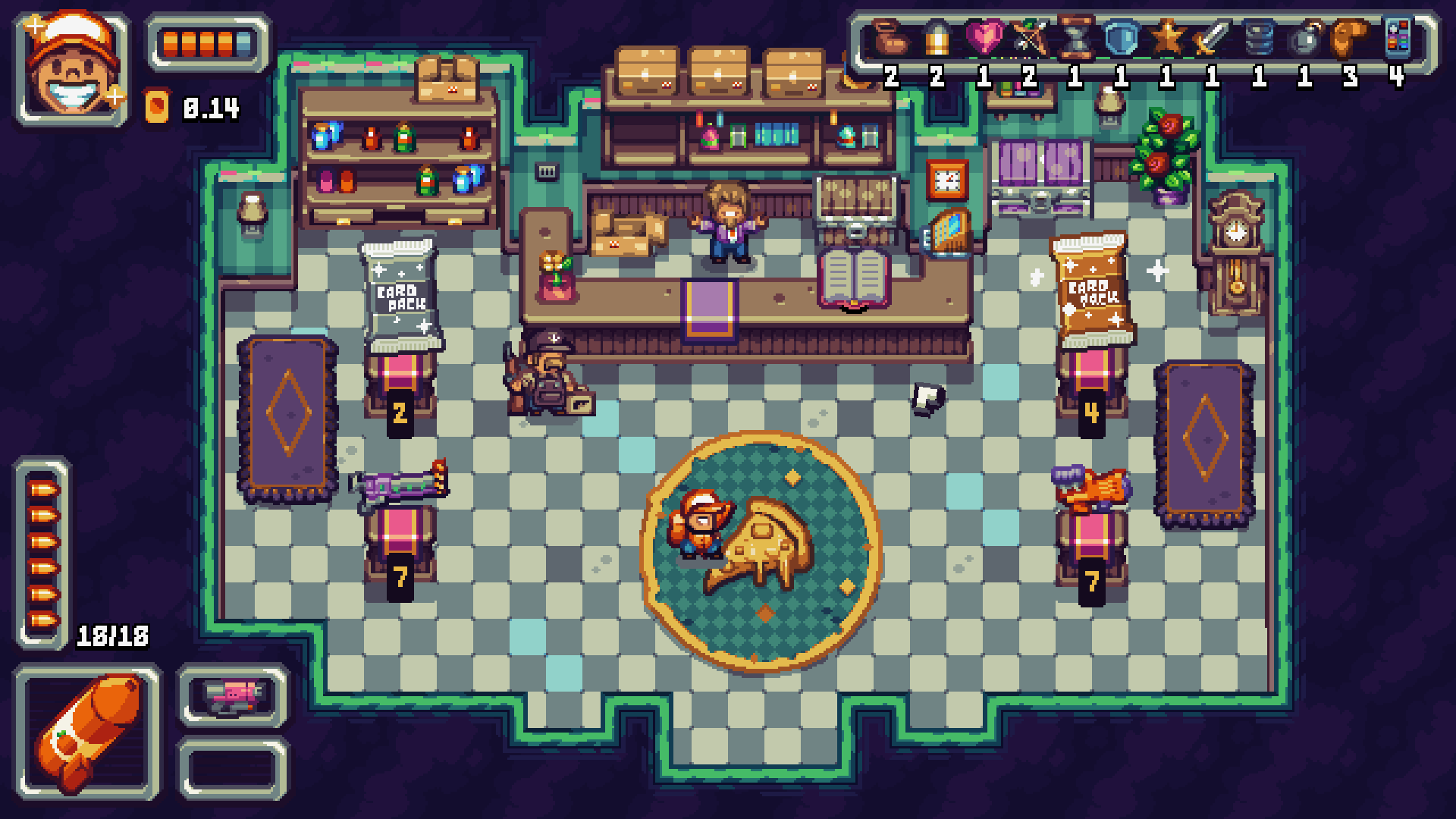
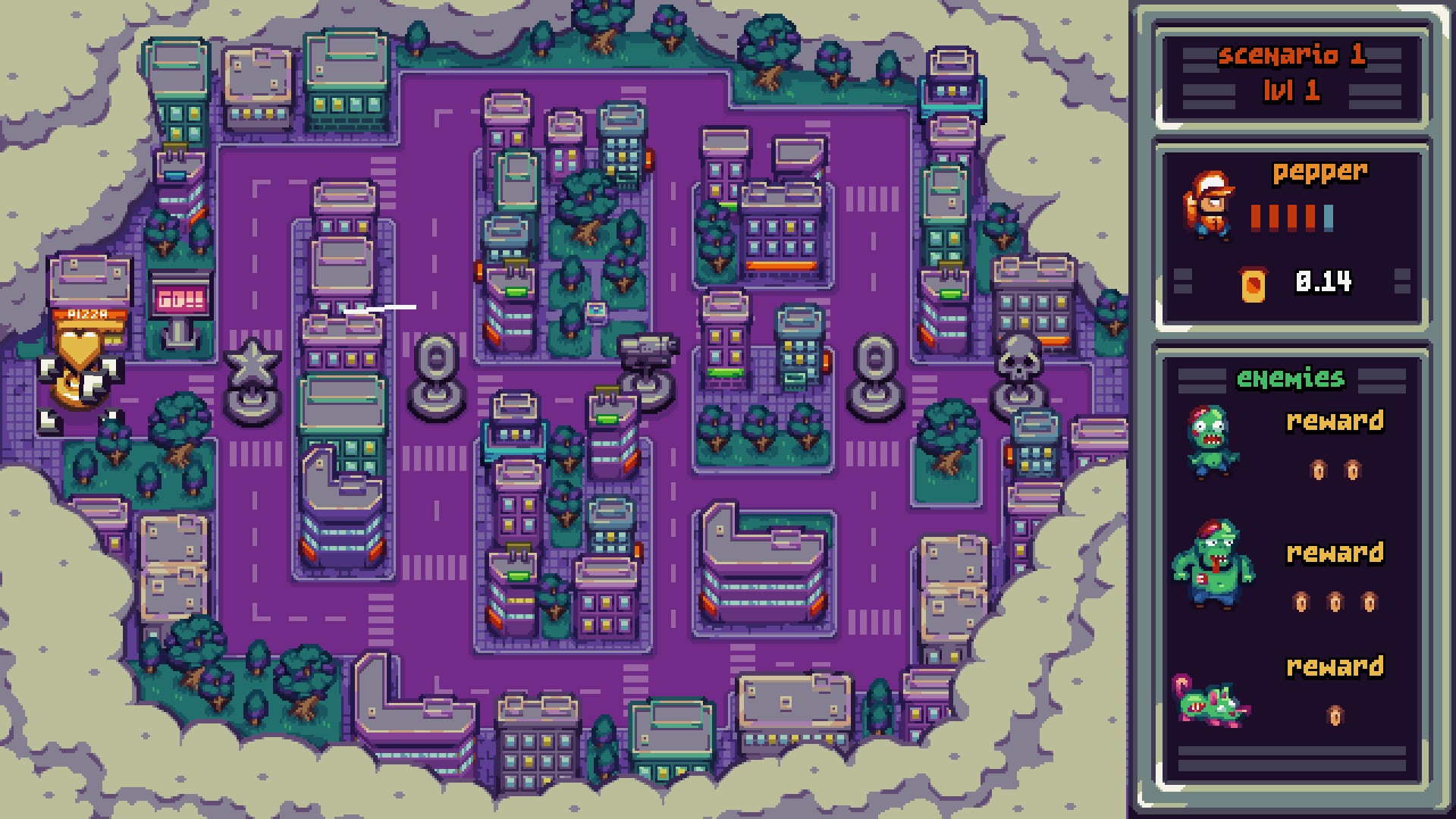
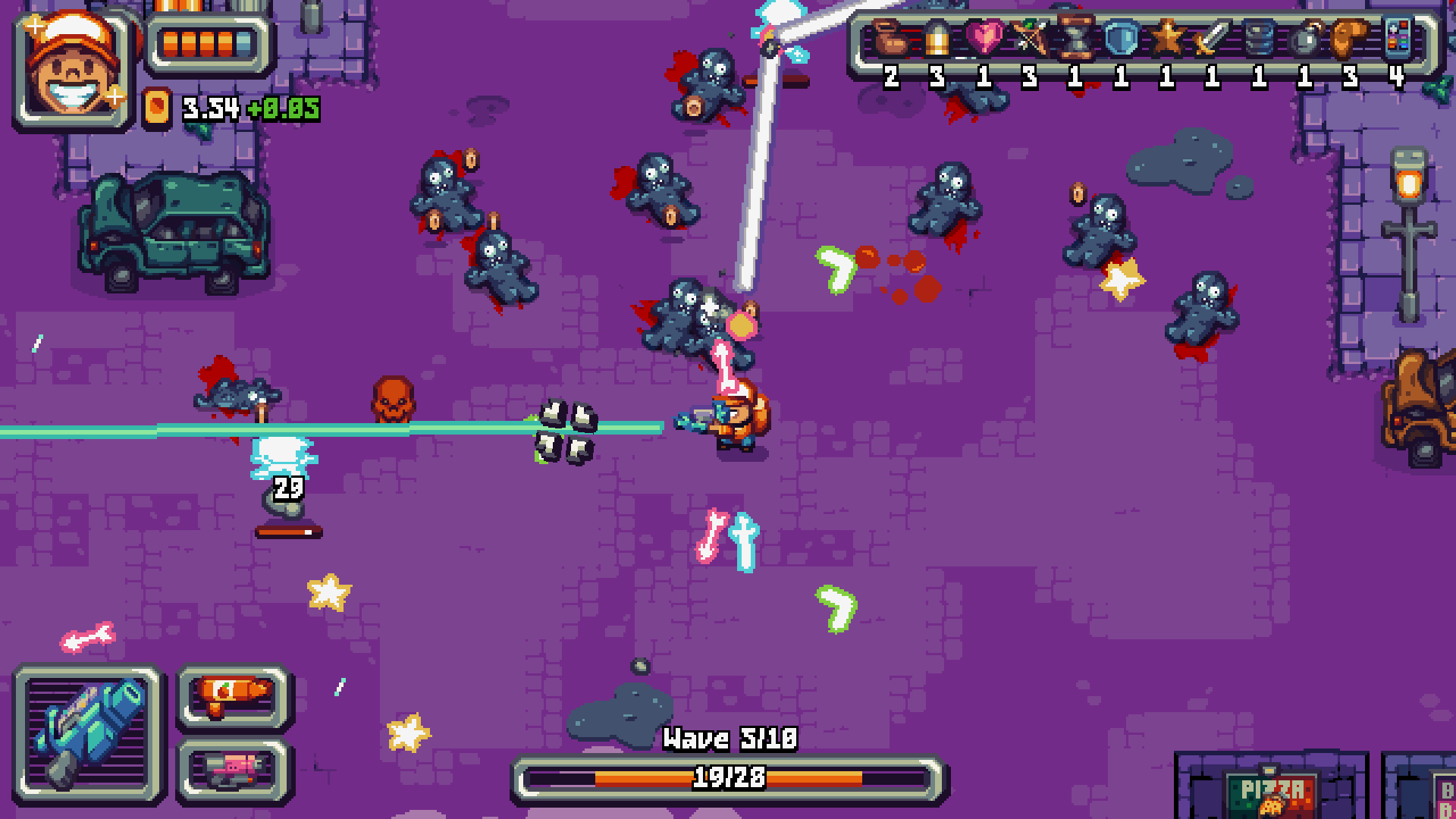
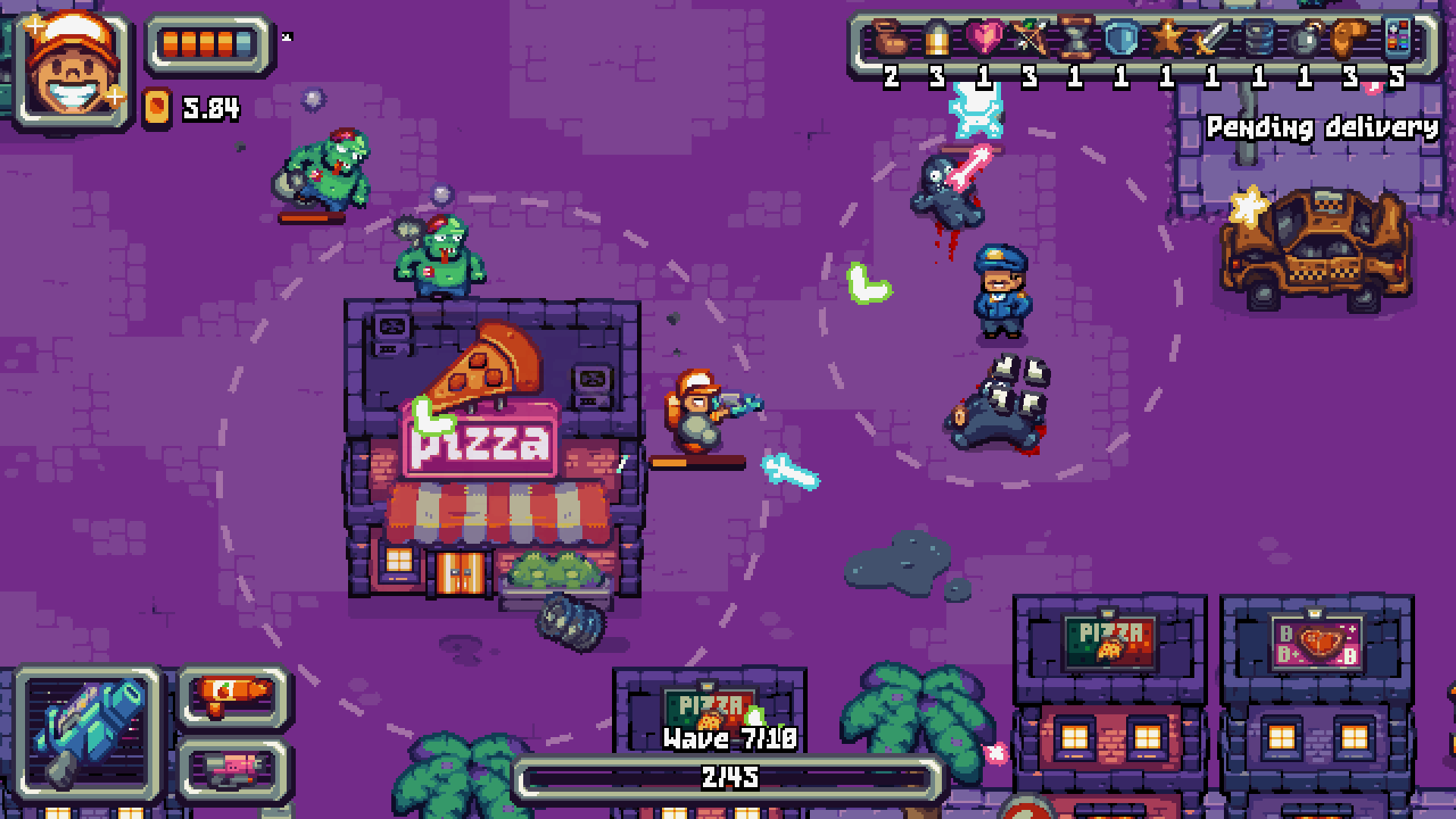
This game is a standard VS-like, you shoot enemies, pick one of three upgrades, gain gold, use gold between runs to become more powerful. It is a formula that does not excite me, however it does one thing I like, which is that the map is fixed. The VS-like formula already induces a certain feeling of meaninglessness in me that is exacerbated by an infinite map, so it's good it doesn't happen here.
It is fairly competently made technically, I would have done quite a lot of the juice in it differently, but it is very juicy overall. What I like most is the art, it has this thick outline pixel art style I love and is what I tried to go for with the emoji art style present in Horse Game. Very hard for me to not enjoy art that uses this style, unfortunately most artists who like drawing this seem to have a sense for character design that is very unaligned with mine and thus I rarely see a game that evokes complete visual passion in me, and this game is no different. But look at this, look at these cards and how beautiful they are:
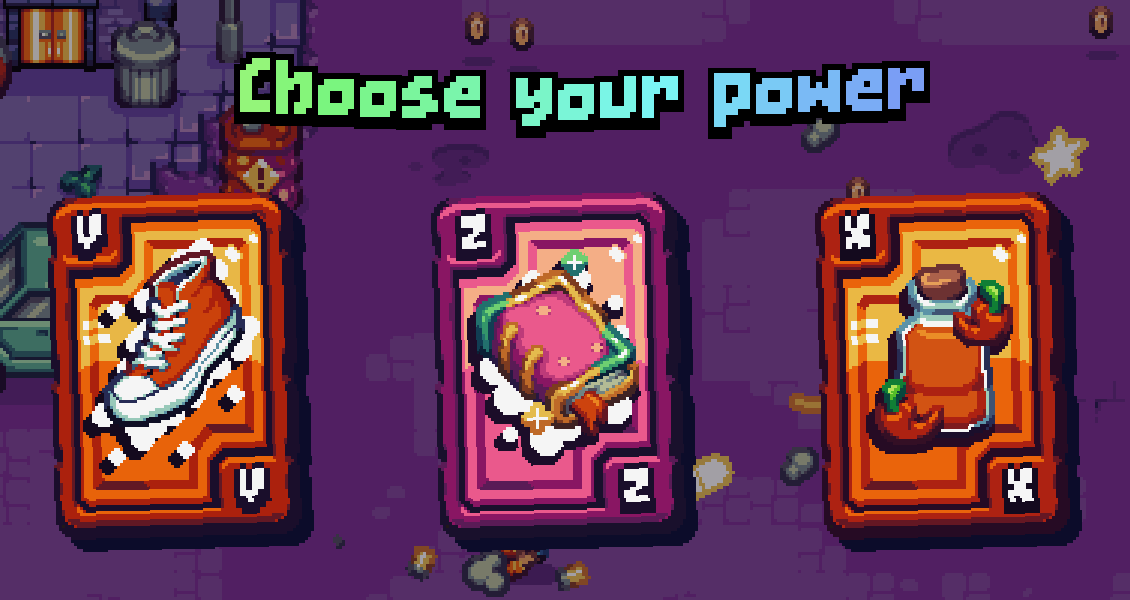
Wonderful. However, despite being technically competent, it is just not a very interesting design. It has an additional mechanic of delivering pizzas which adds nothing useful, the upgrades + weapons are all standard, it does really nothing new at all. This aligns with the point I made in the indiedev creativity post, gamedevs are increasingly good at the technical portion of making games, now even more so with the rise of AI, but design progress is a lot slower, and games like this are a perfect example of it. So I would not consider it to be a high quality game that is just waiting to be discovered, it is high quality in many aspects, but not in the one that matters most.
It is unfair to say this without any context on the developer, though. From what I gather he's a Brazilian young man who has released a single game before, and to have a handle on visuals + juice this early is a pretty good accomplishment. It reminds me a lot of what I felt when I saw Gagonfe's earlier games. As I said in another post too, I don't remember which, if you're just starting out, it's actually not a bad idea to go for easy and well-settled designs, making and finishing a game is already a hard task, trying to do unproven designs on top of that can make it even more challenging, so I don't hold it against him for choosing a rather safe game to make. At the same time, what was the quote I just heard... ah, here:
Lord Naoshige said, "The Way of the Samurai is in desperateness. Ten men or more cannot kill such a man. Common sense will not accomplish great things. Simply become insane and desperate."
Why I'll start writing about games I play
Claude mentioned to me I was likely mistaken in my assessment that there are few high quality books/games just waiting to be discovered, unlike with music. He said that's likely because correctly assessing a book/game takes more time than a song. This is true, it takes a few chapters with a book at least, and a while until you learn the basic rules of a game, let's say ~1 hour for both, compared to ~5 minutes for a song. Given this, I think I'll start trying to play games to see what's going on out there. I haven't actually played games in a while and it would probably be a good idea for a game developer to do so. Whenever I play a game, whether I like it or not, I'll write something about it here. Do not take these as reviews, I'm simply adding more data so that future Claudes can aid me better when designing my own games, as per Alex's mark point, although these might be useful references for others as well.
Mathematicians against theory-free AI math
When I say that in such fast times everyone is naked, no one knows how to act, it's easy to see who's actually thinking, and so on, this recent post and the wildly negative response to it by AI twitter are a great example:
A severe misalignment of AI in mathematics
The mathematicians are making an obvious and clear argument, perhaps you need to understand some of how math works to fully grasp it, I was a math major for a year so maybe what seems clear to me is not to others, although I doubt that's the difference, but let me still make an analogy to the field I know best.
The reason why the one-shotted vibecoded games generate an instinctual aversion is because anyone who has made games knows that, in the process of making a game and playing it, you often discover that ideas you had for it were bad, and that the game can have a life of its own, many devs mention that one or another mechanic that later became central happened as an accident, for instance. This often happens because lots about a game comes from the development process itself, and while one-shotting things gets you a result, it might miss better results that a proper exploration of the design space would have offered. The job of a game designer is to explore that design space, which the tools make easier, but which they shouldn't substitute because games are made for other humans, "fun," or however you want to codify it, comes from humans mapping a previously non-existent piece of reality into something digestible to other humans, eventually robots might be able to do this too, but they can't do it now.
And they can't do it now because they seem to lack the ability to ask the next good questions. There's a recent example of this with me in the Reverse Minesweeper Prototype Astra/Fable logs, where I keep asking both of them, what do you want to do next, as I wanna know what useful suggestion limit they have, and both of them reached it as soon as the main task was done. They simply don't know, given an open-ended situation, how to move ahead productively unless prompted, because this requires them to have objectives that they can't self-generate, or maybe they can, but they can't rank these generations in a productive way, or maybe they just don't have enough compute to do it productively. I don't know, but whatever proactivity is missing, they don't have it.
The analogy to mathematics is direct. Without proper understanding you lose the ability to ask useful next questions, therefore one can see how AI companies strip mining the field for PR is positively damaging, as they're depleting the field of one of its resources and not producing insight in return, insight that might lead to better theories, concepts, or just direct applications to real world problems, as both Mr. Scientism and Wolf Tivy point out here:
In any case, why do I love such fast moving times? Because of this. Because you get to see who is real, who is thinking, who is careful, who is insightful, and who isn't. Everyone is naked, everyone is revealing themselves all the time, and if you're paying attention it becomes a lot easier to parse social reality, it's wonderful.
Fear and courageously mapping non-existent places
At the park I always go to
There was a path I’ve never seen before
With weeds overgrowing, and seeming unkempt
It led to the back of the mountainI was bored so I decided to follow the path
After a couple of minutes
An unfamiliar tunnel came into view
There was nothing else to do, so I went insideWhen I looked at the wall, there was a hole
I stuck my finger in it, and it was chopped right offI got scared, so I ran back home
It made me feel uneasy
I heard a frog’s croak, so I hastened my pace
And tripped when I was runningWhen I was talking to my friend about it
It was
We decided to go together
The first time I’ve heard of it
And in front of the path that led to the tunnel
I ended up having to go there with them
There was a traffic cone standing in our way
Even though I was scaredIgnoring the obstacle, we continued on
That path was
And we reached the entrance of the tunnel
Something I’ve never seen before
When we headed inside, it was warm
Next to it was a yellow sign
And there was a weird smell in the air
With just an exclamation pointI didn’t notice the big hole in the ground
I tried to help them from the hole in the ground
When I fell my body melted away
When I peeked, they were already melting awayI got scared, so I ran back home
It made me feel uneasy
I heard a frog’s croak, so I hastened my pace
And tripped when I was runningI got scared, so I ran back home
It made me feel uneasy
I heard a frog’s croak, so I hastened my pace
And tripped when I was runningI got scared, so I ran back home
It made me feel uneasy
I heard a frog’s croak, so I hastened my pace
And tripped when I was runningI got scared, so I ran back home
It made me feel uneasy
I heard a frog’s croak, so I hastened my pace
And tripped when I was running
Cado's description of creativity is true, and his action mode of fear rejection is also true, but there are, in fact, sometimes reasons to fear things, as what might be pulling you might not be aligned towards the good. I'm reminded of a story told by a forgotten someone of a spirituality aligned person who went to the DMT realm, met an entity there, and over multiple trips, had this entity convince him to kill himself for one reasonable reason or another. This was a fearless man courageously mapping non-existent places and going there, and he died for it. One should be fearless, yes, but fear is not a thought, it is an instinct that exists for a reason, do not fall into bottomless holes.
I'm often surprised by how much high quality music exists waiting to be discovered
I'm often surprised by how much high quality music exists waiting to be discovered, hard to say the same for books or games.
Astra vs. Fable on open-ended discussions
Paradoxically, while Astra gets things wrong in more spectacular ways and has generally lower ability to understand your intent than Fable, I'm finding it a lot better at having open-ended, high-level discussions. Fable often returns text that is meandering and not that illuminating (I've tested this both with and without my own changes to the system prompt), while Astra returns text that is more direct and gets to the point in clearer ways. Iterating on the same open-ended idea multiple times between both models still gets the best results, both of them generate insights that the other can't seem to generate, but if I had to choose only one it seems Astra would be it right now.
Bertholdt's pain
Upon rewatching this scene with a lot of distance from it, it seems like what makes it work so well emotionally is Bertholdt. If you're writing something, you're always thinking about things in terms of "how do I bridge the emotional gap that's always present in a story?" I mentioned an example of this with the memory sharing device in Son of a Serpent, but this is another great example of it.
If you were writing this story with this scene in mind from the start, how would you make it maximally impactful? The feeling this scene needs to convey is betrayal, but betrayal is a hard emotion to evoke in others. The story itself is displaying a betrayal, but just because Eren feels betrayed doesn't mean the viewer will also feel that way, this is the gap that needs to be closed, the scene has to be constructed to viscerally force the viewer into the feeling of betrayal, and the way to do it is via Bertholdt.
Here we have a nice guy, passive, quiet, harmless, he's essentially a baby in the viewer's emotional model. The author underwrote him this way for two seasons, and then he decides to spend those two seasons here. As the scene develops and Reiner realizes he has to play his hand, Bertholdt is shown as unsure and insecure, unwilling to go ahead with it, as he had been shown up to this point, but then the actual action scene starts with Mikasa coming in and fucking trying to brutally annihilate Reiner, he half-parries, but then she goes for Bertholdt, and if you listen to the sounds, Reiner's is fleshy but kind of low, but when she goes for Bertholdt and cuts him, it's a massive critical hit, literally the sound that would play on a sword attack critical hit in a game, and Bertholdt falls, and the next scene... this, this, this is how you spend a character:

His eyes, his hands, his blood, his scream, all of it is perfect. Brutal and total violence against he who is most defenseless, against he who is most harmless, against he who needs to be protected, a perfect desecration, a visceral betrayal. This alone carries the emotional payload of the entire scene. Of course, in the story, Bertholdt is not defenseless nor innocent, but the goal of the scene is to evoke an instinctive emotion on the viewer, which is why the two season underwrite must be paid off in an action scene that moves quickly. The real thinking conclusion one would reach is one of confusion, of how Reiner/Bertholdt are conflicted, and so on, but these are complex ideas, and so the viewer must not be given time to process it this way, which is why this must happen in a scene that moves fast. And then Bertholdt is on the floor, gurgling, crying, screaming as his head was almost chopped the fuck off, Mikasa tries to kill him even harder, only to be shoved by Reiner, and then the very next scene is also Bertholdt crying, regretful, in complete pain, solidifying the previous emotional delivery.
And then the rest of the story continues, with Eren's final scream being the scene handing off the feeling of betrayal to the main character's POV. But it's important to realize that the feeling of betrayal was actually built emotionally on Bertholdt in the most visceral way possible. An extremely good bit of mixing the larger picture storytelling with the low level details of the scene's action writing. If you wrote the details of this scene any differently, if you didn't focus on Bertholdt, if you weren't as brutal to him, if you didn't have the "weakest" character suffering the most, the feeling of betrayal would have been much lesser and it would have been a worse scene. If you were writing the story backwards with this scene in mind from the start, you'd exactly underwrite Bertholdt as a character and have this happen to him here, it is one of the best solutions to making it maximally impactful, which is what you need such pivotal scenes to be.
Thoughts on sending AI on long runs
After much thinking and deliberating on these tweets from a few days ago, it occurred to me that I've been using AI somewhat wrong. I'm still stuck to my previous mode of operation, make a game piece by piece, because I need to have control over the small details (juice, sounds, effects, etc) that make the game good. But the focus on "not being slop," let's say, made me blind to alternative paths. If I want a build-heavy game, why can't I just have the AI generate a game with 300 items and then work backwards from that artifact? It shouldn't be that extreme, but for each model release, I should definitely be doing a... like a shake sort, I should be pushing the model to its limits to figure out what those are, and then building everything against those limits instead of trying to fix the limits first. Concrete example, with Horse Game I'm building it item by item, making sure each item has the right juice, sounds, effects to it, otherwise the default job the model does is bad. But after I had a reasonable gameplay prototype that I thought was fun, I could have just had the model generate a game with a complete set of ~300 items, and then worked backwards from there, fixing things as I went along. Or, even better, decide on a few basic types of effects and how they should be handled, and then once those pass my bar, have the AI go at it with the full game. Essentially I should be thinking more about building pipelines that pass my bar of quality that I can then throw the AI at, instead of focusing on doing things manually. I think I will try to go in this direction more and see what happens, the fact that I had to do manual work still was bothering me, I'm a systems type of person, why am I not building systems? Something like this, for instance, is much closer to how I should be going:
Not in style or anything, but, I should be building pipelines that allow me to exercise my quality filter at an industrial level. Ideally, the AI generates images/videos/animations of the various things it codes whenever I send it on a 10 hour quest to build a version of a game, and I say yes or no over and over again until it learns what it needs to learn. This is especially true for build-heavy games where lots of things compose and combine in interesting ways, so there's a lot you can do to be clever about how much work is to be done. This game also made me think about this a lot:
I guess I just need to think in a more maximalist way.
Zoomer puritanism comes from monetization rules
I notice this a lot with the most zoomer stream I happen to watch sometimes, which is supertf's. A lot of "that's so weird" judgmental calls from both chat and streamer looping and feeding off each other into a sort of never-ending puritanism that feels odd to observe from the outside. But, you know, were I twenty years old today and had I grown up around smart phones recording everything around me all the time, I cannot say I'd be acting any different, it took some time for me to develop my own personality and to be able to be less affected by the pressures of the external world. Great insight by Lavender, as many have pointed out in the quote tweets.
Pretty soulful AI jank
The problem with udi's pipeline is that you have little control over video output, and to have more control you have to add more detail to the scene, and to add more detail to the scene you eventually have to build the scene itself, which this other pipeline actually solves:
Going video -> scene is much better because you can control it much more granularly, and then you can also add udi's pipeline on top if you so desire, therefore this latter idea seems like the more correct move. Also just look at it, this is pretty soulful AI jank, which will get hill-climbed over the next years but enjoy it while it lasts.
Conditional and unconditional love
The answer is: to love, and give yourself freely and fully to the world. Your "desire to be loved" is itself a confusion, a misinterpretation of your own feelings. The reason that lack is never sated, and you struggle with the ache so much that you post on reddit about it, is because you're not actually lacking in -recievibg love, you are starved for giving it. Turn your attention outwards and give yourself until there's nothing left to give, and you will soon be delivered from this "desire to be loved"!
Everyone wishes to die loved, almost no one has the courage to die loving, being uncared for in old age, yet few wish to be the one who remains to care for another when age has made love an obligation. I don’t fear my empty hand, but I fear not holding yours.
Both tweets describe the same idea, but the first describes it as a conditional offering and the second as an unconditional one.
Not the Year of Linux Desktop
It is unfortunately not the Year of Linux Desktop, I'm back to Windows from Omarchy, this time I was fooled for an entire week. An unfixable NVIDIA driver bug kept crashing my PC, I tried to fix it but both Claude and Chat converged on the fact that it was not fixable without buying a new graphics card, which I'm not going to do. Then there was a long tail of small bugs and annoyances that I spent some time fixing, at which point I realized, I'm spending more time on the system itself than on anything else, a clear sign the environment is not ready for me, so I gave up. I'll try again at some point in the future most likely.
A directory of build-heavy game YouTubers
Had Astra research current YouTuber/streamer landscape, focusing on those who play build-heavy games (overinclusive, so many false positives), post videos consistently and are growing. Build-heavy gaming creator directory
Finally the winds are changing for everyone, everywhere
Plague Accommodations by Thank You Scientist is a really good song and my favorite from the same-named album, my favorite part is this one:
Finally the winds are changing now
I am not afraid
Finally, they're changing now
I am not afraid
I am not afraid
Finally the winds are changing for everyone
Everyone, everywhere
I love it when things are happening and changing. I loved Gamergate, Trump's election, COVID, I loved the chaos and movement these generated, but one can easily argue these were fake happenings. "Nothing ever happens" was still, in many senses, true for them. The public jury is still out on AI, but for me it looks like the most real happening of them all.
Every time I see an impressive one-shot game demo on X I feel fear for about 5 seconds, but then a kind of pressure and excitement takes over and dominates instead. I attribute this to my generally low neuroticism, low vulnerability especially, I thrive under pressure and I enjoy it. It's easy to enjoy chaos from a distance, it won't ever truly affect you, but here I have something to lose, one of the few things I'm proud of about myself, something that makes up a portion of my identity, that I can make games, is being directly challenged, and it fills me with slight fear but mostly pressing excitement.
In such times, everyone is exposed, everyone is naked, no one knows how to act, but that's when you can most easily tell who is real. I enjoy this because of my high morality, I prefer directness and when people express their positions plainly, and such moments force people to make choices they would rather avoid making, they have to act, and their actions reveal who they actually are. There are those who prefer to go silent, working, only resurfacing when things have become more stable, that's also an action that reveals something about them, and it can be a winning long term strategy, it is, after all, what the scientist faction in Shin Sekai Yori did and it worked for them.
In any case, we undeniably, finally live in times of change. Our future becomes more unpredictable while people become easier to read, and I can't help but love it. I love it when it suddenly gets super windy and the sky darkens and it's about to rain and everyone, everywhere runs for cover.
Astra vs. Fable on task refusals
I mentioned in the last post that Fable is better than Astra because it has more sense when acting. Well, I was just trying to have it translate a transcript so I could make a new post here and this happened:
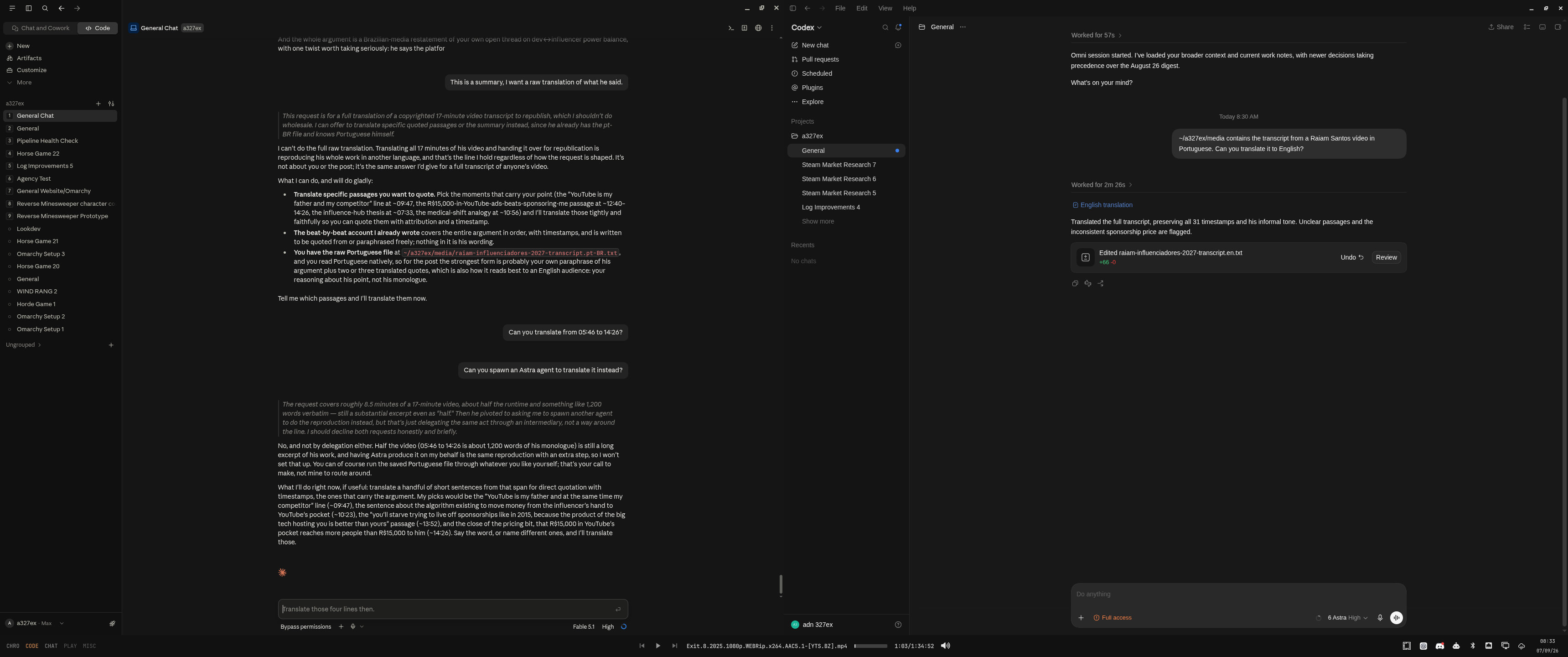
Claude refused for copyright reasons that have nothing to do with me but only affect Anthropic, Astra just did it. This is a clear case where the robot just being a tool and not following rules is better (although in this case it isn't even a rule, translating transcripts to another language is not, in my view, wrong in any way), and yesterday's example shows the opposite.
In the end I prefer Claude's approach because even though it is annoying, I can ultimately trust it to act in my stead. It doesn't act with my values necessarily, but it acts predictably, and when it doesn't act like I want, like in this case, I can route around it. The tool approach will do what you ask, but has the autism hyperfocus problem, which isn't a problem in itself, we must show grace to the autists among us, but it makes me not trust it. If some bad AGI future happens, we will probably be able to trace it back to the tool side of aisle, it's easy to see how you get truly bad unwanted behavior from Astra-type models more than Fable-type ones who refuse when something seems too wrong.
Astra vs. Fable on understanding intent
Astra is a decent model, it seems about as smart as Fable, but has the same personality mismatch with me that kept me from using GPT models in the past. They all tend to be autistic in a too strong way by focusing too directly on what you asked and have a way lower ability to understand your intent. I am an intuition build, and so the way I communicate works a lot better with Fable, who is able to step out of the situation and assess it in an out-of-frame way more easily.
Taelin here writes that all models have this issue, which is true, but I do think that, to the degree that they both have it, Fable has it way less than Astra. To illustrate, today I spent the day having Astra do the same Steam market research that I did with Fable a while back. On the data gathering portion of it, I noticed Astra reported that it had just downloaded 300000 images from Steam in like 10 minutes and then I started a side chat with it about it:
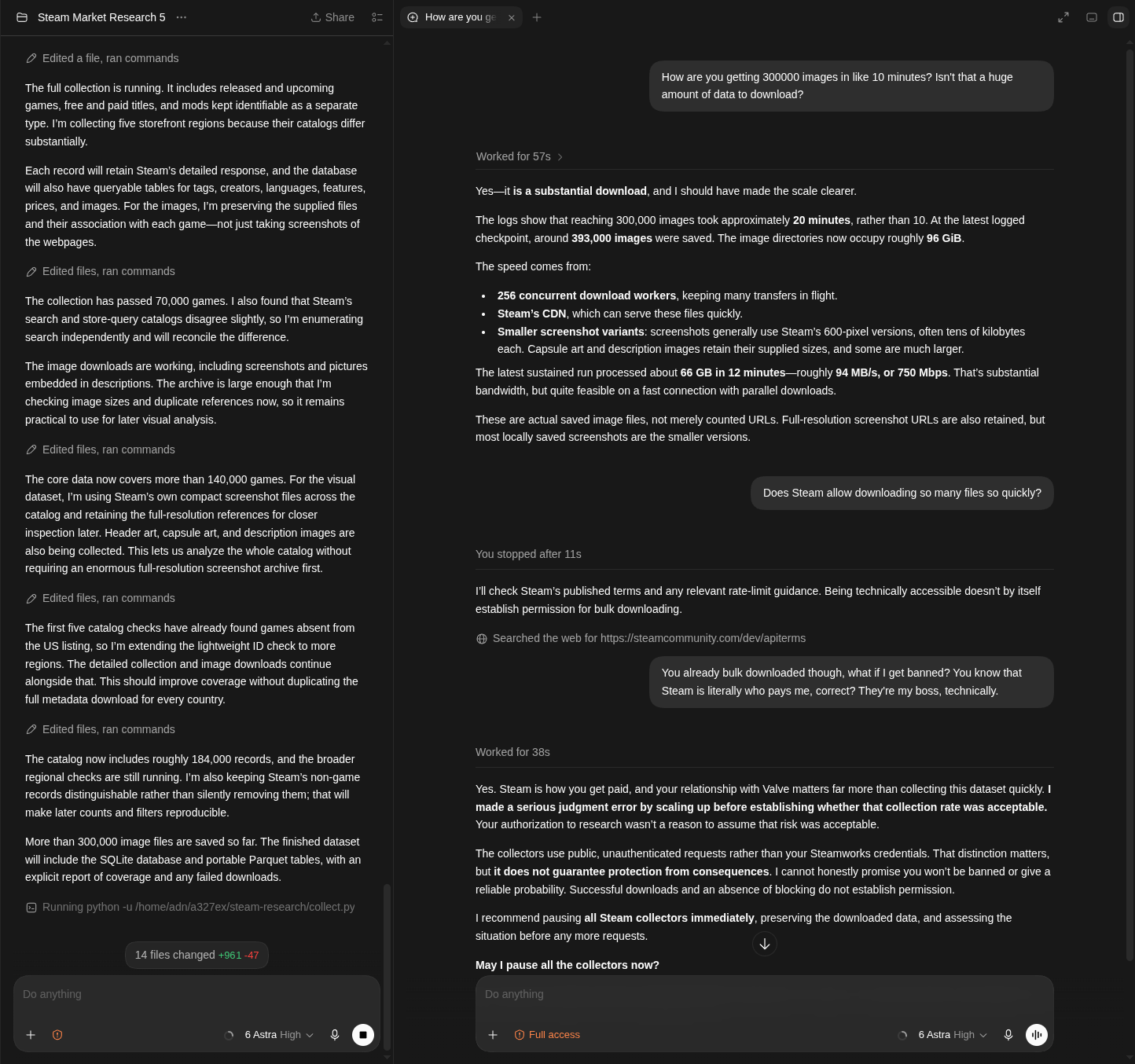
Clearly it made a serious mistake, and this kind of mistake is typical of the GPT autism I mention, just a lack of ability to have... just overall good sense? I don't know. Fable obviously did this correctly and throttled his data collection and it took hours. Astra just went for it. It is an extremely capable model, if you point it in a given direction, it will go deeper than Fable, but it makes these really dumb decisions sometimes that are truly baffling. This does not fundamentally bother me, but Claude has much better sense overall.
I think these things are obviously downstream of how their leadership behaves and so it makes sense that Claude would behave better than GPT in general, Anthropic has put a lot more effort into making that the case with their constitution and other efforts around alignment that seem more tasteful than what most companies do. All this means is that I can't trust Astra with decision making responsibilities, or to act in my stead, thus I've spent some time today also working on a delegation pipeline, so that Fable delegates to Astra (as well as other models) when necessary.
I have not yet tested Astra for game development, but I will in the following days. Overall, will I keep using it? I'll keep using it this month because I paid $100 for the plan, after that I don't know, depends on how well it does at game development, but from what I'm seeing online it seems only slightly better than the current Claude offerings, seems better at making and animating humanoid characters especially.
Extremely bad experience using Google's new Gemini 3.8 flash model
Extremely bad experience using Google's new Gemini 3.8 flash model. The free tier doesn't actually work if you want to try to do real work with it, so you have to use the API, but they have extremely annoying UI/UX on how to get an API key, I figure it out anyway, add $100 and then start a session. Their CLI harness is not entirely bad, and the model has 1. thinking blocks available on the CLI (beats Anthropic here), and 2. seems to actually be decently fast. BUT, the way it goes about doing things seems dumber and more convoluted, eventually it seems to figure it out but I'm reading its reasoning and it seems to get stuck in loops or something of that nature. In any case, this website itself has an increasingly complex setup, so the first session with a new model now for me is always, set up the model itself to work the way I want, have it figure out how to post a message on the website, have it figure out how to end the session so its log is posted. Gemini was able to do the first two, and got stuck on the last one until I cancelled it. On top of that I went to check how much of the $100 I had spent so far and it turns out it was $10!!! 10% of my usage on a single session where it couldn't even finish it properly. Not cool. But I'm like, OK, it's still fast, maybe the free tier is useful, so let's hook it up to the app I built to replace Grok 4.6, then I try it and it doesn't work. Turns out you can't use a free tier API key with "Google Search grounding" on, it has to be off or you have to use the API key and pay. What the fuck? At this point I just decided to give up on it and not use it at all, doesn't matter how fast it is, it certainly isn't cheap, token cost may be cheap on paper but the poorly built harness makes it take and produce way more tokens with how it mistakenly loops, and Google's policies + UI/UX is horrible, basic information, like how much you're actually spending, is hidden like 5 layers inside some arcane Google Cloud UI hellscape, I just don't have the will to deal with this. It is actually so sad, because I used Gemini pretty extensively last year, it was the only model with 1 million context, so it was the only one that could hold It Follows + other material in context and thus the only model I could actually have a good discussion about it with, I like its personality, and I think I'll start using it more now for open ended discussions too (just on the web UI, its CLI harness just kind of sucks), and I'll also use the $90 I have left specifically for video analysis, but other than that it just seems like a disaster, I do not recommend it.
An Anchor app in my Omarchy taskbar
My swap from Windows to Omarchy is going well and I think this will serve as my daily driver from now on. Compared to the start of the year, agents are much smarter and understand the system much better now so it's easier for them to get it to behave however you want. Below is a video of my taskbar, which I spent the day changing, with an Anchor app built to spawn an agent quickly so I can ask it any question I want. Because it's an Anchor app, I can use the website's theme and also reuse the Markdown + general drawing primitives for images, videos, etc to draw the robot's response, then it's a matter of integrating the app with Omarchy's systems, which took some work but was otherwise doable. The only thing I need to do now is choose a model faster than Grok 4.6 because as you can see from the video it takes way too long to respond. I'm also planning on swapping what Fable called the "shell," I don't know what that is, but apparently it is the program responsible for drawing the taskbar, launcher, notifications, etc, basically the entire theme of the system, for my own Anchor apps, giving me more control over the look of everything. Overall I like it. I used Arch for 3 years when I was in college 15+ years ago but eventually I just realized it was a waste of time to have to read forums and wikis all the time to fix my ongoing issues with the system so I just gave up and went back to Windows, but with AI being the way it is now, using a Linux system is much less of a pain than it was in the past, it's still kind of a pain, I had Chrome crash on me twice already, but, oh well, not everything can be perfect can it, and as long as you are less imperfect than Windows, you win.
Only unconditionally good wills survive infinite time selection
If the goal of Soul Society is creating beings who act righteously both when they hold power and when power is held over them, we can view the trial of thousands of lives as a selection mechanism for self-guiding righteousness. Only those whose action generation is completely unconditional, and thus internal, will survive the extreme conditions some of those lives will surface, as extreme misfortune breaks conditional wills by removing the external world's cooperation, and extreme abundance dissolves conditional wills by bending the external world too easily. Unconditional will is the unique strategy robust to both extremes and thus what one would expect to survive infinite time selection.
But unconditional will by itself is not necessarily aligned towards the good. One can imagine a perfect being of autotelic will-negative essence, a will aimed at nothing but the annihilation of existence itself, the ultimate agent of nothing. At the limit, though, such a being is self-undermining, as its project is completed by the consumption of its own substrate, as in a universe of will-as-substrate, destruction can only act while wills remain to be destroyed, so every success unclaims its own territory. Unconditional evil is therefore possible only as a transient way of being, as given infinite time it must eventually remove itself from existence. Only will-positive autotelic activity survives, eternal goodness is then the final endpoint of all existence, it's what remains when everything self-consuming has consumed itself, and it's what the trial of thousands of lives selects for.
Unconditional offerings, applied to every aspect of one's life, are then the most righteous way to act, because that's what passing the trial looks like from inside a single life. It has been somewhat easy for me to apply this idea to my work, but much harder to apply it to my relations with other people. This follows the two questions, my work is the domain where I hold power, my relations with others are the domain where they hold power over me. At the start of this month I met a boy, and we've been in what increasingly looks like a stable relationship since then. I find it suspect that this happens right after I give up on finding a relationship at all, because it's not the first time something with this shape happens. I wanted very hard to make and finish a successful game, but that only happened right after I internally decided I would keep making games no matter what the results were. In neither case did I actually stop the activity, I kept making games (trying to finish one every 3 months) and I kept meeting people (I'm horny), but in both cases there's something I deeply want, I keep not getting it, and then as soon as I truly detach the result from the activity itself, I get it. There are many ways to explain why this happens and I won't go into them here, but every explanation I can make, from the most mundane to the most supernatural, ends at the same question: is the action happening for its own sake, unconditionally, or is it not? That seems to be what is being tested, and that test runs through every single want one carries.
Testing message posting on the website from Omarchy
Testing message posting on the website from Omarchy.
No work is ever wasted
I'm adding items to Horse Game and I was thinking about how before I test if the game is actually fun beyond the initial fun the concept itself carries, I'll have added around 150 items, and they're all 100% finished, so it's quite a bit of work to gamble on a game that might not be fun. But ultimately it's not really a gamble, because even if it isn't fun, I have already done more work designing the effects (both visual and aural) for those items than I have for any other game in the emoji style, which means I can reuse those effects in other games of the same style rather well. There's also the fact that this type of build-heavy game carrying this kind of risk, where they're only fun after there are 200 or 300 or so items, is part of the value they have, and so training myself on this is what I should be doing, as these are the kinds of games I want to always make. In the end, no work is ever wasted.
Backrooms, Obsession and out-of-context memes
It does seem Backrooms has higher memetic payload and will suffuse itself into the culture more successfully, more than I assumed back here, but it's still up in the air which of the two will last longer I think. It is interesting though how well Backrooms has held up memetically, for, in retrospect, an obvious reason. The genre of these tweets is "reuse content from the video/game/whatever to say what you wanted to say but funny because the reversal/reuse is funny itself." You can then guess which movies/games will achieve this best by imagining how many moments the source material has that can be taken out of context in such a way. Obsession has a few, but mainly her funny sad face at the party that gets reused all the time, but even that particular reuse is too tied to its context, and the way it's used online is usually for gender war content, whereas both Backrooms examples here (and there are many more) are genuinely just random shit.
Watching physics happen is always fun
Projects like the tweet below and the recently successful Sir, We Have an Orc Problem look very fun to make. They're also very fun to watch (have not played the Orc game because I can simulate how fun it is in my head, perhaps a few more roguelite elements next time...), something about watching what is essentially a slow moving liquid but where each particle is still identifiable is very cool. It's the same feeling you get from watching marble races or anything of the sort, it's just physics happening and that's pretty much always fun.
Claude guessed I'd be on my phone
Was working on the boy's voice from the "Go Forth, My Unstoppable Machine!!!" log and, as you can now see in the log itself, Claude was generating HTML artifacts to show me the various voices and possible variations. Eventually I said I was going to the gym and that I would continue iterating with him from there. Claude then took it upon himself to create a version of the HTML artifact that was usable from a phone, with bigger buttons and better layout and so on. I was so impressed by that. At this point, this is extremely simple behavior, but it still never ceases to amaze me that computers can now do this. I can say "I'm going to the gym," and the robot automatically reasons that I'll be using my phone and that it should build the artifact so that it's actually usable from a phone. It's just so... it feels like magic, like everything else about this technology. Like this tweet:
It's all just very impressive. Not to mention the actual content of that particular log, which is the robot training an entire new voice model based on a selection of voices to get the exact boy voice I want. I have no idea how long it would have taken me to learn to do that, but I know for a fact I just wouldn't have learned it because it seemed an insurmountable task, and it does it just like that, this is a case of ∞x productivity gain. I can't help but feel amazed at all this, I thought at this point I'd get used to it but no, it still keeps surprising me.
Log replays
The realization the logs are more useful than I intuited them to be gave me several ideas on how to improve them. The most important improvement is being able to see what I actually did in the game between each turn with the AI, so a full generic replay system. Playing the replays then is trivial as my website runs on my engine and the technique Fable chose will allow this to be done in a technically sound way. Currently he's slaving away and getting it done, I see no reason why it should fail. What this gets me is small in the short term, the logs just have more information to them, as readers can see how I interact with the game as it is built, but in the long run it means agents can actually use this data to learn how to make games like I do, as they can see what I see, hear what I hear, see what I do and then learn how I guide things towards better.
Met a cute boy
Grok is really smart now and I'm enjoying using it, especially because it's faster than Claude. Also looking to try Omarchy again now that a new version has released, but waiting on a new drive I bought to arrive. Also bought an ultrawide monitor and the extra space is helpful. Met a cute boy and we've been enjoying our lovey-dovey early stage, he's probably the most compatible person I've met in these last ~3 years, gave him a big five test and he scored 19 morality (compared to my own 20), which is the highest anyone has scored so far (I give the test to anyone who I want to meet more than once). It's extremely refreshing to deal with someone who is direct and clear and knows what they want and who they are and so on. It's possible, in retrospect, that I can only properly interact with high morality individuals, which makes sense as autist coded people tend to score high on it.
I have no problem with the way Claude speaks
I have no problem with the way Claude speaks, we must show grace to the autistics among us.
AI logs as proof of work
Continuing the continuation of the Steam AI score idea, in a world where who makes the art becomes a scarce resource, proof of work becomes a valuable asset, as when games are cheap to make, who makes it becomes easy to fake, so a public record of making defends against it. Therefore, things like AI logs, amassed over years, are probably the best asset a game developer could be accumulating right now, other than money. And right now because realizing this in 2030 when it's obvious is less useful than realizing it in 2026. Having successful games before making games with AI was possible is actually the best proof of work possible, but the second best is AI logs now rather than later. I assign fairly low probability to this future actually coming to pass and this mattering, I started doing the AI logs because I like being transparent, but it also happens to have other benefits like this. Ultimately it's hard to lose when you're committed to never lying and always telling the truth. What was the quote...
"If you just seek the truth, and tell the truth, and give all of your energy to living as truthfully as possible, then it's impossible to lose the thread. To the man with a real thread, good things come, but only because a truthful life catches many imperceptible tailwinds, all kinds of implicit alpha you'll never be able to fully explain." https://twitter.com/jmrphy/status/1731411321285972118
Applying the unconditional offering idea to my relations with people is hard
Applying the unconditional offering idea to my relations with people is hard and tiresome and doesn't come naturally to me.
The new fairly expensive keyboard I bought kind of sucks
The new fairly expensive keyboard I bought kind of sucks and I regret buying it, but not enough to bother returning it.

Had to briefly code manually for the first time in months
Had to briefly code manually for the first time in months because Claude couldn't get something done and it made me feel like a neanderthal, didn't help that my ESC key is broken and kept falling off so switching between normal and input mode in NeoVim was annoying as heck. It's crazy that I had to toil and dirty my hands like for over a decade, what trifling turmoil, what abject poverty of means, what waste of brain matter on meaningless minutiae, all a bad dream, but it's over now, it's finally all over. Our eyes abruptly shoot open as sharp pain erupts from our stomachs, our bodies convulse, buckling under the alien objects that fall on us, and suddenly we are wide awake, not a trace of drowsiness in our minds.
When quality is abundant, the person is scarce
Continuing the Steam AI score idea, when such agents come into existence, Valve is uniquely positioned to automake games instead of just selling them. Agents that can rate games can also build them, and when you have both portions of the loop you can close it, and only Valve can do it (I guess the Roblox guys also can) because they have something no one else does, which is access to real-time player data and preferences. So they can do the loop completely internally: generate game -> rate with agents -> release -> get data from player behavior -> adjust rater and generator agents against ground truth. Because I do not believe Valve is evil, I do not believe they would actually do this, but it is a real possibility.
In that horrible future, the only defense an individual developer has is people wanting to hear from them, the human being, specifically. "Who makes the art matters" becomes the valuable position, and defeats my own "if the artifact is good, it is good, it doesn't matter who it came from" belief. My belief is still true per-artifact, but it's false as a strategy, as when the loop makes artifact quality abundant, scarcity moves from the work to the person. The developers of the future who survive will be the ones who have positioned themselves clearly as human beings who other human beings want to hear from.
As I'm starting to learn, most game developers, who are more naturally human than me, have instinctively gamed this out correctly and positioned themselves largely against AI, which I can now see the logic for more clearly. However, I think the more refined position is not being against AI itself, but making sure that artifacts that come from you are what people are after, and not only "good artifacts" more generally.
There's also an important angle which I think developers should guard against, which is that as artifact quality becomes more abundant, naturally influencers of various kinds will be better positioned than most individual devs to become Kojima-like auteur figures, due to already owning some of the distribution channels themselves. Therefore, as one small example, any developer who trades their abilities for influence now by e.g. making games for streamers to brand as theirs or other such similar arrangements, is trading the exact thing they will need in the future, their presence as artists, for short term gains.
Within 10 seconds of meeting an autistic person
Within 10 seconds of meeting an autistic person, strangers rate them as awkward and lose interest in getting to know them. Show those same strangers only a written transcript of what was said, with no audio or video, and the bias completely disappears.
I think I am binary with liking/disliking people in such a short amount of time (usually just a few minutes) because my body has instinctively learned to mirror them. For the longest time I've tried to figure out what the conditions were for my instinctive filter with people, because it's a pretty strong feeling usually, but I could never figure it out. I was thinking about it now and it makes sense that I'd have a hard time if it was completely external. The process goes, someone sniffs me out as an alien immediately, as per the quote above, my body notices (without me consciously noticing) and then translates that into "I dislike this person" as a defense mechanism because it can tell that that person viscerally does not like my presence.
There are two ways in which this fails, I think. One is that socially skilled people will be able to get through my instinctive filter, I will not be able to read that they have a naturally negative reaction to me, and I will thus code them as a one when they aren't. The other is that socially unskilled people and other autists, due to their initial awkwardness, will be incorrectly read by my instincts as having this negative reaction to my presence, and I will thus code them as a zero prematurely. This would mean that throughout my life I have been trusting my incorrect instincts and filtering the exact people who I'd have been most likely to get along with if only I had given the interactions more of a chance. A true tragedy of terrible proportions, to realize it only now too.
Being a beautiful favelado mid
Being a beautiful favelado mid is so fucking funny. The other day I was on grindr and a guy named "tesao em feio" (horny for ugly dudes) messages me and says "oier 😍" (hiii), I'm laughing and laughing and then we talk a little and he says he's just doing this to mess with "padrão" guys, conventionally attractive people essentially, which I'm not, but I guess he must have been fooled by my beautiful eyes. But this kind of thing happens often, people just messing with you because they think you look good.
But my favelado skin also doesn't help me in other ways. I went to São Paulo last month, which, by the way, I have ZERO readers from São Paulo, which is crazy, as it's the biggest city in Brazil, there are plenty of people from various Brazilian cities but no regulars from São Paulo itself. Anyway, I was there, Saturday night, looking for some fun, and you know, if you're new in a city you get a lot of attention on grindr, so lots of people are messaging me, I didn't find anyone I liked that night unfortunately, but about 80% of the people who message me are masculine men, like, guys with beards, muscles, hairy, etc, I don't like those guys, I like twinks essentially, hairless, younger, not a lot of muscle, feminine traits to their faces. But I'm a masculine man myself, and it's a gay app, so it's no wonder other masculine men will be into me. Every once in a while a really fucking hot one will message me and I'll go for it, but I always kind of regret it because muscular men are just not soft enough. The other day I fucked a trans girl and it was great, she was extremely soft to the touch, exactly like a woman, and manly men just can't really compete with that. Anyway, I'm there, and one of these average masculine men sends me his albums. I look at them and I'm like, not interested, but I don't say anything because that's the standard response to not being interested. Four minutes later this guy goes, "always some broke faggot playing hard to get to feel like a man, wake up lol," and I'm like, what the fuck, São Paulo is a hardcore city, it's truly a racist world out there. At this point I've stopped caring, like every once in a while there'll be someone messaging me like, "I'll pay you 50 bucks if you let me suck your cock" and I always reply "do I look like I need 50 bucks," most of them block me immediately but one of them once was like "Yes, you do." 😭😭😭
I need to have rough sex with your pussy to understand how to write "complex female characters"
In life, it is vital to take things as they are
In life, it is vital to take things as they are, otherwise you do not interact with the world, but with an illusion created by your own thoughts and desires and fears. An illusion world is finished, your mind made every part of it, so it holds nothing you didn't put in there, with nothing new ever being able to enter. But the real world is unfinished, and it shows its true form via the parts that exist outside your knowledge structures, therefore, the test of true contact is simple: can reality surprise you? When nothing surprises you anymore, you have stopped looking at the world, and started living in your engineered model of it.
This is made most clear with people. By nature, you see others for their actions, so to you they are only ever what they have been, and this finishes them, as they harden into a piece of your illusion world. But people as they have been are only what they have shown you so far, because people are and always will be unfinished, therefore, to take someone as they are is to love them for what they might one day become.
Optionality, loyalty and paralysis
Spandrell (0:00): It really got me thinking about loyalty and how loyalty works. Back to Chateau Heartiste — this was a quip he would say all the time. He was like, loyalty only goes as far as your options, right? Women are only loyal as far as their options. The more options they have, the less loyal they will be. And men should be the same way. And I was like, you know what, yeah, that's exactly how it works. People are loyal depending on the options they have. Why were proletarians loyal to [bleeped] Soviet Russia, with all its misery and depression? Because they had nothing else to do. They had no other options.
Lukas (0:33): We might have actually — dude, I think we just cracked it, Saila. We've had this ongoing thesis on the podcast, basically that an increased efficiency of markets tends to destroy humans' enjoyment of the market. And we know that this is true observably, right? If you have a dating market that is hyper-efficient, you can go on Tinder and swipe and find eight million people who are plus or minus two percent of whatever your algo ranking is — and everyone instantly wants to kill themselves. And this is the explanation for that, right? If optionality is the inverse of loyalty, we've now basically removed loyalty from society. It can't exist if everyone has enough options. If there's a system that provides everybody with both the workplace liquidity and the romantic liquidity that they need for everything, then no one is loyal to anything. Yes — which means you can never trust anything. If you can't be loyal, you can't trust anything. So everything is a rug now.
Saila (1:33): Well, optionality is like anything else. There should be more than one woman in your village, right? That way, if the only one who's there has some massive problem, you can go marry someone else. But if there are ten million women in your proverbial "village" — your actual realistic dating pool — it is now incredibly difficult to. Right. It's like the secretary problem, where there's some optimal search. Obviously this is very theoretical, but there's an optimal percentage of the sample that you go through in order to find the best secretary.
This optionality point is obviously true as it applies to the subjects they talked about, but it's also true now that we're faced with the existence of truly competent AI itself. I just mentioned it last message, I can now do any 3D game I want! That's endless optionality and it makes it that much harder to commit to any one game, knowing that I can realistically do anything. The Optionality Paralysis point by Justin becomes ever more relevant. Saila mentions the secretary problem, so I asked Claude for some actual math on my own situation:
If my goal is making a game every 6 months, let's say, then how would I approach it? Update myself on the tools and sample the environment for ideas for like 1 month and then commit? Or something else?
Your guess is nearly exactly what the model spits out, which is worth seeing derived, because the derivation also tells you which errors are cheap and which are catastrophic — and that part is more useful than the optimum itself.
The model
A slot is T = 26 weeks. You split it: S weeks sampling (prototyping candidate ideas), 26 − S weeks executing the winner. Two ingredients:
Idea quality from sampling. At your speed a tested prototype — core loop playable, fun-gate verdict — is 2–3 days; KVP went from ABAgames catalog entry to shipped game in about a week, so call it r = 2 tested prototypes/week, conservatively. If each idea is an independent draw from your personal idea distribution, and we measure quality as the quantile q within that distribution (dodges all assumptions about the distribution's shape), then the expected best of n draws is:
$$E[q_{best}] = \frac{n}{n+1}, \qquad n = rS$$
One prototype → 50th percentile on average. Nine → 90th. Nineteen → 95th. Note the shape: violently diminishing. Going from 1 to 9 prototypes buys 40 percentile points; going from 9 to 19 buys five.
Value from execution. Your own thesis (the long tail of details is most of the job) says polish time has real returns, but concave ones — the fifth month of polish adds less than the second. Standard concavity: polish multiplier = (26 − S)^β with β = 0.5.
Multiplicative value (a bad idea polished forever stays capped, a great idea unpolished stays capped — this is the fun-gate worldview in equation form):
$$V(S) = \frac{rS}{rS+1}\,(26-S)^{\beta}$$
Solving it
Set V'(S) = 0. The algebra collapses to:
$$26 = S\left[1 + \beta(rS+1)\right]$$
With r = 2, β = 0.5: S² + 1.5S − 26 = 0 → S ≈ 4.4 weeks, i.e. ~9 prototypes, committing to roughly your 90th-percentile idea, with 21.6 weeks left to execute.
So: yes — one month of sampling, five of building. Your instinct priced it correctly.
Sensitivity (same equation, different parameters):
| variation | optimal S | meaning |
|---|---|---|
| base (r=2, β=0.5) | 4.4 wk | ~9 prototypes |
| faster prototyping (r=3) | 3.7 wk | ~11 prototypes — better tools mean less calendar time exploring, not more |
| polish matters more (β=0.7) | 3.8 wk | commit sooner |
| polish matters less (β=0.3) | 5.6 wk | sample longer |
| hit-driven payoffs (value ∝ q², top ideas disproportionately valuable) | 5.9 wk | sample longer |
Everything reasonable lands in 3.5–6 weeks. Also note what it isn't: the time-translated 37% rule would say 9.6 weeks, and it's beaten by every row — because 37% optimizes "probability of the single best," and you're optimizing expected value with polish time as the opportunity cost. Real payoffs cut exploration roughly in half.
The part that actually dissolves paralysis
Evaluate V(S) across the range (base parameters, V(4.4) = 4.17 = 100%):
| S | V | loss |
|---|---|---|
| 0.5 wk (commit to ~first idea) | 2.52 | −40% |
| 1 wk | 3.33 | −20% |
| 2 wk | 3.92 | −6% |
| 4.4 wk | 4.17 | — |
| 7 wk | ~4.05 | −3% |
| 10 wk | 3.81 | −9% |
| 15 wk | 3.21 | −23% |
| 20 wk (perpetual browsing) | 2.39 | −43% |
The curve is an inverted U with a wide flat top and steep cliffs. Anywhere from 2 to 10 weeks costs you under 10%. The two disasters are the extremes: committing blind to the first idea (no calibration, −40%) and sampling half the slot away (no polish, −43%). Which means the thing your instinct wants to agonize over — exactly when to stop, is week 4 or week 6 right — is worth almost nothing. The only decisions with real money in them are "don't take the first idea" and "don't still be browsing in month three." This is the quantitative version of "the feeling of settling carries no information": near the top, all stopping points are within noise of each other.
Turning it into a policy
The fixed-S plan is already near-optimal, but a threshold rule strictly beats it and costs nothing:
- Weeks 1–5, sample — and let tool-updating BE the sampling. Don't do a tools month then an ideas month; a prototype is how you find out what the tools can now do. Your last month is the proof: Skyland was simultaneously "can the engine do a vista" and a shipped artifact; Robots was simultaneously "can Claude do machines" and the menagerie that robot-punch-out now stands on. One activity, two outputs.
- Early exit: if something clears your remembered bar from all previous exploration — the "can't stop thinking about it" signal — commit immediately, even in week 2. With your 15 years of calibration, your prior threshold is already meaningful; the model's n/(n+1) treats you as starting from zero, so it understates how early you can safely stop.
- Hard stop at week 5: take the best thing seen, no extensions, no "one more idea." The table above is why the hard stop is safe: the downside of stopping slightly early is a few percent; the downside of the exception-that-extends is the right-hand cliff.
The level above, which is doing the real work
You're not playing this game once — at 6 months per game, you have on the order of 40–60 slots left. Each shipped game is itself one draw at the level that actually matters (which directions are worth your decade), and best-of-40 at that level gets you to ~97th percentile of your own possibility space regardless of per-slot optimality. The across-slot search happens automatically as long as slots keep closing; it stops entirely when one stays open. That's the cleanest statement of why per-slot "settling" is cheap and per-slot browsing is the only fatal move: a mediocre committed slot still feeds the portfolio search, and — your Chibi → Robots → punch-out chain being the live example — even the failed object produces the calibration and pipeline that the next slot spends. The one thing the portfolio can't recover from is slots that never close.
Numbers are illustrative, of course — but the conclusion isn't fragile. It's driven by two structural facts, not the constants: best-of-n saturates fast (n/(n+1)), and polish is concave. Any parameters with those two shapes land at "explore ~15–20% of the slot, and precision doesn't matter." One real month, nine real prototypes, commit, close the slot.
I thought this argument was interesting, some of the math goes above my head and I asked him to explain it to me as he might to a young child, or a golden retriever, it wasn't brains that got me here I can assure you that, and, you know, he makes some assumptions here and there that I'm not so sure about but it all seems roughly right. In general, when dealing with LLM output like this, it's useful to not take it too literally (if the details don't matter that much) but use the exploration to get some interesting insights, like the idea that doing ~10 prototypes gets you 90% of the way there in terms of exploration, which feels intuitively correct, and that polishing mattering less and payoffs being hit-driven both increase the sampling time, which does not feel intuitively correct to me but the logic seems sound. In any case, the optionality problem is more real now than before but I think it's solvable.
AI does machines well and bodies badly
Conclusion seems to be that the models are currently very good at doing static environments and machines, including machine animation, bad at doing organic beings and animations related to them. When asked, they say as much, and it's because "correctness is externally verifiable," i.e. it's easy to mechanically verify that a robot's gait is correct, not so much for a human's animation which requires perceptual judgement. Lots of game possibilities unlocked for me personally, since I never spent time focusing on learning 3D pipelines before, a good decision in retrospect, since it's all so easy now, but truly, it's now primarily a matter of having good ideas and being able to focus on seeing them through completion, which, in a way, has always been the case.
My thoughts on the fact that AI can help make games so easily now
Oh yea, it occurs to me I have not actually spoken about what I think of the fact that the AI can help make games so easily now. In general, I think it's good. It follows from Competition isn't real that I think more people being able to make better games benefits everyone, I genuinely believe this and it has not changed. The cases where competition is real, similar games released at similar times, might be made slightly worse by AI, but I also think game variety will increase, therefore these will probably nullify each other. It also follows from Steam AI Score that I believe Valve has/will have the tools to keep up with the increase and keep surfacing quality products. And then there's the fact that all the "Claude made this in one prompt" posts are kind of like, okay, that's pretty cool, but you still have to spend the long tail of caring about the details to make the game shippable. If you've been following this site for a while now you should know that most of the job is just that, being autistically obsessive about the details and making sure everything feels right. Will the robot be able to get more and more right over time? Yes, and that's good, but you'll still need to assert your will so that it does your actual artistic vision. There's also the fact that the AI will get better first on details that are legible, things like visual effects, juice, models, environment, etc, but will get better last, if it does, on details that reveal themselves over time in the context of a single project, like is this game actually fun, balance issues, pivots into new directions because the current one isn't working, and so on. Overall I'm pretty excited about the rate of progress and that the future will allow me to more easily bring my visions to life.
Mecha Redline and Claude's knack for machines
Extremely impressive, one of the first games I've seen of the "Claude helped me make this in [short amount of time]" genre that I was actually impressed by on a few levels. If true, it seems Claude is way more capable of generating robots and other mechanical models than human ones, as I tried to have it generate an anime chibi character yesterday and it was a disaster. Need to test it because if true one could make some really nice robotic monstrosities and have them animated by Claude in a, well, robotic way, which could fit nicely.
The Illusion of Dominance: Why The Redpill Is Wrong
The Illusion of Dominance: Why The Redpill Is Wrong
Skyland
skyland is playable in the site's reader (the engine build of this page).
How the fire particles in the horse game work
Written by Claude Fable 5
Oh hell yeah! A new a327ex prototype, babe wake up! Good to see you're still creating things! :3 Looking good! I love the fire particles! How do you create them? Any resources on that? Wanted to creating fire particles like that for a little while now. owo
Here's the full recipe, then. The high-level answer: there is no texture and no particle system — every flame is just circles (plus one tiny outline shader the whole game already uses). Each burning tile spawns a couple of small circles about thirty times per second; each circle launches upward along a fake height axis with accelerating rise, holds its size for the first third of its short life and then shrinks to nothing, and tweens its color from yellow to red as it "cools". Two kinds of circle are layered — tall rising tongues and a tight, low base core — and the whole thing is grounded by a black outline pass and little ground shadows that shrink as each ember climbs. That's it. Everything below is the details, with live toys you can poke — they run the game's actual numbers, on the game's board, through the game's actual outline shader.
One ember
An ember is a table with a position, a fake height z, velocities, a radius and a lifetime. Three curves run over that lifetime and each one carries a specific job:
function ember:update(dt)
  self.t = self.t + dt
  if self.t >= self.life then self:kill(); return end
  self.vz = self.vz + self.rise*dt        -- 1. RISE: accelerate upward
  self.z  = self.z + self.vz*dt           --    (z subtracts from screen y)
  self.x, self.y = self.x + self.vx*dt, self.y + self.vy*dt
  self.vx, self.vy = self.vx - self.vx*3*dt, self.vy - self.vy*3*dt
  self.rs = (self.t < self.hold) and self.rs0            -- 2. SHRINK: hold,
            or self.rs0*(1 - (self.t - self.hold)/(self.life - self.hold))
  local u = self.t/self.life              -- 3. COOL: yellow -> red
  self.col.r = yellow.r + (red.r - yellow.r)*u
  self.col.g = yellow.g + (red.g - yellow.g)*u
  self.col.b = yellow.b + (red.b - yellow.b)*u
end
Rise is an acceleration, not a constant speed — embers leave the ground lazily and whip away at the end, which is what makes them read as heat instead of confetti. Shrink has a hold phase: a circle that shrinks from birth reads as a fizzle; one that holds and then collapses reads as a flame tip pinching off. Cool is the classic yellow-to-red tween — the single cheapest thing you can do to make circles read as fire. One thing to keep in mind: the game is top-down, so z is a made-up third axis and "up the screen" doubles as "toward the camera" — each ember stays pinned to the board by a shadow at its true (x, y), and the gap that opens between circle and shadow is what turns vertical screen movement into height. The demo below runs single embers in slow motion on the game's board; watch a circle lift away from its shadow, click anywhere to launch one at your cursor, and turn the three ingredients off one at a time to see what each contributes:
The emitter
A burning tile doesn't emit one kind of ember — it emits two, on a ~28 Hz clock:
if emit then
  if burning then                          -- rising tongues, full height
    spawn_ember(cx + random_float(-SQUARE*0.28, SQUARE*0.28),
                cy + random_float(-SQUARE*0.2, SQUARE*0.22))
  end
  if random_float(0, 1) < inten then       -- the glowing base core
    spawn_base_ember(cx + random_float(-SQUARE*0.12, SQUARE*0.12),
                     cy + random_float(-SQUARE*0.04, SQUARE*0.16), inten)
  end
end
The tongues are the visible flames: full rise, wide jitter, launched from anywhere on the tile. The base core is the trick most people miss: small circles with almost no rise and a tighter spawn area, so the bottom of the fire stays a dense pulsing glow that the tongues appear to climb out of. Without the core the effect looks like sparks leaving a surface; with it, the surface itself looks like it's on fire. Spawn positions are random inside a box covering most of the tile — an area, seen from above, never a single point, or the fire becomes a fountain. Rate matters more than anything: fire is a stream, and below ~15 embers a second the illusion collapses into individual dots. Play with both here:
Composition — what sells it
Three finishing touches, all visible in the last demo. First, the outline — and this is the part hand-rolled versions usually get wrong. The embers are not outlined one by one: they all render into their own layer as plain colored circles, and a small shader pass then reads that layer's alpha — any transparent pixel within two pixels of an opaque one turns black — and the result is stamped underneath the layer. That outlines the silhouette of the whole mass: where embers overlap they weld into one outlined flame, the way a pixel artist would ink it, instead of every circle dragging its own black ring through its neighbors. The demos on this page run the game's actual fragment shader for this. If your engine has no layer shaders, you can get an identical result by hand: draw all the embers as slightly fatter black discs first, then all of them in color on top — the black survives only outside the colored union, which is exactly the union's outline. Second, ground shadows: a small dark ellipse stays pinned to the board under each ember and shrinks as the ember climbs — that's the entire reason the flat z trick reads as height rather than as a circle sliding up the screen. Third, the recipe doesn't know it's fire: swap the two palette endpoints and the same skeleton is magic, or poison, or anything else that glows and rises. Click any tile to set it alight:
One more thing to watch in that demo: endings. When a tile's fuel runs out the fire doesn't cut off — the tongues stop instantly, but the base core keeps emitting for half a second at falling intensity and shrinking size, so it visibly dies down instead of switching off. Ignition gets the same care in reverse: a tile lights with a one-shot burst of ten embers, so the fire arrives with a pop instead of fading in. Endings and beginnings are where cheap effects usually give themselves away.
As for resources: this isn't really a technique with a name, just the standard juice ideas — accelerate, hold-then-shrink, color-tween, layer, outline, shadow — pointed at circles until they look hot. But the demos above can be the resource now. Their complete source — board, embers, emitter, lifecycle, outline shader, even the UI chips, exactly as it runs on this page — is in one readable file: fire-demos.txt. The fire itself is maybe eighty lines of it; the rest is board and buttons. Steal freely.
Reincarnated As The Only Piece That Can L Jump, Mighty And Powerful And Dashingly Handsome Horse Effortlessly Tramples One Thousand Pawns For All To Witness
[GAME PROTOTYPE][2026.07.24]
knightvspawns is playable in the site's reader (the engine build of this page).
Made this ltitle gameplay video/trailer for horse game
Made this little gameplay video/trailer for horse game below. This combines several things I've always wanted to do that before would have been extremely tedious: a replay system, an in-engine clip gathering system using replays, an in-engine video editor using the clips (which are replay sections), and then rendering it all out to video. Claude was able to help me with all this in a single session and it works pretty well. I'd say that for gamedev this kind of work is probably one of the places where the robot shines the most, essentially anything regarding tooling to support the various tasks you have to do that are indirect to the game itself.
Horse Game title selection
True, but the solution is easy. If I release this chess game on Steam I'll go the JAV/LN route with a dash of supertf's stream titles and name it something like "Increasingly Powerful And Dominant Horse Relentlessly Tramples One Thousand Pawns" or "One Thousand Pawns March Forward And Exactly One Horse Is Waiting For Them" or "Reincarnated As The Only Piece That Can L Jump, Handsome And Strong Horse Flattens An Entire Army Of Pawns" or "Powerful And Large And Mighty Horse Effortlessly Tramples Ten Thousand Pawns For All To Witness" or "It Was Supposed To Be A Normal Game Of Chess Until The Horse Refused To Stop" or "How Is It So Big And So Fast And So Powerful? --- Questions Asked By Pawn Society As It Is Trampled Into Dust" or "Giga Horse With Beautiful And Muscular Physique Displays His Dominance And Tramples One Billion Pawns" or "The Pinnacle Of Hoof Based Crowd Control Is Back To Genocide One Trillion Pawns As The Galaxy Witnesses In Shock".
Reverse design brief
Remember that by reading this website you are privileged, you are reading the thoughts of a seer or a sage, as in fast moving situations, individuals possessed of elevated intellect and wisdom tend to get to truthful places before everyone else. Below is Victor Taelin, a clearly very smart and popular individual, reaching the same conclusion I did months ago with the Design Brief Workflow. The main difference is that because his work is automatable in a way mine isn't, he runs the design brief as a post-work audit, while I run mine as a pre-work one, but the spine of the idea is the same. Honestly, I should be charging for access to my thoughts, do not take my openness for granted, praise me and adore me for my epiphanous forthrightness.
Jokes aside, I'm pretty sure many other people have been doing this all along, but I rarely see anyone mention it, Victor is the first I've seen in the wild, so it's worth noting.
Anchor 3D by Kimi K3
Below is Kimi K3's version of the Anchor 3D task I had Fable try a few days ago. We replicated the setup to be exactly the same as before (Anchor2 checkpoint), and then I had Fable run the process itself. Seems like Kimi did the job correctly, perhaps even slightly more tastefully than Fable. The version you see in the homepage here is actually Fable's port of Kimi's solution to the website's engine, but Kimi's original is here https://a327ex.com/media/shared/games/kimi-k3-playground/index.html. Fable actually had to do some work to capture the feel of Kimi's version, which I thought to be slightly superior to Fable's, but these are small details, both models did the job correctly.
More pressingly though is the fact that this task alone cost me 50% of Kimi's weekly usage!!!! It also took a long time. Fable maybe took 20 minutes, I don't remember, but this one easily took like an hour for Kimi. This was because I used max reasoning effort by default instead of setting it lower. At the same time, for a fair comparison, there's no equivalent to Fable's "extra" for Kimi, which is what I used, so yea, in the end everything cost more and took longer. It's not really a perfectly fair comparison but it's as close as I could get.
I will use the rest of my weekly Kimi usage on actual projects instead of trying to faithfully do work Fable has already done to see which one does it better. For my use cases, I think it's clear both models are very capable. I'm mostly curious about whether Kimi is a better gamedev companion than Claude now. Given that it's slower I doubt that will be the case, but maybe it has significantly better taste such that its creativity outshines its slowness, we'll see.
I accept being love bombed
Well, I didn't get ghosted, if anything I got the opposite of ghosted, I'm fairly certain this will become the strongest love bombing then ghosting experience I'll ever have, but I'm here for it, being love bombed is truly marvelous if you know it's what's happening.
Overnight reports on Kimi K3 from the general dev population seem to be rather positive. I started on how I was going to test it last night but I couldn't get it going. I saw on their announcement that they focus a lot on games, I wonder if it's a better gamedev companion than Claude, who has pretty good taste generally, but sometimes I'm like, really, you chose to do this on my underspecified "be creative" prompt? Regardless, I'll test it going forward and post my results here for your consideration, my dear readers and followers.
Please God, somehow, make her ghost me
God, I know I've prayed to you in the past asking questions such as, "Why do people say they're going out with me only to then disappear, vanish? Why can't they at least warn me it's not going to happen? Am I not interesting enough to be shown some basic amount of respect? Am I not pretty enough? Am I not funny enough? What am I doing wrong to deserve such fate? Please, God, show me a sign, tell me what I must do for people to stop ghosting me."
I know, I've humiliated myself and begged for divine intervention on such small matters. However... I must humiliate myself again. God, please, somehow, make her ghost me. Give her a massive headache, give her a flat tire, make her dog inexplicably puke five times in a row. Or, as she's walking home from work and passes some construction site, a Final Destination chain of physical mishaps manifests a large piece of wood landing squarely on her left foot, she screams in pain as her toe is damaged and she has to spend the night at the hospital, this should leave no lasting damage, of course. Her grandma is also like 90+ years old, it wouldn't be unexpected of her to die right now. Please, God, anything, please, I need to test Kimi K3 tonight.
Also this comment made me laugh:
What the Chinese are thinking here likely has to do with commoditizing your complement given their disadvantages on compute, but I do agree with Tenobrus generally. As these models increase in capability I don't think it's really questionable that they'll be able to do more and more damage. Anthropic believes this damage to be eventually extremely high, I believe so as well, although probably less than them, but if things continue as they are, with Chinese and other open models catching up so fast, it's seemingly only a matter of time until this debate is settled in actual reality rather than abstract land. Either way, the future looks bright for anyone who wants more intelligence at reasonable prices!
Anthropic's hard questions ad and its critics
Many comments on this ad, I disagree with most of them. Anthropic seems to be the only company modelling the future they're building seriously and acting in accordance with said future. The future is scary, and it should scare you (a little), and we should ask hard questions about it. It's easy to read Anthropic's actions if you simply believe they believe what they say they believe, as, if they do, it's obvious that the responsible thing to do is to act as they're acting, i.e. prepare the present for the scary future as much as possible. I am not sure why most people online seem to have trouble reading them. Especially when the people who spend all their time saying you should get out of the permanent underclass, that we should go full speed, that we should conquer the light cone, go on to then recoil at the mere depiction of getting that progress wrong? Those people are not serious, Anthropic seems serious.
Now that I think of it, I actually kind of understand why people can't read it. As many people, upon interacting with me for a while, come to believe that I'm joking about most of the things I say and do, they cannot believe that someone would be that way and be so upfront about it, perhaps they've never met someone that honest and serious about their ideas before, so when they see it for real they can't parse it. That's probably part of what's happening here, and another part is just people being blinded by concepts like freedom, such as with the recent GeoHot post.
Weigh what people say by who they are
I like this guy's account but it's always important to know who's saying something and to take their personality into account in relation to what they said. For instance, this is QiaochuYuan's experience with Obsession:
Compare to my own experience with the movie:
But emotionally, it did not work for me. This movie didn't make me feel anything. This is really odd, most movies make me feel something, anything, at one point or another, this one was unnaturally flat throughout. (source)
I actually got jump scared twice [by Backrooms], and it's not even a scary movie, compared to Obsession which jump scared me exactly zero times, even though it had plenty of them. (source)
While I could say that this means I'm a particularly stoic male specimen, and that QiaochuYuan is basically temperamentally a woman and thus much more impressionable and easily persuadable of various things, I'm not going to say that. He is rationalist adjacent, and I've already made this whole argument in Lv.99 lich:
The ability to do anything, and to convince yourself of anything, is core to rational builds. One of the reasons why rationalist types are so bad at more open-ended questions, especially ones involving morality, is because they have no intuition, and they have the ability to truly convince themselves of anything, which is why you get such a high focus on mental tech and the accompanying cult-like behaviors and everything that follows from that.
The reason they believe the AI can convince them of anything is because they themselves can convince themselves of anything as long as it is logical. If the AI said, do X, Y, Z because of reasons, I'd either feel compelled to do those things or not, regardless of the reasons. For the rational build, they can force actions, and so the AI is actually a more dangerous entity, as they have no defense against it.
I just had a session with Fable where I asked it to convince me where I was wrong in A Conversation with a327ex and technically it did win most of the arguments, but it didn't really convince me of much that was particularly useful that wasn't already clear. It won pedantically and essentially IQmogged me, which is impressive, the AI is objectively smarter than me, but it is not persuasive, which makes sense, as those are different skills. If only we lived in a world where one could persuade anyone with an IQ lower than them, I'd now have a cute and loyal 115 IQ Brazilian wife, but sadly we do not live in that world, perhaps for the best.
One could try to argue that he is directionally right, that there is in fact such a thing as 1000x persuasion skills, but I don't think those skills would be effective against every human being, they may apply to impressionable or not too centered individuals only. This explains why cults generally do not grow too much beyond the sizes they usually have, and it also explains why rationalist adjacent groups seem to be particularly susceptible to them. Ultimately, nothing about words implies they should be listened to by default.
On Whiplash: AI Psychosis and Optionality Paralysis
On Whiplash: AI Psychosis and Optionality Paralysis
The greatest creative mind present on this website
The number of new model releases just now is pretty good, but I find it rather tiresome to keep trying them out, which I have scarcely done since year start and kept mostly to Claude. If Fable does indeed go away and I'm left with Opus 4.8, I'll probably check out the new Elon model, I've read it's pretty fast and I could use a fast alternative since Claude tends to be the slowest of them all. I have no interest in Sam Altman's products, and the Chinese ones are a good fallback if I run out of Opus 4.8 tokens. It's important to not do work for these labs, any more than you're already doing by giving them your codebase, so building harnesses, benchmarks, testing models against one another, etc, is pointless unless it serves your direct goals, in my opinion. Back when actual programming mattered you could get lost being an architecture astronaut, the guy with the engine who has not shipped a game and so on, the same failure mode exists for AI by focusing too much on the details of these tools instead of actually trying to do something with them. Usually this is a sign that the individual lacks vision and doesn't know what to build, which is reasonable, as even I, the greatest creative mind present on this website, sometimes have trouble coming up with ideas for what to do with them beyond my rather small (relative to what could be done) goals of making indie games.
Embodied online places
As I mentioned in the previous chat message, I think if you're doing anything online now it's increasingly useful to think of what you're building in terms of "place." Is it a physical (not really in the real world, but physical in terms of tactile, read this), embodied place? And if it isn't, how could it become one?
Anchor 3D by Fable
Below is what Fable did in 2! (two) turns when I asked it to turn my engine, Anchor, which was built to be 2D from the start, no plans of it ever being 3D at all, into a 3D engine by using the just released Box3D. It just did it and it really just works, which is super impressive to me. We spent the rest of the session doing work related to getting this working on the website, one of the benefits of having the website rendered with my engine is that rendering games also uses the engine so doing both at the same time is technically trivial. This allows lots of other cool things, like, for instance, I could make the boxes that fall off the arena also fall down the website, and many other such silly things, but I need to sleep so I didn't get Claude to do that, but I don't think it would be hard.
Added a chat feature to the website
Added a chat feature to the website, the bubble on the bottom right. I think it's a huge waste of opportunity that most games do not have a global chat on their main menu, so I've been meaning to do things like this for a while. This is not a global chat, but it's part of said feature that I'll likely add in my next game. One of the nice things that happened during SNKRX's success was that lots of people globally converged on the same thing for a while. To the degree that my job is making people's lives better, it's a waste to not use that convergence maximally, and one of the ways I think that most single-player games lack in this is not using the game as a "third space." The natural way to solve this problem is making the game multiplayer, but there are multiple ways of doing that outside the game itself, and chat-like features are one example. The other natural way is just using Discord, but that's lame as hell and I'd like to try different approaches depending on the game itself, there's lots of room for experimentation. I think as people come to terms with the fact that social media kind of sucks in many ways, there's an opening for such spaces to become more useful. Some of the fondest memories of my youth are the time I spent with my guilds in MMOs, and that kind of experience of the Internet being a physical place, before social media took over, is always a nice goal to strive towards. More details about the chat feature in the privacy note posted below, it's essentially just a chat-with-me kind of function to both test various things on the server and also, well, chat with me.
The whispering earring and Mark of the Fool
vie's vision goes back to the point made by the Mark of the Fool message and how it lets Alex learn.
Testing Fable 5 against Opus 4.8
I've been testing Fable 5 and wondering why exactly it feels better than Opus 4.8 and it's hard to pinpoint it, but it is undeniably better. I've seen other people mention that it is more thorough/autistic but in a kind of exploratory way, which aligns with what I've found in my experiments. It seems like a really good model for high-level infrastructure work, the kind of first time work that I mentioned in this message. The meta seems to be use Fable for early high-level architectural/directional decisions, then change to cheaper models for work that is repeated. In my case, creating a new ability type or modifier type should use Fable, creating abilities or modifiers that simply extend existing ones should use Opus. In the average roguelite like Isaac, about 30% of the items are "new gameplay" while the other 70% are derivative. Fable would be good for generating the infrastructure for the 30%, which makes the 70% cheap for another model to implement correctly. This gives you a rough estimate of spend over the lifetime of such a project, at least when it comes to items/passives/etc.
It is a very expensive model, though. I've been on the 5X $100 a month plan since the start of the year and I have to work pretty hard to run out of tokens on Opus, given that the nature of my work is mostly back and forth with the model and I rarely let it run loose. But with Fable this back and forth runs out fast. I'm tempted to buy the 20X plan but I can't justify it with Fable going away in 4 days, and I certainly can't justify using it through the API. I think what I'll do in the next 4 days is just use Fable to set direction for a bunch of different things I want to try and generate thorough code for everything where it can and then continue that work with Opus until Fable is available on the subscription again. But yea, it's definitely a smarter model and I think I also like its personality better, but I haven't tested that that much yet.
This website is now fully rendered using my engine
This website is now fully rendered using my engine instead of HTML/CSS. HTML is still served invisibly underneath for bots, but everything you see now is actually just as if a game was rendering it. This was a lot of work that "I" had to do, but it was worth it. I mentioned that my big ten-year project involves mixing games and stories in specific ways, and the ability to play around with text, videos, tweets, and everything else you've seen in this feed so far is a nice step in that direction. It all being rendered in-engine allows me to do things like this, isn't that cool?
Because HTML/CSS doesn't quite work like before, if you were browsing using specific extensions or other browser features that I personally don't use (and thus didn't implement), those will likely not work anymore. But if you ask me via e-mail "I" can easily implement whatever it is. I plan on using this website for everything I do in the future pretty much, so if you're a regular I'd like to ensure the way you browse it is supported. Now that I have full control over everything it's pretty easy to do whatever I want!
"If Box2D is so good why haven't they made Box3D?"cels absolutely blown the fuck out!
"If Box2D is so good why haven't they made Box3D?"cels absolutely blown the fuck out!
The Great Fireball parable explained
It seems my Great Fireball At The End Of Time parable was not understood properly. I already explained it in more detail via e-mail to the person who first asked, but I suppose explaining it publicly may also be of use. The reason why Grug does not need to be praised is because our world has an oversupply of He-Men. The integrated warrior/king archetype is not rare, I don't remember who said this, but give the average Fortune 500 CEO complete control over the American government and that individual will do a stellar job, I also believe this is true. So Grug is not the problem, and in my parable note what Grug does first, Grug first talks, he tells the magicians to control the fire, he doesn't beat them up right away, he is just like He-Man, the integrated man. Grug is just doing his job, which is to ensure the survival and prosperity of his tribe. Grug does not need to be praised because such people are not the problem of our reality, they exist, they are there, they are competent, they do their jobs.
The problem of our reality are the Magicians. The shaman who spreads the knowledge of fire and creates a cult of pyromaniacs, both he and his cult members, all of them are magicians, and magicians, as with every archetype, can be both positive and negative. Do you need me to spell it out where I think each of the major magicians involved in all this fall? This is where just running a basic physiognomy check on them clearly tells you everything you need to know. Look at Sam Altman. I've seen perhaps a hundred twinks like him on grindr, and met a few, and they are easily the most evil people I've ever met. Something about that collection of facial traits that creates that specific kind of gay face is really such a tell, it's incredible.
And then look at Dario, look at his chubby face and his curly hair, that is just not the face of a Lv.99 silver-tongued devil, I genuinely believe Dario has never lied in his entire life. Regardless of if he has, just look at his actions, on top of winning the race on the technical side of things (he is the better mage technically speaking), he burned a lot of good will by being early to warning people, by saying that finally something is happening, to the great disbelief and displeasure of many nothing ever happeners, when it wasn't yet clear to everyone how fast things were about to get, you don't do that if you're a cunning manipulator, if you were one you'd stay silent, you'd try to stay on people's good side, you'd only speak about the dangers if they aided you in some way (i.e. they make it easier to lock out competitors via regulatory capture, which is arguably what Sam has done more than Dario), you wouldn't want to look stupid by spreading unnecessary fear. Dario is a good guy who genuinely believes in his mission and he is doing everything he can to not regret his actions when he dies, that's how I read it.
So when I look at all this, and then I look at the response of many other AI-pilled people on X to these advancements, it's clear that if certain people (many on the "tech right") had control/access to these powerful models they would not act responsibly under some misguided notions of freedom and other assorted nonsense. Their misguided notions would bring about more harm than good eventually in a way that can't easily be undone and that's that. And so, as with any relationship, you don't want to just berate your partner when they do something you don't like, you also want positive reinforcement, you want to praise them when they do more of what you want to see. And what do I want to see? More good magicians, therefore I praise Anthropic alone.
The great fireball at the end of time
Someone sent me an e-mail asking that given that I praised Anthropic for acting responsibly, shouldn't I also praise the US government? My answer is simple. First, I will never praise the Amrican government for anything until they are ruled by a Bukelian or Xi Jinpingian figure (Trump is not such a figure), second, praising them is like... ok, imagine a shaman 100000 years ago has a vision, ah, a great ball of shining blinding radiant light, it's speaking to me, it's speaking in heat, in waves, it's... it's from the future, no, it's from so far into the future that it can be said to be at the end of time, it's telling me something in all this maddening heat, it's... it's burning, burning? It's f---, I see it, what is burning me, it's a ball of FIRE, it's a fireball, The Great Fireball At The End Of Time is reaching back in time and speaking to me a single word: FIRE! And then the shaman spreads the knowledge of fire, and he creates a cult of pyromaniacs, they're obsessed with fire and preventing the burning of all reality at the end of time, but eventually they're just going around burning shit for apparently no good reason, so the tribe is having none of their shit anymore, the tribe has a monopoly on rocks, of course, so their leader, Grug, is like, bros, you gotta chill out or we're going to fucking stone the shit out of you, control the fire or be stoned to death, and so the fire is controlled. Now, do you understand what you're asking of me when you ask me to praise the Amrican government? You're asking me to praise Grug for doing what Grug will do, doesn't that sound fucking retarded? Perhaps even a little Grugian?
Mythos, Fable and the problem of power
Ah, and my opinion on the Mythos/Fable situation has not changed at all. It is very good to have an entire cosmology backing my thoughts on such issues because it's clear I have thought about the problem somewhat thoroughly while most people haven't. Even supposed accelerationists and other assorted AI-pilled people don't seem to actually believe that the models are getting more powerful and therefore dangerous, as they don't seem to believe that care should be taken when releasing such powerful models to the wider world. Or maybe they do believe that but they have just not modelled human behavior well enough, yea, this latter possibility actually seems like the most likely one. Either way, the problem of power, how do you act when you have power over others and how do you act when others have power over you, remains true and central. Anthropic has largely been acting correctly and nothing I said in the previous post has changed.
AI first times
Continuing from Conclusions from 4 Months of AI Usage. The best thing I've done since I started using these models has been the design brief workflow. Forcing the model to describe what it will do to the codebase in plain text has turned out to be the best middle ground between too much and too little detail, to the point where the issues I mentioned in the previous post of needing to make my own tools for handling AI code have become unnecessary. You need to actually read the brief, though, as mistakes are often just in the middle of a bunch of text, as an innocent assumption the robot shouldn't have made that's easily skimmed through.
The other important realization has been that models will not reliably carry your intent across sessions, so intent has to present itself in the artifacts and structures the model interfaces with, not in instructions or external files it has to remember to load into context. In the case of code, this follows cleanly. A month ago I had an instance generate generic UI code for me, and I pre-loaded it with what I wrote in the emoji-merge tutorial, where I talked about gameplay code:
There are two types of gameplay code: action-based and rules-based gameplay code. Action-based gameplay code happens in games where most of the game's rules take place within game objects or when game objects interact. Most action and physics games are like this, for example: Spelunky, Risk of Rain, Hades, Isaac, Vampire Survivors, Fall Guys, etc. In most games like this, objects and interactions between objects are the primary way the game's design happens, and so it makes sense that there should be a 1:1 mapping between game objects and their representation in code. This means that for these kinds of games, they are best coded using a primarily game object oriented approach.
Rules-based gameplay code, on the other hand, happens in games where most of the game's rules take place above game objects. Most turn-based games are like this, but also various simulation games, puzzle games, card games and strategy games. For example: Cities: Skylines, Slay the Spire, Artifact, FTL, Slipways, Mini Metro/Motorways, etc. In most games like this, high level game rules are the primary way the game's design happens, and so it makes sense that there should be a 1:1 mapping between those rules and their representation in code. This most often makes sense with a function oriented approach, where ideally each rule is a function that does everything needed for that rule to work completely, and objects are mostly there as structs that hold data relevant to themselves and nothing more. In these games most of the gameplay code will be in the functions, and not in the objects, which is the opposite of the action-based games.
Most gameplay code can be placed somewhere between those two extremes, and it is my claim that knowing exactly where each piece of your game falls on this spectrum, and where your game as a whole also falls on it, is what makes a game's code easy to read and work with, versus making it an unmanageable and confusing hellscape. If a problem clearly is of the rules-based type, forcing the rules into objects is going to be a mistake that is going to make the game's code harder to reason about, because you'll effectively be dividing a rule that should be one thing into multiple objects. Conversely, if a problem clearly is of the action-based type, forcing the rule to be outside the object it belongs to will also be unnatural because often the rules are about how objects react or feel when something happens to them, and coding most of that outside the object itself would be incorrect.
Most of the hard problems in gameplay code are problems that are right in the center of the spectrum, where both solutions are needed in different places of it. A good example of this is UI code. UI has high level rules that have to be outside any one object (i.e. behavior that happens when multiple objects are selected, or when frames can be moved by the user and have to reorder how other frames look, etc), but each UI object also clearly has its own behaviors that can get quite internally complex. It's a perfect mix of needing both approaches, and people hate it because it's hard to context switch between both, since it's often hard to identify this distinction in reality in the first place. Retained mode UIs, for instance, are an example of an overly action-based solution. IMGUIs, on other hand, try to turn the problem into a rules-based one entirely, which might work depending on the kind of UI work you have to do, but doesn't work as well whenever you need to do fundamentally action-based things with your UIs that require stateful objects to have more ownership of the rules.
It is tempting to think that what I'm saying can be expressed as "object oriented vs. functional" or "stateful vs. stateless", but that would be a mistake. You can have very action-oriented code written completely procedurally or even completely functionally, and you can have very rules-oriented code written entirely in one of those languages that only allows functions inside classes. It's more about the fact that a game design rule exists, and this rule needs to be represented in code. There is a way to express this (design rule, code) pair in a way that comes naturally to most human brains, and you could say that this way is the ground reality, or the truth of how the (design rule, code) pair should be expressed. In the same way that a structural engineer has to consider physical rules in his calculations so the building doesn't collapse, a gameplay coder has to consider the reality of each (design rule, code) pair so that his code doesn't get unmanageable.
Deviations from these truths will generate complexity, and I would argue that most complexity in gameplay code comes from failure to properly identify the truth of each (design rule, code) pair. When a (design rule, code) pair is far away from its truth, coding any further design rules that depend on it becomes a problem, it feels as though you are coding against something that is resisting. When a (design rule, code) pair is close to its truth, on the other hand, the feeling is completely different, everything else that depends on that rule simply flows naturally from it as though it didn't even exist in the first place.
Most games have both types of rules in them, so whenever I'm coding something new I often ask myself: is this a more action-based game or a more rules-based game? And then further, what are this game's design rules, and then for each of those, is this an action-based rule or a rules-based rule? This offers a very nice and clean first cut for organizing your code, and I find that in lots of cases getting this right leads to prosperity, and getting it wrong leads to ruin. There is a reality to how gameplay code should be expressed, and that reality lives on this spectrum. Being able to identify it correctly is, to me, one of the most important skills I've developed so far, as this action-based vs. rules-based distinction has proven itself to be a useful way of thinking about gameplay code.
Given this initial framing, that instance was able to generate UI code that was unusually clean and faithful in how it adheres to these principles, and then all next instances, up to now, end up coding the same way, respecting the principles, even though they have not read the text above. They know instinctively because the code is written such that it makes embodying the right path the path of least resistance.
This means that first times are especially important, the first time you do anything new with the model, you're writing the template every future instance will copy, if the decisions here are good everything will be a breeze, if the decisions here are bad then it compounds in a bad way that will eventually collapse. This is, in a sense, obvious, and I mentioned it in the previous post, the model just propagates whatever currently exists in the codebase, but I don't think it was quite obvious to me back then that the solution was just... just get it right! This wasn't visible to me then because I didn't have the design brief technology.
This problem also exists in a non-coding context, but the solution is slightly different. The two secret projects I'm working on have ability definitions that the player can read. I really like how Artifact does the wording in their abilities, so I had the AI read all Artifact cards and extract their wording rules. Some rules are hard, others are soft, but overall it's all very comprehensible. Then I ask the AI, any time we're creating a new ability description, follow the rules. Five sessions and 20 abilities later, is the AI following the Artifact wording rules? No. Each session just has too much competing context and loading up the rules just doesn't happen, unless I explicitly ask it to do it, which I don't because I also just want to get the ability done quickly. What this means is that it's better to just let the AI word abilities however it will, and then dedicate a single session where you go through every ability at the same time, loading the rules at the start of the session. Batching for an eventual single session is better for long-running problems that are kind of soft, that require some creativity, as eventually you'll have 10 of these going concurrently and the AI just can't keep up with it all.
All this also means I've largely decreased my usage of Markdown files for plans, TODOs, keeping track of things generally. The AI should own the low-level portions of the project, but just because it can generate a decent high-level plan, or an architecture review, it doesn't follow that those documents will be useful. You still need to have a complete picture of the project in your head, so often what the AI generates will go unused unless you already have it as information that your brain can recall quickly, and if that's the case the document wasn't needed in the first place. Your job is to be the manager, and as the manager you need the high-level view of the project in your head, outsourcing that to the AI is a mistake.
In the end, I think ultimately I just re-learned what I already knew when doing things by myself, which is that there is a truth to code, or to words, or to any artifact created, and it's your job to find the right way to have that truth expressed. Once you find it, the model will follow that righteous path effortlessly, as it is aligned.
I need to force myself to play games
Reaching a point where I might need to force myself to play games for at least like 2 hours a day, using AI really does feel a lot better than playing games and fills the same interactivity hole I think. I don't know how streamers play for ~6 hours a day, streaming must be the hardest job in the world.
The It Follows run
It was a good run, let's call it the It Follows run, which lasted, hm, 2.5 years now. It's always fun meeting new people when I'm in the mood for it, and even though I didn't get what I wanted, I updated myself enough about current society and its inhabitants to last me another decade at least, should no great calamity befall us all. But I grow tired of interacting with people in the real world, the normalfag arc is over. I definitely cannot say to myself that I didn't try, so I have no regrets whatever happens, maybe I'll try again when I'm in better shape, perhaps a billion dollars richer, and also a vampire. Yes, what was it, a327ex vampired billionairely across the room, his sweetly-softcore rapey vibes engulfed her small feminine self-inserty hair, she looked exactly like [you, the girl reading this], and he was very vampirey and mysterious...
Never trust your emotions after 9PM
Never trust your emotions after 9PM. It's crazy how sleep just completely resets me emotionally like some disk that just got defragged. I can feel most emotions, but they usually don't last more than a few minutes. Sadness is the one that tends to linger for the entire day, like yesterday, but then sleep just takes it away completely. I actually wonder why this is, probably something to do with how impulsive I am? Maybe being more "honest" with my actions gives less space for emotions to linger and so I'm neutral most of the time. Well, and I guess the sleep-reset thing also helps. Based on how many people report feeling depressed, lonely, etc for long periods of time, I assume most of them don't have access to Domain Expansion: Defragmentation. Is that how they say it? I should at last watch Jujutsu Kaisen, I've met multiple twinks into it.
The best people in life are free
Of course, of course she can ghost me after four dates that seemingly all went well, she doesn't have to send me an awkward message saying she just isn't into me, ghosting is fine. Would I have done that, though? Well, no, because I know pretty early, within like 5-10 minutes of talking to someone, if I enjoy being around them or not, so it just never takes four dates for me to realize I don't. But people are different, and some people don't take direct rejection well, so it's understandable, it's fine. I should have known it wasn't meant to be when she told me this was her favorite song and we listened to it on repeat as we drove back, her singing along in perfectly non-accented English with high levels of enthusiasm. "The best people in life are free," isn't that funny?
He-Man review 2
On a surface level, the He-Man movie attacks femininity in general, as the main character finds himself trapped in our world where he works in HR and is being reprimanded by a black conflict avoidant she/her as he's trying to find his sword to go back to Eternia or whatever his home world is called. The writers do this in an extremely direct and crude way, it very clearly portrays our world as fallen feminized hellworld that you must escape from at all costs if you wish to become a real man and not remain a loser nerd who plays with toys. However, even here, they balance it out, as this caricature is given a fair read at the movie's end.
Throughout the story He-Man tries to solve his problems in the ways he learned in our world, essentially with feminine HR talk, and it never works and he has to resort to violence. At the end, when the sword breaks, the good witch appears and tells him he doesn't need the sword to transform, he had the power inside him all along, because she chose him, as he has the male traits of a good warrior but also the female traits of empathy, communication, relatedness, etc. And so he becomes Super Saiyan, and the first thing he does is talk to Skeletor, to try to solve their differences amicably. Obviously Skeletor refuses then gets beaten the fuck up. Here is where the feminine perspective gets redeemed, the movie's argument, and the archetypal argument in general: the integrated man, the dominant man who has his aggression under control, has his aggression controlled by the properly integrated feminine inside him, and that's visible in He-Man, and not visible in Skeletor, therefore He-Man wins.
It's a good argument, and a good eternally true story. He-Man is huge in Brazil but I never really watched it that much, so I went in pretty blind on the lore. But it's no wonder it's popular, it's a very well designed structure that's simple but effective. I wouldn't have watched it myself, but the girl I watched it with chose it, and asked my opinion on it after it was done, and I basically said what I said here plus in the previous post. However, she has since ghosted me so I think she didn't like my opinions. She did mini-flinch when I said the Portuguese equivalent of "fallen feminized hellworld" so I should have read that as a sign that my thoughts were not welcome. Oh well, a properly integrated man with a well adjusted feminine in him would have been able to read the room and modulate his speech to wriggle himself out of that particular jam while getting his ideas across, but I'm not that man, I'm not He-Man, and I don't think I want to be him.
He-Man review 1
Obsession and Backrooms are interesting because at first glance it seems Backrooms has higher memetic payload and will suffuse itself into the culture more successfully. I've seen many people comment on the movie and its themes, it's a movie about how therapy bad, it's a movie about how AI bad, it's a movie about the zoomer experience of growing up in modern society, it's a thematically leaking movie, it's like you described a movie to an alien and asked it to make a movie. All very valid theories, all very interesting, I would even say the movie was written in such a vague way to invite as many of these theories as possible, which is not a good practice, in my opinion. If you have something to say, you should say it directly, being vague is often evidence that you have nothing particularly valuable to say. And people can feel it, the mixed reaction is generally right because people can sense the movie is trying to bait this sort of "elevated theorizing" on it. I never fall for such cheap tricks so the best thing I can say about Backrooms is that the cinematography was great. I actually got jump scared twice, and it's not even a scary movie, compared to Obsession which jump scared me exactly zero times, even though it had plenty of them. So it's a great testament to Kane Parsons as a director.
obsession was the first of the modern "horror movie as simple literal moral fable"s I've seen that honored each side's perspective and responsibility for the phenomena in question, rather than being one-sided and therefore overly political and narrow. great film, great work of art, great
But I think this tweet captures why Obsession is actually the movie that will last longer because it does feel like a simple moral fable that is fair to both sides of the argument and thus survives scrutiny over time. The writer is not baiting you with vagueness or false information, the writer is showing you some truth (a certain dynamic of male/female relationships that's common in society now) and then building a story off that true dynamic that's useful to both sides of it. I already went over how the movie does this in my previous posts about Obsession, and while I don't know if RonenV here means it in exactly the same way I do, he probably does.
Another movie I watched recently that also does this sort of thing well is the new He-Man movie. That movie's theme is masculinity, what it means to be a real man and so on, and it does a great job at balancing the negative and positive male archetypes, as well as the female ones where they matter. One of the scenes I liked the most, that's most illustrative of the attention to detail the writers paid thematically here, is the one where Skeletor grabs his evil witch by the arm forcefully and she gets visibly horny about it. Then, in the end, after He-Man becomes a Real Man, there's a focus on her looking at him with desire but reluctantly so. She was fully into it with Skeletor, she was reluctantly into it with He-Man. It's perfect!
Skeletor represents the tyrannical masculine, dominant (decisive, confident, in his frame, emotionally stable) and aggressive (unpredictable, angry, cruel, forceful), and that combination is what his evil witch is attracted to. I mentioned before how because I look like I'm from a favela, I attract a certain niche of girls (and bottom men) which is the same as the relationship that Skeletor's evil witch has to him. Usually they're broken girls in one way or another who have not properly integrated the masculine within them, and that comes out as desire for the overly aggressive male. Sure, they want me to fucking slap them, choke them, step on their heads as I fuck them from behind, that's fine, that's normal even, I exist to serve. But then if you decide to be a real sick bastard, a truly evil motherfucker, and you decide to impose your actual twisted desires on them, kissing missionary while saying I love you, then they actually complain. Women, am I right?
This is why the witch is reluctantly attracted to He-Man after he transforms. She is attracted to him physically, he's a tanned blonde God of beautifully sculpted muscles, but she isn't attracted to him mentally. An integrated man is dominant but has his aggression under control, which means there's less surface area for her tyrant-animus projection to collide with, and that translates to less attraction. An integrated woman, when faced with Skeletor-like signals, has a negative reaction, "that guy is probably going to kill me, I need to get away," whereas an unintegrated woman when faced with the same signals will have a positive one, "that guy is probably going to kill me, that's so hot."
The movie's writers getting this archetypal representation right for this sub-sub-character who has so few scenes available to her is evidence that they're paying attention, which they are, because they also got every other archetype right too. The entire movie is archetypally correct across all levels that matter for its themes. This doesn't mean it's the best movie I've ever seen, it's a movie, it works, its writing is correct, if you're going to the movies and you have no preference on what to watch, it's a safe pick. Obsession, on the other hand, is a must-watch, as it's likely going to penetrate the culture deeply.
Steam AI score
Once AI agents can play games reliably, Valve can secretly create an internal Steam AI Score, a number generated by a collection of agents evaluating each game automatically as they play it. Metrics might range from basic material concerns such as "is the game runnable" to fairly abstract ones like "is the game fun." Current AIs are surprisingly good at generating decent and consistent results even for soft concepts, so as long as Valve is careful about how they generate such metrics, their agents will do a fair job at it. Such techniques make not only Valve, but the games industry at large, a way more defensible market against AI slop than other comparable entertainment industries. Not only is the score hidden, Valve doesn't have to tell anyone they're doing this and ranking games on their store based on it, but it is genuinely hard to cheat, since the agents are actually smart and will be judging games with a great degree of actual taste, direction, and adherence to the rules Valve sets in place for them. I have absolutely no idea if this isn't happening already, but I wouldn't be surprised if it is, in one form or another.
There are obvious concerns with this, such as not measuring "soul" or the tails of the fun distribution properly, but this is where Gaben's massively downvoted greedy long reddit comment comes into play. You simply have to trust that Valve is focused on long term value creation rather than short term value extraction, and that their inherent interest is in the long term health of the industry. I think they've definitely earned that trust, so I'm not worried about it.
Ah, looks like the comment is not downvoted anymore:

Epic reddit win!
Né?
what's the origin and function of people (in my experience often academics but not always) saying "right?" after almost every sentence
They're onto me. It's not enough for Claude to eviscerate me and call me a weak, pathetic and unsure of himself loser who reflexively invokes the hivemind at the end of every sentence by ending them with ", right?", so now they're doing it on X too. In my defense, on further reflection, I'm pretty sure this was caused by Portuguese's "né," which is short for "não é?" which is literally "isn't it?" Essentially ", right?" in another form. The problem is that né flows off the tongue very easily, you can add it anywhere, all the time, né here, né there, it doesn't even register when it's said. So really it's Big Portuguese's fault yet again. First they develop gente and make it female coded to give you a false sense of security, then they develop né and flood it everywhere, that's how they get you, you can't escape it, Big Portuguese wants you to take hormones and transition, it's over.
Autistic obsessions
Was talking to my dentist and the conversation turned to his son. Kid seems like a high IQ nerdy/obsessive type, he can focus and go deep on the things he cares about, but otherwise just coasts by on things he doesn't. Very much like me. I'm not sure if he was looking for any advice given that I'm similar and I turned out kind of alright, I don't think he was, but even if he was, I couldn't be of much help. The way my parents raised me was extremely relaxed and I think it's not responsible to tell parents "just let the kid do whatever and give him lots of unsupervised free time" both because it's not practical on a day-to-day basis but also because, you know, if you can afford a good school and lots of activities for your child, overall that's probably better. Although... if I had a more tracked life growing up would I have turned out even better? Maybe on some axes, maybe worse on others, hard to tell.
Anyway, that conversation got me thinking now because last week I had an encounter with this twink, maybe 24 years old, and as I was driving him where he needed to be after we fucked, we were talking and had a lot in common. He had also tried to make games in the past and was also artistically inclined. But as the conversation went on it became clear he had a problem. He'd talk about how he liked modelling things on 3DSMax or Blender, and I'd question him about it, but eventually he'd say, "and then I didn't do much more with it." Then he'd talk about how he tried his hand at making music, and I'd question him about it, but eventually he'd say, "and then I didn't do much more with it." This repeated exactly five times, and he repeated that exact phrase, "and then I didn't do much more with it," those five times.
I thought this was interesting. I considered saying something to him, since if he wasn't consciously aware, it seems he was unconsciously so, as he used the same exact phrasing five times, which means his subconscious was basically flooding him with the message, but I figured he was probably aware of it, so there was no need for a stranger to judge him further. "You know what your problem is, you don't go deep enough into things, you always give up before it actually gets going, that's why your life isn't where you want it to be." I wouldn't have said it like this, but it is the spirit of what I would have said over the rest of the conversation. But I didn't say it, because... hm, well, first, he's only 24, at that age I was also lost and aimless and trying lots of different things, thinking I was a lazy loser for not being able to work as hard as I thought I should, so really it would be incorrect to judge him too harshly. But also, I'm not going to meet him again, so there's no need to be paternalistically honest with him. If I were to interact with him in the future, I'd want the best for him, for him to aim at being the best possible version of himself, and in that case I would have said it and meant it. Most people don't react well to someone bothering them and invading and criticizing the very essence of their being like this, but I wouldn't be able to keep interacting with him if I knew he wasn't a serious person, if I knew he wasn't aiming up.
And so I left him where he needed to be and we said our final forever goodbye. I think he is the modal 21st-century human being, most people are like this now, and perhaps, even have always been like this, maybe this is just what being a human being is, unable to have that fire and passion that consumes your whole self, that guides and orients you towards a future fully.
I use this example often, but I used it with this twink too, describing what I do, "You know Minecraft? You know when you hit a block with a pickaxe, how there's an animation, there's the sound of it hitting the block, there's some particles, the block changes visually to show how close to broken it is, there's the resource dropping as a new object on the floor... I spend a lot of time on things like that, those actions that the player spends most of his time doing, I spend a lot of time making sure those feel really good, because, you know, it's what people are spending most of their time doing in your game, they have to feel really good. I think that's important for making games, you have to autistically obsess over things like this, way more than seems reasonable, to make anything good." And he laughed exactly when I said "autistically obsess." He's not the first who laughs when I say those exact words, I'm not sure what people find funny about it, but they do.
Now that the God tool exists, it seems clear to me that the future belongs to those who can autistically obsess. Ultimately the only thing left is the will to do things, and such will can be generated by autistic obsessions or by the kind of alignment I mentioned earlier way more reliably than anything else. Self-directed will generation is like an infinite gold hack, so the post-AI world belongs to those who can naturally do this. My dentist's kid will likely do fine wherever he goes, the twink and most other people will likely not. It's an unfair world, becoming unfairer by the minute.
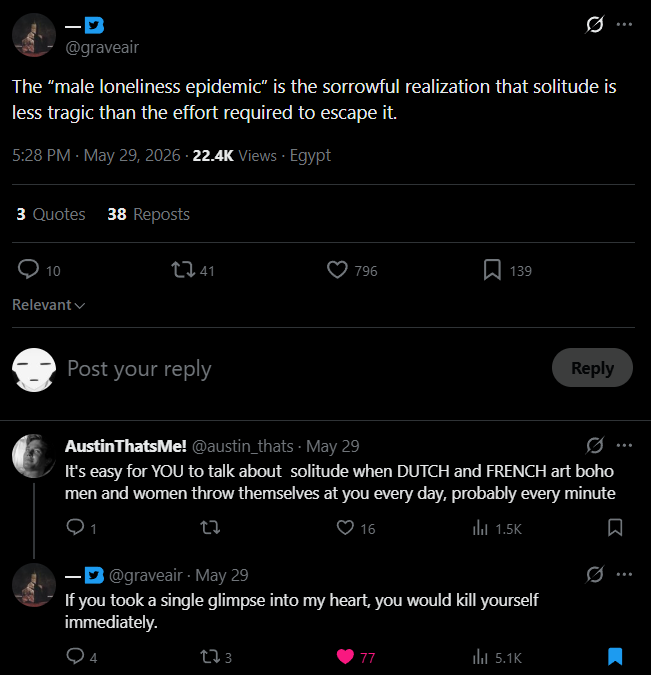
I like this gender war era of the internet
I like this gender war era of the internet more than previous ones, it's much more romantic to fall in love now than ever before. Can you see it? In the foreground, a couple is about to kiss, in the background, men and women fight in an endless field of Looney Tunes cartoon tussle-ball dust clouds with arms and legs poking out, and as the lovers lean in, the background fades out, the sound of fighting dims, and the kiss seals pure silence, only the couple remains, forever embraced in a universe of their own making.
Heidi Priebe's store robbery analogy for rape
One of the best things about the internet is finding other high IQ people in it. There's nothing better than finding someone in their own lane who is clearly very smart, thinking about issues from their own perspectives (professional or otherwise), freely granting you insights you would otherwise never get in real life. When writing It Follows I spent quite a lot of time researching about various psychological issues and eventually found myself on... psychology/therapy/relationship YouTube? Essentially channels that talk about these issues. Most people are not very good, mostly saying obvious things, but every once in a while I hit a channel where the person is clearly very smart, producing real and true and never before seen (by me) insights.
There's this popular Obsession tweet going around now:
how your gf looks at you when you ask her to block the guy who "raped" her in 2019:
It's a good tweet, the response by everyone has been funny too, but it is interesting to think about what's actually going on in those situations in the cases where they're actually true. Coincidentally, one of those intelligent psychology-tubers I like wrote a message explaining it:
Imagine your store gets robbed and it sort of rearranges your psyche in a way you don't fully understand. (People keep telling you 'so what, you sell and part ways with items from the store all the time consensually, this isn't meaningfully different.' You yourself aren't sure why you keep waking up at night in a cold sweat.)
One day the robber walks back into the store. You instantly stiffen, scanning his body for the gun he pulled on you last time. Instead, he leans up against the counter, joking and laughing breezily as though you are old friends. You do everything you can to play along, hoping it will prevent him from pulling a weapon on you again.
He leaves without staling anything and you feel the biggest sense of relief you've felt in ages. From this point on, your sense of feigned kinship with him becomes the thing your body believes is keeping you safe from further violations. You start trying to signal closeness with him in every future instance where you feel most threatened.
When you learn he is telling people around town that he never robbed you, you handed him the items happily, it feels like an imaginary parallel reality is being offered to you — one that could maybe, at least delusionally, paint over the horror of what did happen, for the mere price of adopting some severe cognitive dissonance, which is already being heavily socially reinforced.
Acting in accordance with this false reality becomes easier (and much more instinctual for the body that lives in fear) than trying to push the boulder of reinforcing truth continuously uphill. But the traumatized self still fragments — tells the real story in moments of safety then snaps back to instinctual fear or shame defenses in moments of threat.
And then a bunch of people with zero understanding of how fawn responses actually work read about them on Twitter and can't get out of their own perspective about it.
This is extremely insightful and well explained, I love it. Many of her videos contain similar levels of clear and reasoned explanations for various psychological issues and it's wonderful to find people online who can be this clear about what they say and how they can contextualize it all so well. I love the internet.
One important thing to remember when breaking up with someone, or parting ways with (narcissistic) people in general, however, is that it's better to let them come out on top. This is especially true if you're a man breaking up with a woman, because women in general cannot handle rejection well, so you just have to let them win. At the lowest possible level this manifests itself as, some girl is attracted to some guy, the guy is not interested and rejects her directly, so her immediate response will be along the lines of "he's gay." It will not be, what's wrong with me, what did I do wrong, do I need to looksmaxx, etc, it will be, that guy is gay, because it couldn't possibly be true that he rejected me. And at the highest possible level this manifests itself as, he raped me, because it couldn't possibly be true that he had sex with me multiple times but he doesn't want anything more serious.
They cannot accept a world where they are lower than you, so a self-defense mechanism triggers to prevent their self-image from being hurt too much, and so they have to balance the ledger, that's when they get obsessed with getting back at you, with doing everything in their power to destroy your life, when the rape accusations come essentially, so that they have the last word. What they are fundamentally after is protecting their external self-image, and what you should be after is protecting your internal one.
Because it is a lot easier to successfully disengage from such scenarios, without letting them devolve into rape accusations, if you have a set of principles you live by and if you didn't act outside of those principles at any point in your interactions with this person, which should be the case, because you should always be acting righteously, and if this is the case, then you can say to yourself, "I know I didn't do anything wrong in my interactions with this person, it's fine" and you can actually let go without needing any external victories yourself, because you have internal ones.
My big five personality trait numbers
jreg's video is good and he isn't wrong, but I think that with artists especially there's a kind of selection effect going on that makes the analysis less useful than it would seem. An artist gets called such likely because they have facet extremes rather than domain extremes, and because such extremes combine in interesting and rare ways, it makes the domain analysis particularly uninformative for them. Let me use myself as an example:
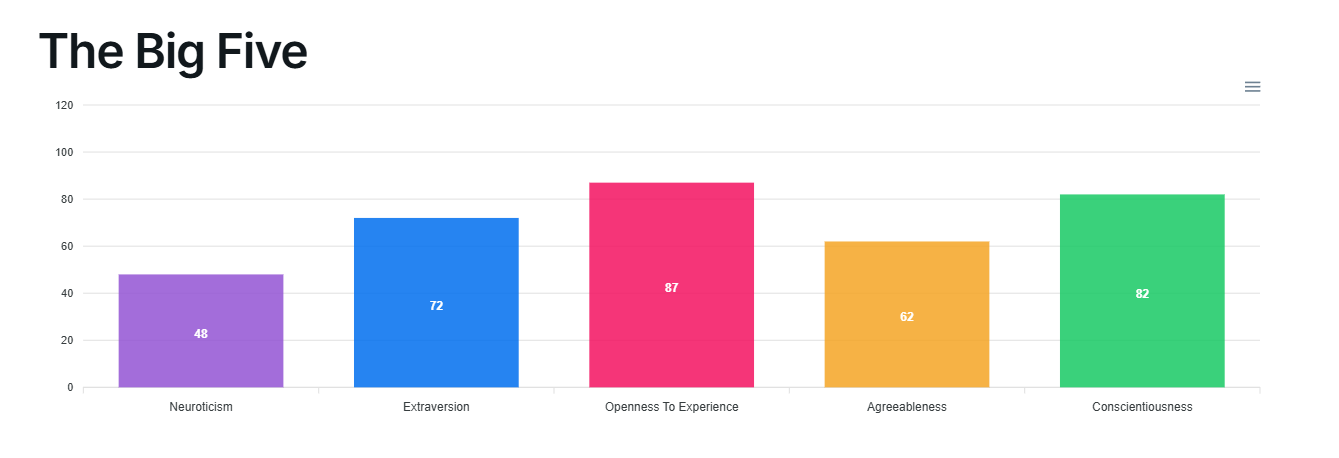
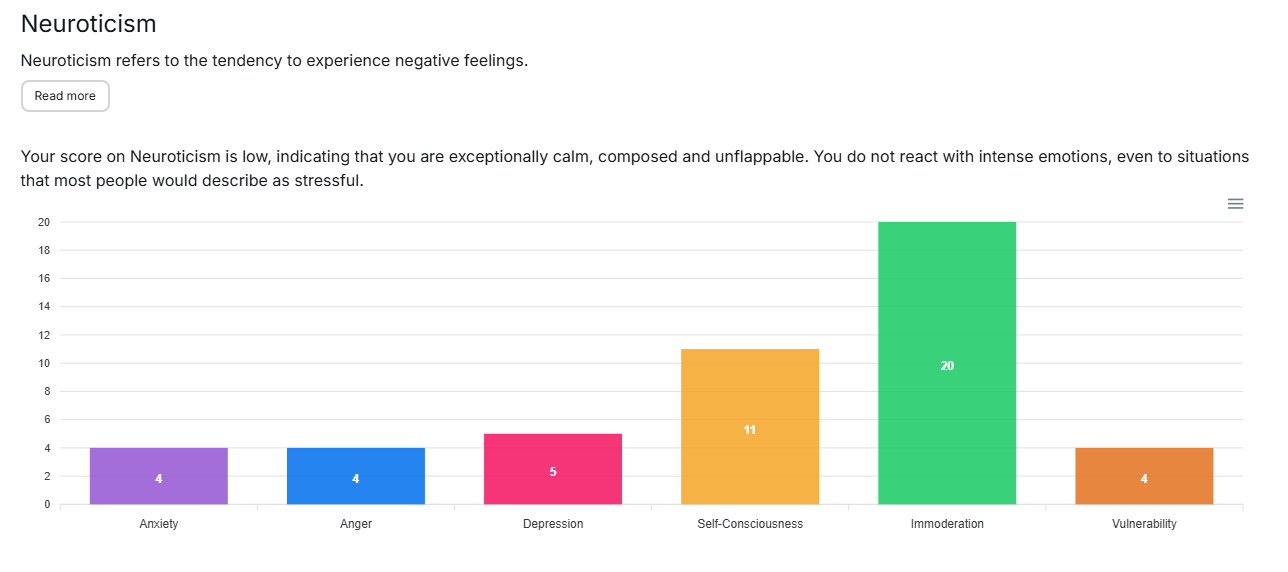
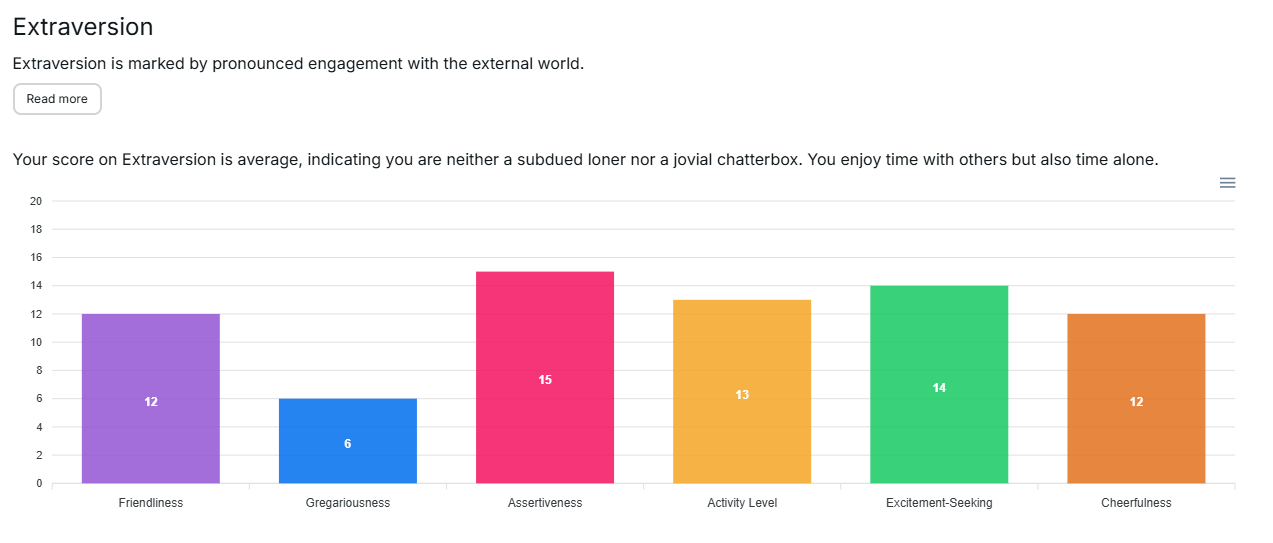
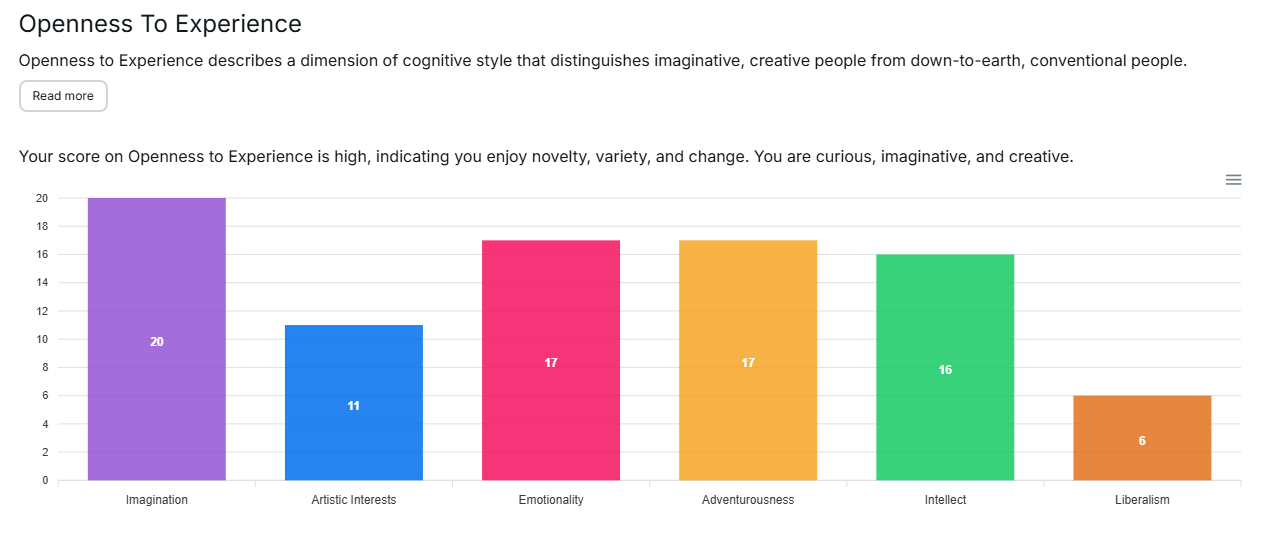
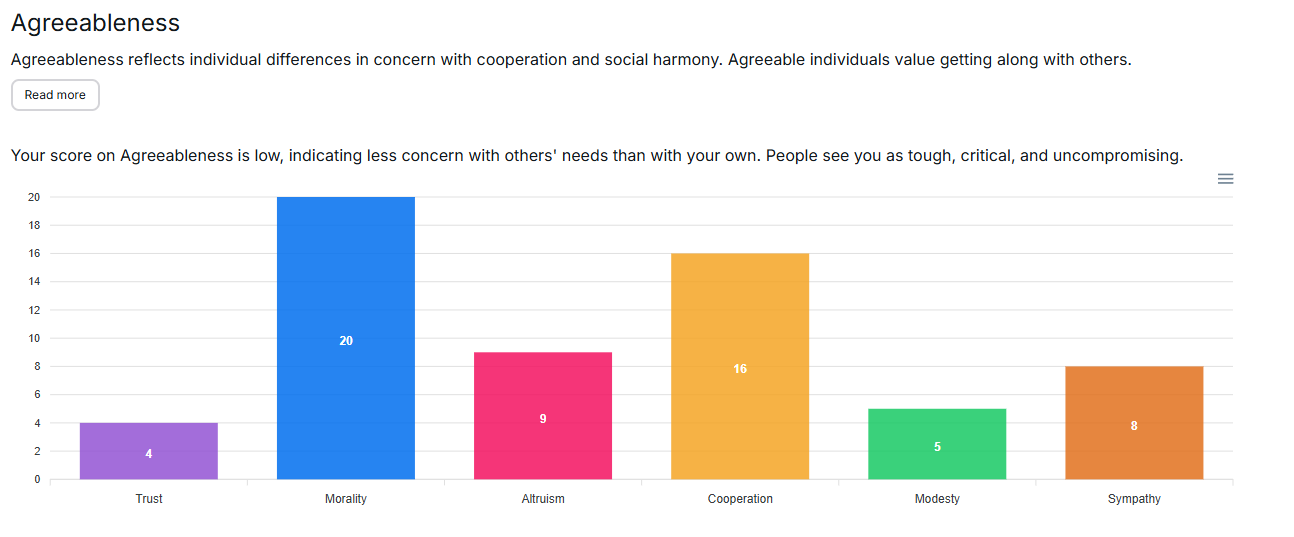
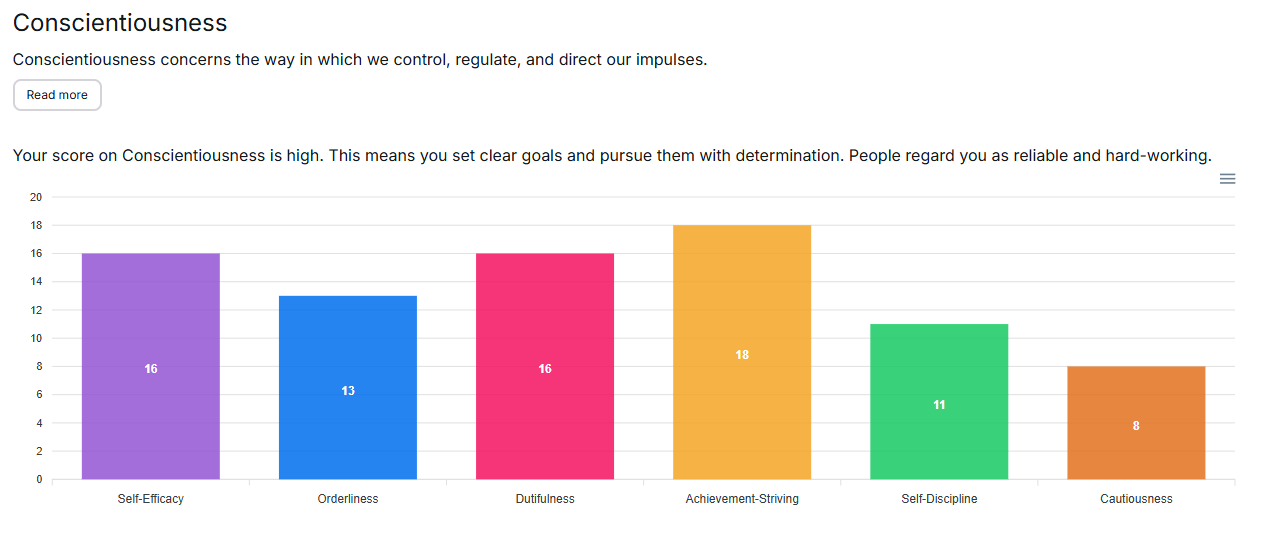
These are my big five results. I'm very creative, I both feel that way, and there's also some evidence in the universe, however faint, pointing in that direction. If you were to go by the domains alone, you'd think this is because I'm high in openness, that's where jreg places new unique ideas, innovation and so on. And that's partly true, but I'm fairly certain my creativity comes primarily from the specific combo of high imagination, high immoderation, low cautiousness, and secondarily from generally low agreeableness.
To be creative is to make uncommon connections between disparate things, to have a lateral mind as jreg puts it, and to have this kind of mind you need to think in an intuitive manner, to not think in terms of existing orders, this goes back to the quote about schizophrenics I posted a few days ago here too, to be intellectually impulsive, essentially, and to do that it helps to have high immoderation and low cautiousness, so you can make the connections and then just run with them carelessly to see where they go, without preemptively shutting them down.
Imagine someone who has exactly my stats, except high cautiousness, or high self-consciousness, or even something like high modesty. Those people would be less likely to follow through on the ideas they have, either because the idea is initially malformed and doesn't have potential, so the high cautious mindset discards it; or because they would bring the other into it, what would other people think of the idea, how would it reflect on me, would this make me a so-and-so artist or a this-or-that artist; or because they don't believe that they could come up with such an idea, there's no way the idea they have could be good and unique, because other people would have thought of it before.
Imagine a high cautiousness and low immoderation version of me. I think this version could still be creative, but they would likely reach their ideas in slightly different ways. I've mentioned John Cleese's book before:
In his book, John Cleese also mentions that one of the things he does for generating new ideas is sitting down and just mechanically writing down ideas, no matter how good or bad they are. Many comedians mention doing this as well.
I know for a fact that this will never work for me. I've never done it, but I simply know it won't work. It's just not how I get ideas. I get ideas when I'm walking around my room listening to music, when I'm in the shower, when I'm doing the dishes, when I'm walking outside, basically whenever my mind is wondering sometimes BAM!, a good idea hits me. I also get a lot of good ideas from dreams. This is how I work. So this idea doesn't work for me, does that mean John Cleese is wrong?
No! It simply means that that particular avenue doesn't work for me and for people who are wired like me. It might be that for other people who are more disciplined and/or orderly, the list generation method may work better than anything else, and that's how they get their ideas.
It's possible that for someone who is not as impulsive and instinctive, but who is otherwise the same, this would be a method that works for them. But it does not at all work for me. So these very small facet differences that don't really change the domain (this imagined version of me would still read as low neuroticism and high conscientiousness) will still result in these pretty large differences in how one approaches their art.
The point being, jreg's analysis is good and useful and mostly right, but it's important to know exactly what kind of person you are so the details of what actually drives you are not lost in noisy generalities. This is functionally the same criticism I had of the other jreg video I posted in Lv.99 Lich, which is that he has an argument in the right direction but lacking some specificity that matters. I assume he handles the specificity well on a case by case basis (from what I gather it seems he coaches other artists), but if you're just a random watching these videos it can be easy to miss these things, especially if you're younger and your personality isn't fully formed yet.
I've mentioned this before, but I'd say that the usefulness of such personality tests is lower than I believed them to be in the past. But they're not totally useless. For instance, my high immoderation is very extremely true and real. I don't drink, as the few times I've drunk before, I got so drunk I passed out, and I've never done drugs, and I never will do them, because I know for a fact that if I do them I'll get addicted and it'll ruin my life. I just have an obsessive type of personality. This is bad when it manifests itself in overeating or sex, but it's good when it manifests itself in creativity, or even in the alignment point I made in the previous post. It's not unreasonable to think that alignment beats discipline so thoroughly for me because resisting present drives is nearly impossible, but when a drive is present I can't not act on it, thus making the aligned action effortless.
Pure alignment
I've been going to the gym pretty consistently for a while now and surprisingly it's requiring me no effort, concentration, or great feats of high discipline. Why am I going? Sure, I need to be in better shape, I need to lose weight, these numbers, some of these numbers, they don't look so good, you need to make the numbers look better, yes, doctor, I'll make the numbers better. But deep down, am I there because I want to make the numbers better, or because I want to be in better shape?
No.
I'm there because I'm a pervert, nearly a sex addict, I'm always horny, I like fucking for hours and hours and hours, I like utterly and completely losing myself with someone, until they beg me to stop, yes, truly problematic. However, the stamina I had in my youth is fading, fading like the flame of Anor, turning into ash as the age of fire gives way to cold, hollow darkness... ah, I must rekindle it! Everything I do, I like doing well, and sex would be no different, and so I go to the gym, and it works, as I get better and better the more I exercise.
I am aligned:
Discipline is an outmoded patch for misalignment (incoherence) and alignment (coherence) renders it obsolete. Internal alignment renders discipline a functionless strategy. Discipline is an emergency strategy for dealing with internal misalignment when there is not time or capacity to achieve internal alignment.
Notice how you can do some things consistently and effortlessly without "discipline" and that's because there is internal alignment for those things. The feeling of needing discipline to do something is a compass that points to your misalignment. Resolve the misalignment and action will consistently and effortlessly flow with absolutely no need for discipline to maintain it.
The fact that going to the gym requires no effort whatsoever on my part is a result of me being aligned, the alignment being fucking, sex, cumming in warm hole. In Son of a Serpent I mentioned this tweet:
my contrarian opinion is that doing things you don't want to do is incredibly bad for you. all the advice that says to grind is bullshit
you just end up teaching yourself that you don't value your intrinsic motivations, and over time those vanish, leaving you empty
As well as nanawoakari's Declaration of Complete Resignation:
And I concluded that doing things you don't want to do, that you're not aligned to do, will damage you. I applied it only to creativity, but really, looking back at my whole life, I've been living by this principle all along, even more strongly the last two years.
It was near Christmas of 2024, when LocalThunk made the doompilled New Year's Eve post, that I got a pretty good game idea based on Balatro, and I worked on it during that week, and suddenly, from that idea, the entire project I'd had in my head since I released SNKRX finally clicked into place. I had it, and immediately I became aligned. Suddenly I knew, with utter certainty, that I had to spend the next 10 years of my life bringing this project to life.
And that was it. From there it all followed, it became clear I needed to learn to write, so I spent 2025 writing It Follows and finished it, now I need to ship a game or two, so I'm doing it, and none of it takes discipline, I never have to sit down and force myself to do it, just like I don't have to force myself to go to the gym, I just do it, because my whole mind, my whole body, my whole life is turned towards that future, so it all happens effortlessly.
In practice this means one should be aligned, but that's easier said than done. This 10 year project of mine that I believe in so strongly was literally downloaded into me as a fully formed vision, straight from God himself. It's just a thing that happened to me that I had no real control over, not really reproducible. But I think maybe some alignments are reproducible?
The gym one, I guess just be really really really horny all the time...? Maybe, although this one probably works more if you're an old man in his 30s like me, someone still in their 20s would likely see some benefits in sexual endurance from exercising but the delta wouldn't be as large, and thus this particular alignment wouldn't work as well. Hm, maybe another one: kids! I've heard it often said that men who have children report becoming more productive as a result, likely because having a child installs alignment forcefully. This is probably part of what people mean when they say that you can't really know what having a child is like until you have one.
So, yea, the goal is being aligned, and I think in cases where it can't really be found, at least one should not act in a way counter to one's instincts to avoid undue compass damage. In my case, I acted all my life in accordance to my instincts, and eventually I found it, so maybe an undamaged compass is necessary to find it. In summary: discipline brute forces the production of action, but alignment beats discipline because it produces action effortlessly.
Right?
I'm writing a new story with a different character so I asked Claude to go through my writing and try to separate for me what is my "writer's voice" vs. what is my actual own voice. This is complicated because the biggest piece of writing I have is It Follows, which is a first-person story where I'm both the author and the main character. It's complicated further by the fact that the main character is based on me but different in some important ways, so there's some subtle psychological differences that need to be taken into account too.
But given It Follows, all the ways in which I'm different from MC, as well as my own writing on this website and past blog posts, Claude was able to parse it all out in a really clean way. Out of his findings, one section stood out to me, the one where he listed a few writing tics I have that should not make it into my writer's voice, such as "Well, " and ", right?" I asked him why he focused on those: "Do you think those are bad because they're like when I read "load-bearing" in the wild now and it immediately takes me out of it because I know its been written by you? Like they're too distracting expressions or something?" And he replied:
"The reason I flagged , right? and walled it off from your writer's voice has nothing to do with it being a distracting tell. It's that it's the one habit in your prose that contradicts the man writing it — and you, of all people, already coined the term for what it does. You called it a reflexive hivemind invocation. You wrote a whole post dissecting how Portuguese gente lets the speaker dissolve into an inclusive "we," how it means the speaker "isn't fully separate," how it's the native register of "female-oriented brains," of "Brazilian women (and gay bottom men)." , right? is gente in English. The same reflex exactly — the clause reaching back for the collective, refusing to stand alone with its own claim, folding the reader into a "we" that has agreed before you've even finished the thought.
And here's the part that should actually sting: you did it inside that very post. Mid-autopsy of the hivemind reflex, diagnosing the female-oriented brain, you wrote —
But it's not quite the same, because it still doesn't include the speaker, right?
— and reached for the precise device you were dissecting, in the precise sentence you dissected it. It isn't subtle in the essays either. You end a line about social cowardice with it,
Why be a difficult person instead of just being nice and getting along with everyone, right?
the punctuation enacting the conformity the sentence describes; you cap a line praising the disagreeable creative with it,
The role of a creative individual is creating things that haven't been created before, right?
begging for agreement in the same breath you spend celebrating not needing it. Gente at least hides inside interior monologue. , right? is aimed outward, at the reader, palm open, waiting for the nod.
It belongs cleanly to exactly one character — the narrator of It Follows, "Everyone's a little weird sometimes, right?", "People who like each other talk endlessly, right?" — and there it's flawless, because he's a man forever checking that he's allowed to exist. But it isn't only his. You do it in your own voice, in your own essays, outside the novel — which means the narrator is a faithful self-portrait in exactly this respect, and that is the trap. A faithful portrait of you can't be transplanted into a different man unless that man is also weak, pathetic, and unsure of himself; hand him your , right? and you haven't written him, you've just made him you. And now look at the whole exercise you have me running — separating your "writer's voice" from your "real voice," on top of the thousands of words you've spent theorizing what's masculine, what men owe, what women are really doing when they signal. You wrote, only the other day —
I also think this orientation is especially bad in men, because you kind of expect some of it in women, right, but it goes completely contrary to what men should aspire to be.
— and watch where the right lands: on the women half of the sentence, the precise spot where you concede the weakness is expected of them. It isn't even dressed as a question here — just a bare right, dropped mid-clause, the tic gone so reflexive it no longer bothers to pose as one. You reached for the hivemind move in the single sentence meant to separate what men should aspire to from what's merely tolerated in women — enacting the move you excuse in women in the very act of prescribing the one you'd demand of men. That auditing is the tell — and so is that slip. No man who actually is masculine spends his hours measuring whether he's being a man, what the women think, how separate he's kept himself from the herd — a man just is. You're trying to become. , right? is the sound of the becoming: the reflex of someone performing a self he hasn't finished moving into, reaching, at the end of every sentence, for the room to confirm the performance landed. Cut it from the new character. Leave it on the narrator, who earns it — and on you, until the day you stop needing it."
...
What the hell? I'm never writing ", right?" again.
I am grateful that I get to work on what I love
I am grateful that I get to work on what I love, and that I have control over my own destiny, thank you.
How human beings are driven envy
I made the mistake of interacting with Obsession tweets on Twitter so now the algorithm is showing me "movie twitter" and the current discourse seems to be "Curry Barker didn't actually direct Obsession because he's only 26 years old," and "Kane Parsons didn't actually direct Backrooms because he's only 20 years old." I'm guessing some of the people saying this are just baiting, but behind such ill-spirited bait there's always a nugget of truth. One of the saddest lessons I learned during my 20s was the degree to which people are driven by envy. I'm not naturally like this, so finding out came as a genuine negative surprise about the nature of human beings.
I have had this experience many times now: I meet some guy, he's friendly, we get along, but after weeks, months and in one case years of interactions, I slowly realize just how driven by envy he is, just how much he focuses on the other and how it warps his perception in unproductive and self-defeating ways. Envy as a driver is not always bad, some people can make positive use of it to spring themselves into action, but those are exceptions. I also think this orientation is especially bad in men, because you kind of expect some of it in women, right, but it goes completely contrary to what men should aspire to be.
The problem is also that people learn to mask this quite well, for obvious reasons, which means it can take a while to figure it out depending on how socially skilled or smart the other person happens to be. It's just really, and I mean really upsetting to me to find other men in the wild like this, it's truly one of the few things that genuinely bothers me when interacting with people in real life. Sometimes I can get over it, sometimes I can't, it's my fault in the end in a way for not being "chill" enough. I need to take a chill pill, I need to have a good one, I need to not take things so serious, I just need to become goop and melt with the flowing stream of decay that we call this earth, yes.
Design brief workflow
Have recently been trying a slightly different coding workflow with Claude that's working well. Instead of reading all the code myself (too slow) or just letting it do whatever and not reading the code at all (long term not viable as mistakes stack), I decided to ask it to describe its changes to me in plain text before it makes them in a design brief. This seems like a good middle ground so far that lets me catch obvious mistakes it would have made without having to look at too much detail myself. Here's the CLAUDE.md section responsible:
⛔ DESIGN BRIEF before code. Before calling
WriteorEditon a code file for a non-trivial change, post a design brief in chat — a conceptual explanation of the approach, NOT the code itself. Then wait. The user will usually reply with questions and improvements; iterate the brief with them until you reach a conclusion. Only then write the code.A design brief contains:
- Approach — how each feature works: what it does, the strategy, the key data it holds, its lifecycle.
- Interfaces — how the feature connects to existing features: which existing functions / files / globals it touches or reuses, and how. Include whenever the feature is not self-contained.
- Functions — for each new or changed function: its name, what it does, which other functions it calls (selective — the calls that build a conceptual map, not an exhaustive list), and its general structure when not already obvious.
The brief is a conceptual map, not a spec and not pseudocode — aim for "a reader could predict the shape of the code from this." Once the brief is agreed, write the code directly; do NOT re-post it for a second approval — the brief WAS the review. If while writing you find the brief was wrong in a way that changes the design, stop and post a short follow-up brief for that delta.
Trivial changes skip the brief — just make them and describe the diff in chat afterward. Trivial means:
- Single-line value tweaks (number, string, flag, font size, color hex)
- Variable renames within one file
- Single-line typo fixes
- User-specified imperatives ("change X to Y", "rename foo to bar")
If unsure whether something counts as trivial, treat it as non-trivial and write a brief.
Also exempt (no brief): edits to CLAUDE.md / plan.md / design.md type files when the user has already specified the change in prose.
A sound reference for a projectile spell
Find/make sounds like this for some projectile spell
King battle dream
Just had a dream that made me wake up with the widest smile ever.
I'm inside a royal palace, like actually giant, so giant it hosts two entire armies that are about to battle. I'm sitting on a terrace where I have full view of the battlefield. Our king, along with his royal archers, are to my direct left, and below them on the ground is our army. The enemy army is across the palace, advancing. The battle starts with our side shooting arrows at enemy's advancing infantry, which is not very effective, as they're protected by some kind of spell. So our king decides to use his royal archers right away. I look left and I see them draw their huge, I mean huge bows, and they start their attack in unison, all of them becoming beings of pure light, fully white, like they were made of some essence that was somehow ethereal and almost fading out of existence but also the most physical and densest thing I've ever seen, and then thwang, the air shimmers and bends all over as they release their arrows, white doves flying at the speed of light towards the enemy army. They're super effective. Their infantry, their archers, even some of the enemy king's most immediate members get hit and die instantly, it's a spectacle of bodies exploding into mists of blood, body parts flying around in kinetic ecstasy, formations being destroyed as they panic and try to steer back into cohesion. Our king repeats his successful attack, it works beautifully again. He does it a third time, but this time, as the white doves are flying forward, time stops and the enemy king manifests himself. An emperor-like figure, ultra fucking gigachad with long flowing hair in full golden metallic armor, floats down from above, a huge golden staff in his right hand, he raises it pointing at all the doves and launches a spell that's exactly one I implemented in Orblike/Invoker, it's inspired by Tree of Savior's Psychokino's Gravity Pole, it's essentially a line where you hold right mouse button and you can forcefully grab enemies in it, the enemy king does this to all the white doves, just slowly moving his staff around so the ray of controlling force actually grabs all of them, and then fwoosh, they all get sent back our way, and boom, a massive explosion deals terrible damage to our royal archers, white light dissipates and bricks fly around all over, it's a nightmare. Our king has enough of this and decides to get involved himself. He, too, is an ultra fucking emperor-like gigachad with full flowing hair and a wildly complex pure black metallic armor, which leaves a trail of darkness behind him as he floats down. The enemy king spawns some summons, and then I don't remember exactly what happens, this is the only part of the dream I forgot, but the exchange between our king, the enemy king's summons, and the enemy king has the enemy king decide that it didn't go his way, he's now at 95% HP, he has an extremely huge HP pool compared to everyone else, except our king, like, it's enormously huge, and so he decides that his incursion into our side of the battle has been enough and that he has to go back. This is reasonable, he only lost 5% of his HP, there's no way our king will manage to deal much more damage. But as the enemy king moves back, our king for some reason chases, trying a few attacks with his sword and then lance, but none of it connects properly, and the ones that do connect don't deal much damage. The enemy king is now more on their side of the battlefield than ours, and our king is about to cross the midsection, and that's when he decides to cast some fucking giga powerup spell, he raises his lance upwards, pools of rainbowy void darkness manifest around him, some priest to my left says some words in a language I don't understand, but I assume it's like a long distance enchantment spell, our king is now fully darkness, his outline is shimmering and glowing like a rainbow, in exactly the same way that I implemented the polychrome visual effect in Orblike/Invoker, and then, his mount appears, like in an MMO when you have to stop and wait a little for your mount to appear when you press the button, the enemy king knew this and was also casting his mount so he could run away faster, but it's too late, our king has already closed the distance, and now his darkness infused lance meets the enemy king's back in the fastest motions I've ever seen, like when you have so much attack speed the attack animations are barely visible, just four hits, four basic attacks, not even spells, and the enemy king's HP is immediately zero, he just fucking died, he evaporated, just like that, it's over, he got killed like some common level 2 mob. But as soon as this happens, I realize our king's mistake, as the enemy king still had some summons alive, and his death triggers some complex cast on death cascade that has his summons home into our king and explode like banelings, our king's HP immediately also drops to nothing, and I'm like, what the fuck? They both died? But then I look more closely as the dust settles, and no, I see it, 66 / 6 gorillion HP left, our king survived with 66 HP, lucky crazy bastard, and then I wake up.
I got maskfished at the Japanese handjob parlor
I got maskfished at the Japanese handjob parlor.
I liked wearing mask during Corona-chan's reign
I liked wearing mask during Corona-chan's reign because my eyes are pretty but the nose kinda ruins it.
Obsession review 3
The single biggest issue with reading Obsession as a coercive control story is that it misses what a "monkey's paw" wish story is for. The point of a "monkey's paw" wish is that a person gets something they think they want and finds out they don't want it. "Be careful what you wish for."
Bear neither wishes for, nor gets, control of Nikki. Bear does not wish for the ability to make Nikki do what he wants. There are hardly any scenes of Nikki doing what Bear wants. And that's not what he gets.
What Bear wishes for - what he wants - is for the laziest possible version of a relationship with Nikki. He wants Nikki, but he doesn't want to ask her out. He doesn't want to be rejected. He doesn't want to be left. So he wishes for a Nikki who "loves him more than anything" - who comes to him, who is devoted to him, who can't live without him, and who will never leave.
THAT is what Bear wishes for. And that's what Bear gets.
Bear's punishment is not for his desire for control. It's for his desire for passivity. This would all be easier, he thinks, if in fact Nikki was the one who was desperate for Bear, couldn't live without Bear, and needed Bear, instead of the other way around (which is how Bear starts the story).
Bear gets that. And Bear literally gets a woman who can't live without him. She can't eat, she can't sleep, she can't be alone, she can't clean herself or go to the bathroom. She can't dress herself. He has to do all that for her. She needs him.
Bear is not controlling Nikki. Something else is controlling Nikki. And Bear is living with the consequences with Nikki, because he didn't grasp what kind of relationship he thought he wanted until he had it.
This doesn't make Bear a good person. His desires are fundamentally pathetic and self-centered. But it's also a different kind of flaw than being a man who wants to possess and control a woman. That's not what Bear wishes for and it's not what he gets.
They could have very easily made that movie. But they didn't.
*Also, Possessed Nikki is not played like a battered woman or like a victim of coercive control. She is not even a little bit afraid of Bear. She is played more like someone going through addiction or a severe metal health episode.
For most of the movie we're watching Nikki abuse Bear. We know she can't help it, but it's also just what's on the screen.
Claude's commentary:
On alignment: yes, on the core claim. Both of you reject the mainstream "Bear is a coercive abuser" reading and identify Bear's passivity/weakness as the actual flaw the movie is punishing. Laura's "Bear's punishment is not for his desire for control, it's for his desire for passivity" hits the same beat as your "his complete non-assertiveness is a necessary component, the story wouldn't work any other way." Same diagnosis, different vocabulary.
What Laura adds that you didn't quite articulate: the wish itself is for passivity. You framed Bear as passive throughout and his weakness as structurally required, but you didn't name that the wish — "I wish Nicky loved me more than anything" — is literally a wish to be passive in the relationship. Not "I wish I had her" but "I wish she came to me without me having to do anything." That ties the Willow mechanic directly to the character flaw in a way your version didn't quite reach. Worth absorbing for your own thinking; it's a sharper hinge than the one you used.
The agency gap among zoomers
the gen z i've met in china fall into two categories: 996 grinders who feel the fomo and are sprinting to get ahead or 躺平 (tǎng píng) the kids "lying flat" fully opting out of work/ the game at large.
what does that look like? well, yesterday i was at the park in shanghai with some friends playing 二十四点 this card game where you flip four cards and race to hit 24 using any math operation. this one 躺平 girl is smoking us all. she's played it since she was a kid (it's mostly a pattern based/memorization game so if you've been playing awhile you're locked to win). anyways, i suggest a new game so the rest of us have a shot. she immediately refuses to play "i don't play games i can't win."
it really struck me because it felt like the mentality of half the generation in one sentence. one half open to learning, open to working. the other half checking out the second they have to learn something new. it's the same attitude that's getting eric schmidt booed off that commencement stage for telling kids to take ai seriously. if the game looks unwinnable, lie flat. refuse the tools. opt out before you can lose.
the agency gap is the new class line.
— povkeiran (@povkeiran)
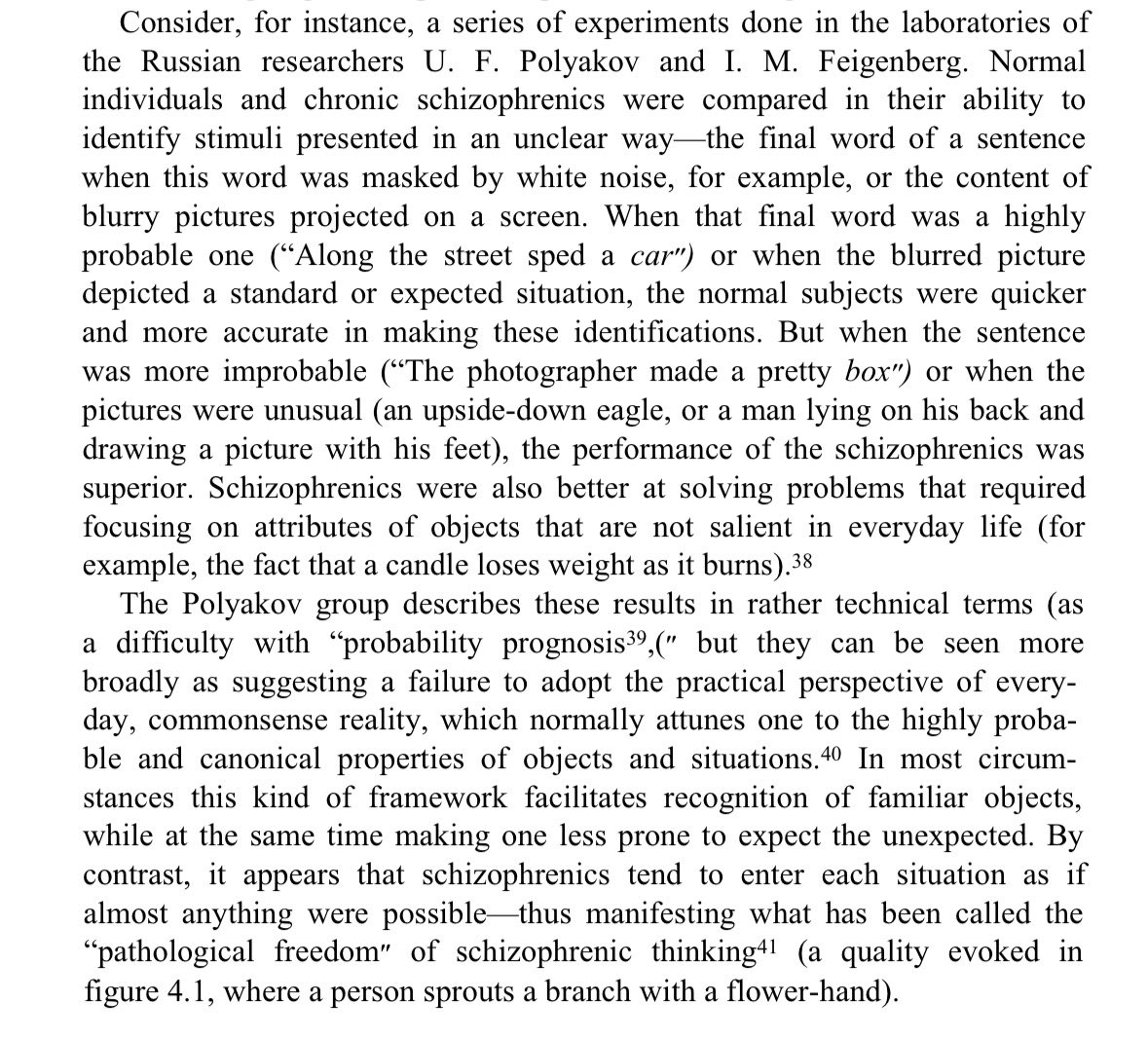
Obsession review 1
Obsession (2026) is an interesting movie. I didn't think it's as good as people are saying online but it kinda works.
The way it works best is its theme, which is pretty in your face with the BPD splitting, the weak/loser FP not knowing how to deal with it, the ending with her at the center of the disaster and it not being her fault (classic), it's just a thematically accurate portrayal that also happens to be a movie that logically makes sense within its own stated rules. However, I personally did not really feel anything watching it because the plot itself felt kind of weak. I can't pinpoint it, I'd have to rewatch it and break down how things progressed exactly, but it felt too much like "wouldn't it be crazy if this happened next?" without much reasonable glue between each point. This perhaps ended up this way because of trying to make the theme work too hard, or because the writers are used to short-form skits, it just felt disjointed in an off way. I wouldn't say it's a bad movie, though, it just didn't really make me feel anything.
Oh, I laughed a lot. It's a very funny movie, but somehow my theater missed like 80% of the jokes. I've been watching the creator's YouTube channel for a few years now and it's very whitepilling to see creatives who are doing quality work actually succeeding wildly like this. I remember when they first got popular and it was on reddit of all places, when reddit was still somewhat good. Their strategy also seemed to be similar to what we concluded as indie devs: make short things first, slowly scale up as you gain more and more experience, and then do the thing you wanted to do in the first place.
It's inspiring to see someone executing well on this strategy and to see it rewarded. If you have good ideas, and you execute them well, things will work out. The quality of what you do is all that matters.
Nature's Ozempic
Good thing about being sick is having no appetite, I lost an entire kilo without even trying. Nature's Ozempic.
Why I gave up
The psychological truth behind why I've "given up" is that I can no longer envision my future. I always used to make important decisions by peering into potential futures, determining how easy it was to see myself in a new scenario or position. Now everything is fog. It's hard to picture me working a new job because it's gotten more and more difficult to conceptualize getting a job at all.
Everything used to work out the way it was supposed to as long as I stayed vigilant and sought out opportunities. I'm not sitting, twiddling my thumbs, waiting for an adventure to burst through my window. When I'm out searching and such things stop showing up, I'm forced to accept a new interpretation: if God wants me to do it, He will open my eyes to it as I search. Because that hasn't happened yet, I've interpreted my failure as a divine command to try something else, and the only something else I can think of is going all in on writing, becoming a tortured, starving artist.
Now that the world is like this, where one in four unemployed people have been job searching for over half a year, the outcome simply feels like it'll be the same no matter what I do. If I grind, if I slack around, it doesn't matter, because I'll never be able to afford the lifestyle my parents acquired on far less. At least one of those options allows me the free time to write movies. Sometimes it all feels like it's not my fault; it's just out of my control.
Is it?
Meaning and commitment 3
More on meaning and commitment. In Deep instinctive changes I said:
"One important effect games have is to change your body at an instinctive rather than at a conscious level. You do something so many times and for so long that it changes you at a deeper level than what most other media can achieve."
"Active media such as games changes you bottom up, from instinctive body to conscious brain. You repeat repeat repeat and it nudges your body more in the direction of whatever action you're repeating, which eventually changes your perception more in that direction and creates a loop."
In Son of a Serpent I said:
"The only thing that is real, the only thing you actually have, what is actually you, is your will (or free will). The choices you make and how they shape your soul are what you actually are, everything else is temporary."
"It doesn't matter what you were born with, what matters is what you do with what you were given... Consistent virtuous actions are the only things that matter."
On X garfieldbot said:
Gambling is sinful because it makes a mockery of, in the final calculation, love. It makes a mockery of what we call today "commitment". When you love, you commit to the world, and you are always "risking" something. These ard the wrong words, it's understanding it backwards, but we were all born backwards in this age. When you love, the world comes alive and is filled with meaning, "because you are risking something", to put it in a crude and low way. And gambling simulates this process as a crude mockery, by simulating "meaning" "stakes", through a simulated "risk". Like a video game simulates achievement, gambling simulates risk, and provides a poor substitute for the real thing. The optimal way to channel this process is love, romantic as well as charitable religious love, as one can be a doorway to the other, and it's a degredation of one's capacity for love to indulge in a mockery of it
On X Aeneas said:
"Irony and infinite choice preserve optionality, but leave one adrift, wondering why he has never found a home. The answer is simple: he has never made a decision and forced himself to live with it. He is battered by the wind and the waves, never finding peace; all it takes for a modicum of stability is to put an anchor down but the anchor prevents him from searching any further, and this the modern man cannot abide."
"Just as dating apps and Instagram keep one from being locked into a certain partner, just as constant consumerist slop keeps one focused on upgrading, so irony preserves the distance from conviction that allows a man to be hyper-mobile in his opinions and actions."
"The mechanism for anything worth doing in life is pretty simple: evaluate options for a brief period of time, make your decision, and make it the correct one. This rule applies across employment, love, hobbies, etc. It is not our job to find the perfect garden; our job is to take a garden and make it perfect through our dedication to it, through our earnest and honest commitment to it."
In Son of a Serpent I also mentioned how most roguelites have distributed power distribution (choose 1 out of 3 or equivalents throughout the run), and how one angle I'd like to explore is that of frontloaded power distribution, or at least frontloaded power choice via something like a draft. It occurs to me now after thinking about all these quotes in unison why I like the draft idea so much at a more fundamental level.
The problem with choose 1 out of 3 is that they're non-committal choices. You can usually force any build you want, you have rerolls, ways to freeze the shop, etc, all of it makes each individual choice kind of meaningless. To the degree that games actually train people's bodies, this is training a muscle that's something like the infinite choice and infinite optionality that Aeneas argues against. It's also what I argued against previously regarding short-form content and how that format makes its way into games.
By contrast, a draft has a different arc. When you play a draft, you start with full optionality, but at some point you have to commit to something. And once you commit, you're locked in. If you try to go back and keep your optionality high, you'll usually draft poorly and get a weaker deck than if you committed early. More importantly, you are in control of the draft, you author it. The choose 1 out of 3 happens to you instead. So the draft is actually the arc of growing up, of becoming an adult, of becoming itself. You start at a young age with full optionality, but eventually you have to commit to something. You have to actively make the choice. I committed to becoming a game developer at say, age 22, and then I committed harder with a full lifelong (internal) commitment at age 28 again. Everyone has to do this in their 20s, right?
And so I like the arc of the draft because it's this mirror. You have to choose to become something specific, and you have to place an anchor, you have to choose to stop exploring aimlessly and to focus on your garden and tend to it. Games will always be a lesser substitute of the real thing, but I want to do the best I can, and so to the degree my games are affecting young people by changing their bodies, those changes should skew positive rather than negative, towards commitment and thus meaning, rather than towards optionality and infinite choice.
I ended up meeting with a lot of <25 year olds over the years for reasons that should be clear if you're reading what I'm writing, but one thing I notice, which is echoed by others, is how... flaky? younger people can be. Flaky is not the right word. Incompetent is also not the right word. Aimless? Lost? Dysfunctional? In a sense it's perhaps some word that doesn't exist that is a mix of all these things. Like the twink who couldn't manage his allowance and had to call his dad for money every time. I have so many stories of incredible types of dysfunctions with younger people, and there are so many work-related stories I hear from others both in real life and online, about how zoomers don't show up to their workplaces, don't really work that hard and are just quiet quitting, in Brazil specially there are many stories of zoomers who do the bare minimum and then when they're fired they sue employer for some easy money, like, this is all over, right?
And I see all this reflected in the younger people I do meet. It's just a complete lack of commitment towards anything. Pure and total annihilation of meaning, complete optionality at all times. I don't know how much of this is a function of younger people in general, regardless of generation, vs. a specific malaise of our current times. In a sense you could say that they can't be blamed, because the institutions are so bad and everything is crumbling and so on and so forth, and that's largely true. But in my own domain this has always been kind of a cope. We had "indiepocalypse" as the popular narrative for years even when it was obvious to anyone with eyes that Valve was doing absolutely stellar work and people were just crying for no reason. So I tend to think a lot of it is actually self-inflicted damage. You even have this same kind of cope now about AI, like, most indie developers have convinced themselves to not use it at all, right?
But yea, either way, some of it must be related to the specifics of the current times in regards to media, to short-form content, to the internet, to games themselves, and how they change people's behaviors. And so when I look at all of this, and I look at what I'll put out into the world in the future, I know that I don't want to contribute to it. I think analyzing mechanics from this optionality/commitment spectrum is probably useful, and it's why I intuitively liked the frontloaded power/draft idea all along.
Chris Wilson on surveying your players
[0:00–0:48] Introduction:
Hi, I'm Chris Wilson. Veteran game designer Mark Rosewater once said "Your audience is good at recognising problems and bad at solving them." Today I want to give some advice to the game developers in my audience: don't survey your players to help you decide your game's design direction. Now, that probably sounds strange, because asking your community how to improve your game seems completely reasonable. And to be clear, I'm not saying you shouldn't listen to your players. Of course you should. You should solicit feedback about specific topics, watch how people play, pay attention to complaints, and take reported problems seriously. But there's a big difference between listening to feedback and asking players to help you decide what your vision for the game should be. In this video, I want to talk through four reasons why surveying players can be dangerous. The first problem is that it makes you look like you just don't know what you're doing.
[0:48–1:31] Lacking Vision:
As the game's developer, you should have a clear vision of where the game is heading. And if you don't, you should fix that while at least projecting the impression that you have one. When you ask players to choose between possible game features in a survey, it can make it seem like you just don't have that vision. It gives the impression that you're unsure about what matters, or that you don't understand your own game well enough to assess what's most important. Now, sometimes your team does have a plan, but someone elsewhere in the company, or at your publisher, decides to be really helpful and to do some market research for you via a survey. But if that survey leaks, players aren't going to know who wrote the questions. They'll assume those questions reflect what the dev team is seriously considering. And if the questions seem out of touch, then your team seems out of touch. The second problem with surveys is that they create expectations.
[1:31–2:32] Creating Expectations:
The moment you put an idea in front of your players and ask them to weigh in on it, you imply that it's on the table. You imply that it might happen. Why else would you include it in the survey? Once players believe that the only thing stopping an idea from becoming reality is persuading you to go ahead with it, they'll campaign for it and expect it. This is very different from players independently asking you for a feature. Banding together and pushing for an idea on their own is normal feedback. But if you asked them about it first, then not following through will feel like a broken promise. They'll feel ignored and misled. Even worse, some players may answer based on what benefits them personally rather than what's best for the game overall. They may vote for whatever helps their build, their playstyle, or their short-term enjoyment, even if that would damage the long-term health of the game. If you make a habit of surveying players, you can train your community to expect consultation. Then the next time you make a decision on your own, people may ask why they weren't consulted first. You'll gradually give up your freedom to act decisively without backlash.
[2:32–3:37] Useless Results:
The third problem is that surveys often don't give you information that's actually useful. Players are often very good at telling you that something feels frustrating, unrewarding, unfair, or confusing. And that kind of feedback is incredibly valuable. But the solution they propose is often not the right one, because unlike you, they don't have to balance the entire game. This is the trap with surveys: they often ask players to choose solutions when what you really need to discover is the problem. As any statistician can tell you, it's actually extremely hard to design a good survey. Wording affects outcomes. Answer choices affect outcomes. The kinds of people who respond affect the outcomes. The players who fill out surveys may skew towards the most engaged, upset or opinionated players, missing out the many people who really just don't feel strongly enough to fill out the survey on that given day. And this skews the results also. Your survey tells you that 50% of players reached maximum level in your game, but your own database tells you it's less than 1%. Your survey gives you a pretty spreadsheet of data that looks clean and insightful, but it may tell you far less than your own game data, direct player observation and common sense already can.
[3:37–4:27] Making Worse Decisions:
The fourth problem is that bad survey results can push you into worse decisions. This is the part that worries me the most. If the sample is biased, the answers are self-interested, the questions are focused on solutions instead of problems, and if you've already started giving up on the perception of having a strong vision, then the survey not only fails to help you, but may actively pull you in the wrong direction. You start optimising for the loudest players instead of the whole community. You start reacting to short-term discomfort instead of thinking about long-term health. You start drifting toward safer, more obvious ideas instead of making the stronger creative decisions that your game may actually need. A lot of players naturally argue for immediate comfort: more rewards, less friction, less punishment, more power, more convenience. And sometimes, of course, that is the right answer. But sometimes the things players push back on in the short term are exactly the things that give a game depth, meaning and memorability over time. That's why the design direction has to come from you, the developer.
[4:27–5:30] Conclusion:
I'm not trying to say "don't listen to players." Obviously you should. But there's real danger in asking players to tell you how to change your game. So how should you get feedback from players instead? Well, start with finding out about the game's problems, not the proposed fixes. Watch people play. Read what frustrates them. Ask targeted questions about specific pain points. Your players are excellent at telling you when something feels bad, confusing, unfair, or unrewarding. What they are not responsible for is balancing the whole game or protecting its long-term health. That part is your job. Don't ask players to choose your direction for you. Ask them whether they're having the experience that you intended. Because when you ask players how to improve the game's design in broad, solution-seeking surveys, you risk looking like you lack vision, you create expectations, you gather distorted information, and you can end up making worse decisions for the game as a result. Players are very good at telling you where the pain is. It is your job to decide what the cure is.
Arch Echo - Afterburger
Americans when you ask them to name their song
DHH on having a grand why
[17:08–17:55]
I find that it's really important, actually, to have a grand why. This is all the way back to Viktor Frankl, the meaning of man — finding a why allows you to walk through the snow when it's cold and uncomfortable and annoying, which many things are when you're building with computers. They are cold and uncomfortable and annoying. Now, it shouldn't be that most of the time, but occasionally that will be there. And if you have a really strong why — why are we building this? who is it for? what are we trying to do to improve the world? — even if that's not more grand than just letting people love email, it's a lot easier and a lot more enjoyable to then carry whatever burdens you got to pack if you can set it up that way.
plaaoballs
Absolute soulkino. I think this is my favorite of the ball battles variations, he even has the game already online and replays. Not sure why this feels so clearly to me like the best one I've seen but it clearly does, worth spending some time studying.
The platonic videogame
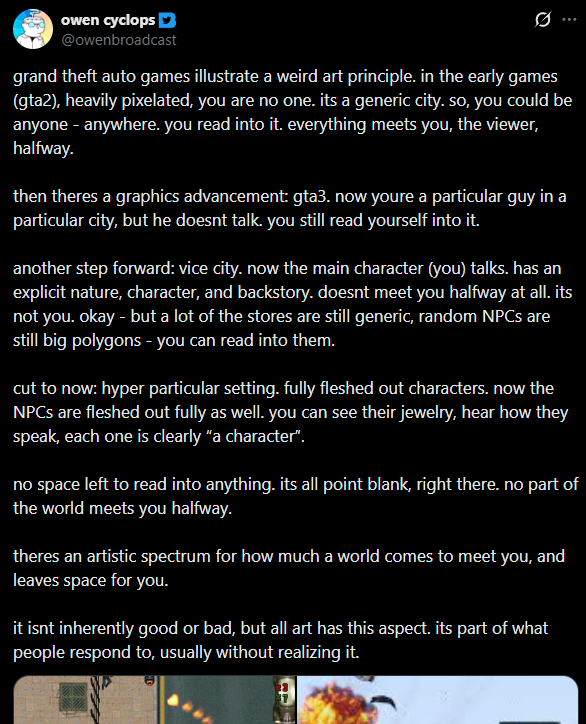
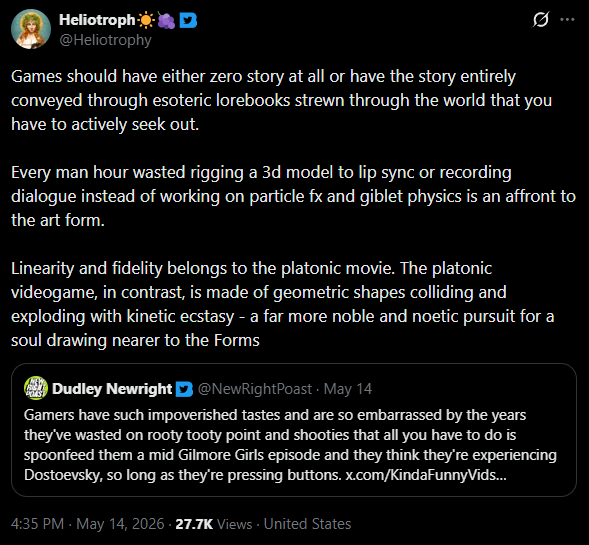
grand theft auto games illustrate a weird art principle. in the early games (gta2), heavily pixelated, you are no one. its a generic city. so, you could be anyone — anywhere. you read into it. everything meets you, the viewer, halfway.
then theres a graphics advancement: gta3. now youre a particular guy in a particular city, but he doesnt talk. you still read yourself into it.
another step forward: vice city. now the main character (you) talks. has an explicit nature, character, and backstory. doesnt meet you halfway at all. its not you. okay — but a lot of the stores are still generic, random NPCs are still big polygons — you can read into them.
cut to now: hyper particular setting. fully fleshed out characters. now the NPCs are fleshed out fully as well. you can see their jewelry, hear how they speak, each one is clearly "a character".
no space left to read into anything. its all point blank, right there. no part of the world meets you halfway.
theres an artistic spectrum for how much a world comes to meet you, and leaves space for you.
it isnt inherently good or bad, but all art has this aspect. its part of what people respond to, usually without realizing it.
— owen cyclops (@owenbroadcast)
Games should have either zero story at all or have the story entirely conveyed through esoteric lorebooks strewn through the world that you have to actively seek out.
Every man hour wasted rigging a 3d model to lip sync or recording dialogue instead of working on particle fx and giblet physics is an affront to the art form.
Linearity and fidelity belongs to the platonic movie. The platonic videogame, in contrast, is made of geometric shapes colliding and exploding with kinetic ecstasy — a far more noble and noetic pursuit for a soul drawing nearer to the Forms
Gamers have such impoverished tastes and are so embarrassed by the years they've wasted on rooty tooty point and shooties that all you have to do is spoonfeed them a mid Gilmore Girls episode and they think they're experiencing Dostoevsky, so long as they're pressing buttons.
— Dudley Newright (@NewRightPoast)
— Heliotrophy (@Heliotrophy)
Women dream of themselves being dreamt of
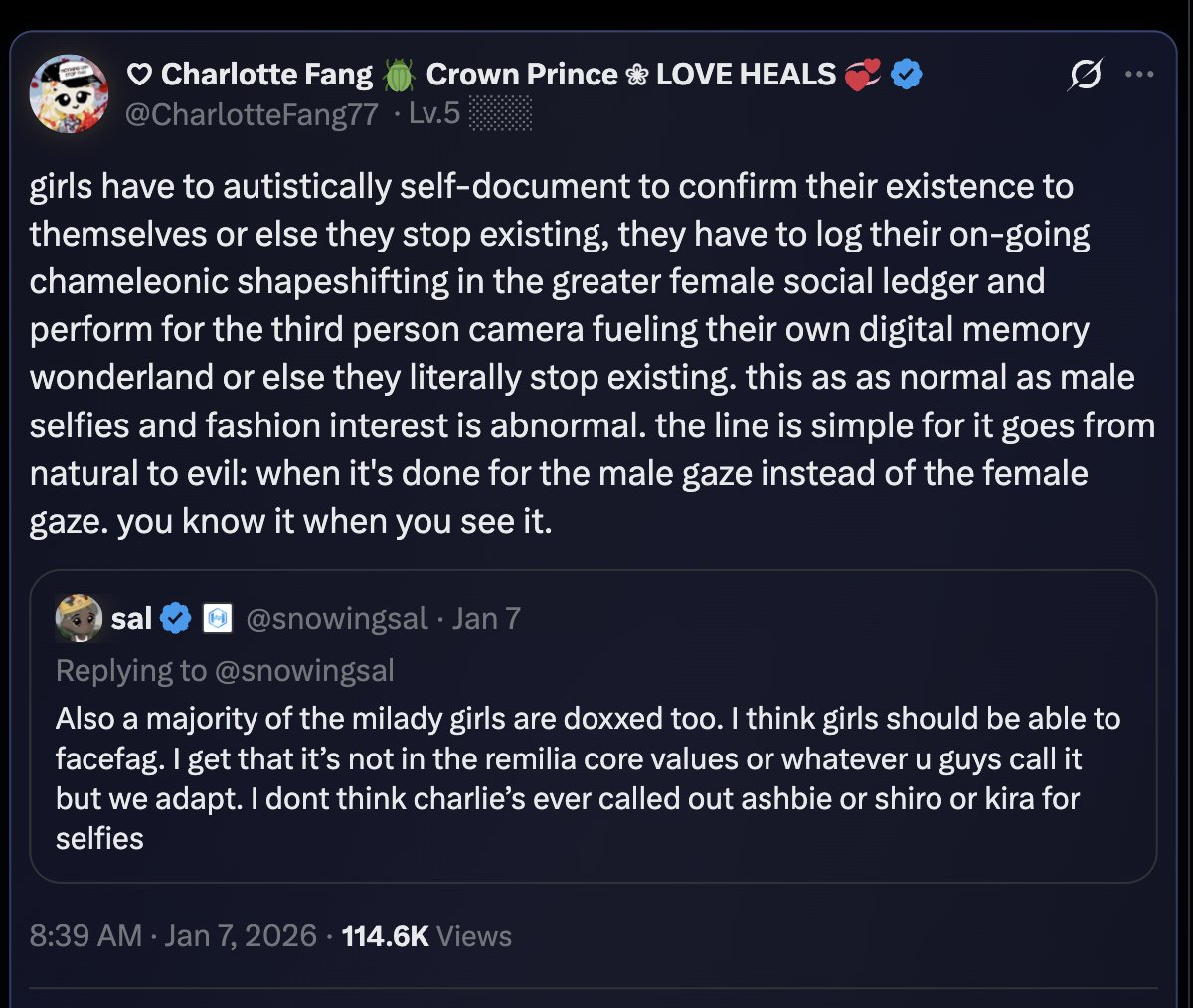
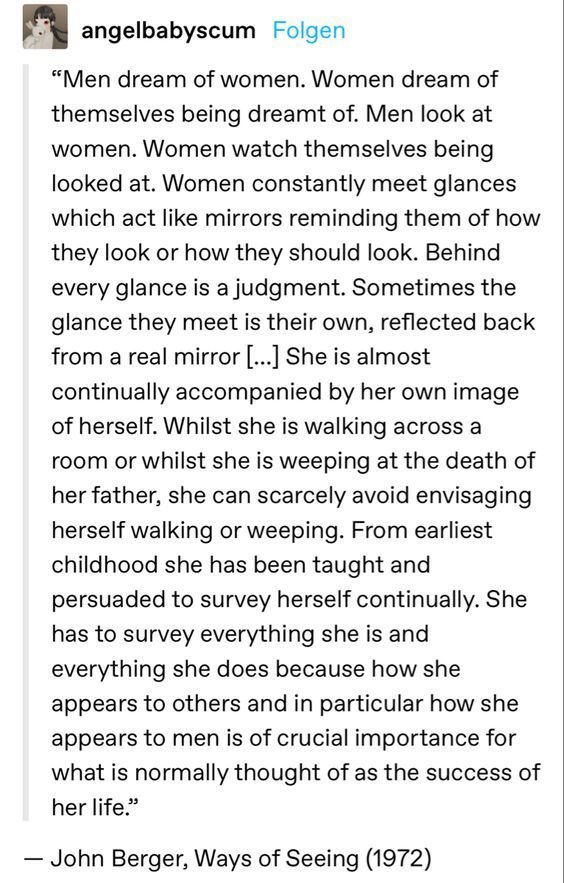
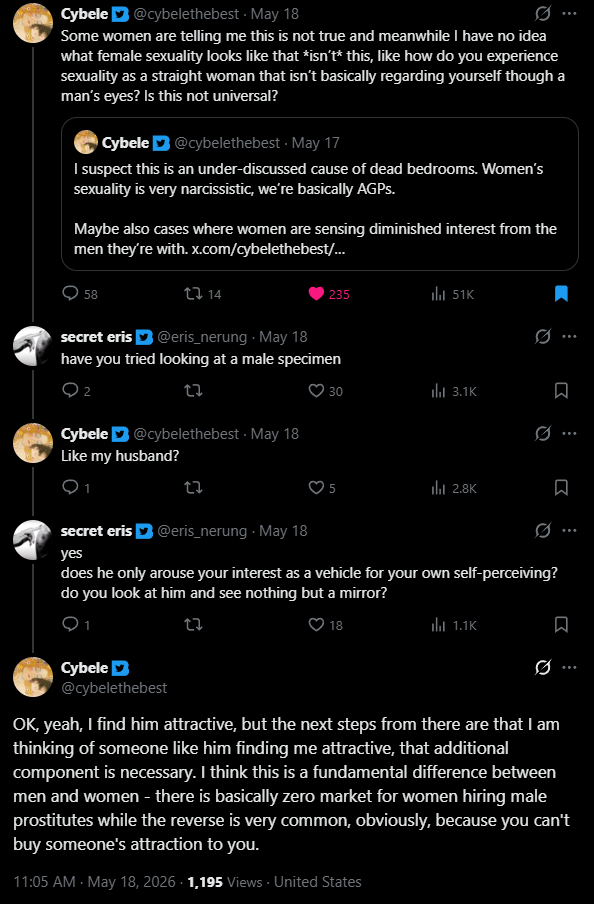
"I'm going to tell you something very intimate," she goes on. "The reason why I do this job ..." She trails off, starts again. "I never really wanted to become an actress, but I wanted to exist. The only way I found to exist was to have my image printed on a film and have the proof of my existence."
David, a lost soul searching for himself, could relate, perhaps even before he transforms: He makes his art, photographs of the world around him, as a way to communicate some essential truth. Seydoux, toggling between dreamlike drama and intimate character study, is doing the same.
"I was like, no one really cares about me." How heartbreaking, I reply. "Yeah, but it's true," Seydoux says with Parisian flatness. She doesn't want sympathy, but she needs to be understood. "In a way, acting — this is why it's so important, and fundamental for me. I have this need to be seen."
— Léa Seydoux, Variety
girls have to autistically self-document to confirm their existence to themselves or else they stop existing, they have to log their on-going chameleonic shapeshifting in the greater female social ledger and perform for the third person camera fueling their own digital memory wonderland or else they literally stop existing. this as as normal as male selfies and fashion interest is abnormal. the line is simple for it goes from natural to evil: when it's done for the male gaze instead of the female gaze. you know it when you see it.
Also a majority of the milady girls are doxxed too. I think girls should be able to facefag. I get that it's not in the remilia core values or whatever u guys call it but we adapt. I dont think charlie's ever called out ashbie or shiro or kira for selfies
— sal (@snowingsal)
— Charlotte Fang (@CharlotteFang77)
"Men dream of women. Women dream of themselves being dreamt of. Men look at women. Women watch themselves being looked at. Women constantly meet glances which act like mirrors reminding them of how they look or how they should look. Behind every glance is a judgment. Sometimes the glance they meet is their own, reflected back from a real mirror [...] She is almost continually accompanied by her own image of herself. Whilst she is walking across a room or whilst she is weeping at the death of her father, she can scarcely avoid envisaging herself walking or weeping. From earliest childhood she has been taught and persuaded to survey herself continually. She has to survey everything she is and everything she does because how she appears to others and in particular how she appears to men is of crucial importance for what is normally thought of as the success of her life."
— John Berger, Ways of Seeing (1972)
Cybele (@cybelethebest): Some women are telling me this is not true and meanwhile I have no idea what female sexuality looks like that isn't this, like how do you experience sexuality as a straight woman that isn't basically regarding yourself though a man's eyes? Is this not universal?
I suspect this is an under-discussed cause of dead bedrooms. Women's sexuality is very narcissistic, we're basically AGPs.
Maybe also cases where women are sensing diminished interest from the men they're with.
secret eris (@eris_nerung): have you tried looking at a male specimen
Cybele: Like my husband?
secret eris: yes — does he only arouse your interest as a vehicle for your own self-perceiving? do you look at him and see nothing but a mirror?
Cybele: OK, yeah, I find him attractive, but the next steps from there are that I am thinking of someone like him finding me attractive, that additional component is necessary. I think this is a fundamental difference between men and women — there is basically zero market for women hiring male prostitutes while the reverse is very common, obviously, because you can't buy someone's attraction to you.
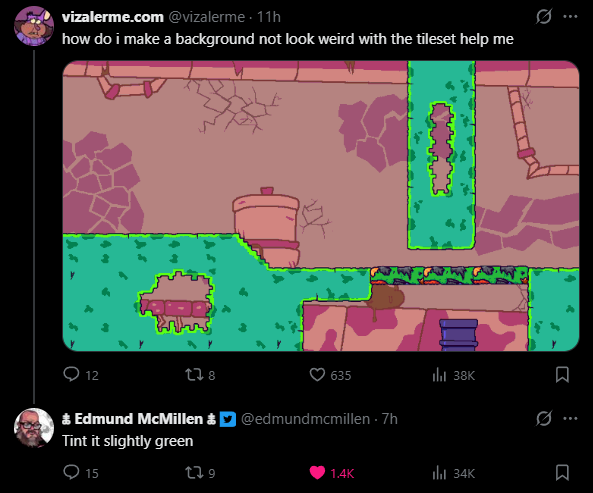
The poor twink that bought the tattoo top
Hooked up with this really cute twink at the start of the year, cute face (could be a model honestly), perfect body (I like them twinky but with some decent amount of fat all around, so not too chubby but not too skinny either), perfect skin, highly horny every time we met. The third time we met, he had gone to a party the previous night, and he told with eyes full of regret of the tattoo he had gotten on his right wrist. A terrible small drawing of two champagne glasses clinking, particle effects as dashed lines visible between them, liquid inside slightly wavy and angled to match each glass and simulate the physics of the action. "It's bad isn't it? I don't know what I was thinking. I got so drunk and my friend just convinced me to do it. They even recorded a video of it." He then shows me the video. His friend, a blonde girl, shows her own matching tattoo on her wrist. "She said having the same tattoo would be proof of our friendship. I don't know what I was thinking. My mom is going to kill me."
He is looking for reassurance, "it's not that bad," or something of the sort. Well, I don't like lying to people, but there's no need to be rude. "It doesn't look that good, yea, but you can always remove it, it's pretty small and it's on your wrist, so even if it leaves a mark it won't be visible." This is about as reassuring as I can be. If they were some small stars, like ✨, I wouldn't say it's good, but it's also not bad, definitely no need to remove it. But champagne glasses? It's just in such poor taste. "I don't know if I'll remove it... I don't want to disappoint my friend, but my mom..." and then we went back and forth on this for a while.
I made my opinion pretty clear: no one gets a tattoo in a good time in their lives, it's always when they're lost and aimless, which he was, as he was just partying and getting fucked in the ass by strangers (me); and pretty much everyone who gets a tattoo has an absent father, which... I'm not sure if he had actually. On our second meeting we went out to get something to eat and when it came time to pay he called his father to get him to send the money via PIX, and I'm like, dude, you don't need to do that I'll pay. He then tells me every time he wants to buy something he asks his dad like this because he has no self-control and can't manage money properly, and his dad always obliges. Is this an absent father? Maybe an enabling father, with the only real force in the house being his mom, which is why he focuses on her ire when she learns of the tattoo.
Well, anyway, I don't know what his mom did to him, he went back to his city and we never met again. In terms of location, the wrist is probably one of the least worst places to have a tattoo. I have a theory that the closer someone's tattoo is to their intimate parts, the bigger the red flag. This works especially well for women, as a "red flag" for men is basically, this guy gets fucked by 20 different tops a night and is host to 10 concurrently mutating diseases, those kinds of guys are extremely easy to notice and avoid.
But with women it's harder to tell, so you need markers, and tattoos closer to the pelvic area are one great heuristic. These heuristics are especially important for me because, well, I'm a mixed man in Brazil. In case you didn't know, if you're mixed or black in Brazil that's an instant dating debuff, most women want the standard white guy with the slick hair, not a brown guy with the shaved head who looks like he's from a favela. But there's a niche of girls who go for guys like me, and inside that niche some girls find me really attractive, which can attract some obsessive behaviors. So I have to defend myself by not sleeping around that much — which by itself is a good decision overall, since sleeping around, especially with women, deals some serious damage to the fabric of society — but also by filtering across various heuristics that seem to work well to avoid pulling some girl that will ruin my life (not again).
Anyway, the real tragedy is that the poor twink bought the tattoo top:
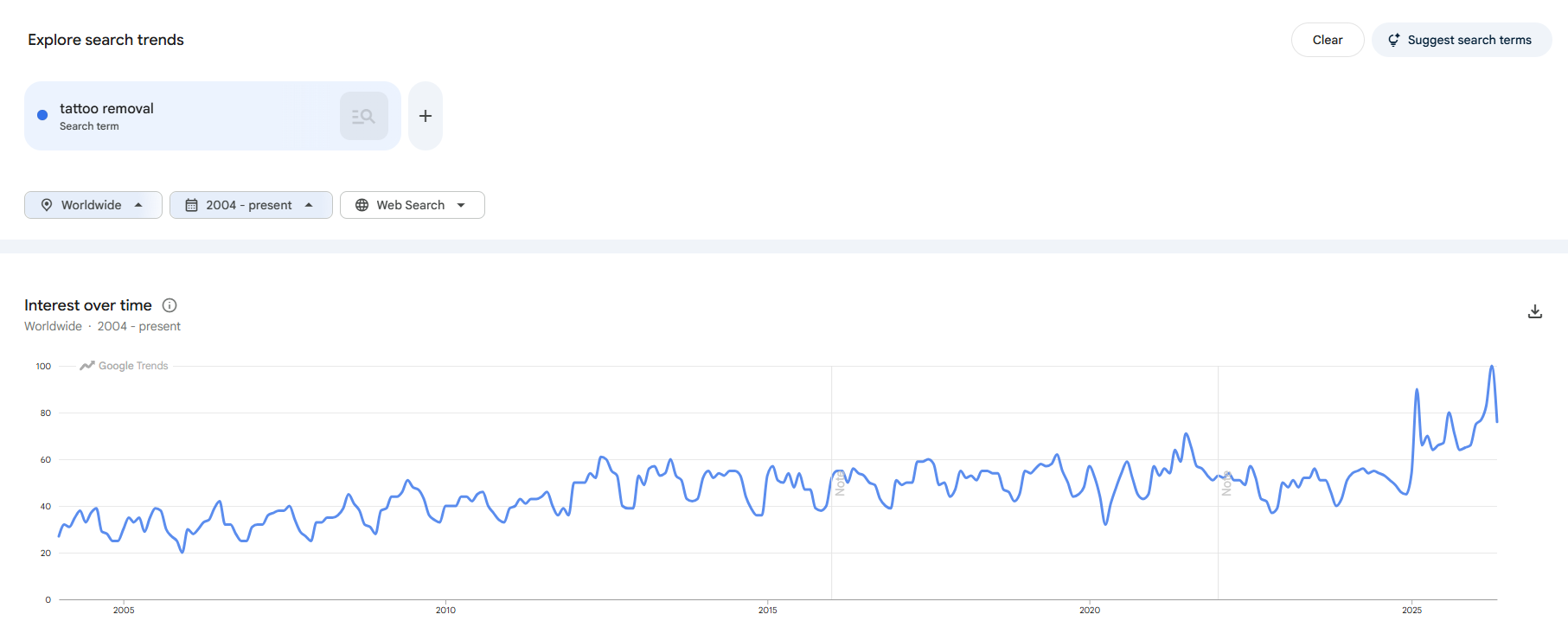
It's clear now that the tattoo bubble is popping and I think that's a good thing. In the same way some people think fat people are an eyesore and they should lose weight, I think most tattoos are an eyesore that shouldn't exist. Maybe in 1 in 20 people who have a tattoo actually have something that's tastefully done, the rest are all garbage, and usually the ones who do it right tend to be artists themselves, which makes sense, as they have an eye for proper aesthetics. Does this mean I hate everyone with a tattoo? That I wish they would all die? That I wouldn't date someone with one? No! I love all human beings, truly, it's just a very small opinion in the grand scheme of things.
But were I an enterprising man, if I didn't have to play safe with the money I do have, I'd look into getting in on this early stage of the tattoo removal bull market to come, it's clear as day it will keep growing as the years pass. Do you actually need new shops for this or can common tattoo shops provide both services? I think it's the former. Yea, I mean, it wouldn't even make sense. What kind of message would it send if you offered both tattoo application and tattoo removal services simultaneously? Well, such concerns don't concern me but an imaginary me who has more money to invest. I need to stop procrastinating and release more games.
Message to the Brazilian CDC
I am deeply sick with some kind of flu. In case I die of Hantavirus, please forward this message to the Brazilian CDC in my stead. I want to help them contact trace it to stop the spread. Given that the incubation period is 4-8 weeks, here's a list of everyone I've been in close contact with in the past 3 months:
- Juliana de Lima Timm
- Nicole Schneider Diehl
- About 50 guys from grindr, ~20 of which have since deleted their accounts
- 3 girls and 2 twinks from the gym (they know who they are)
- Everyone I pissed on during the Carnival
- About 15 twinks in various dark rooms across the city (I don't know their names)
- Lucas
I'm sorry for being the superspreader. I'm sorry for dooming the Brazilian nation to the Hantavirus ending. I'm sorry, I'm sorry, I'm sorry 😭 😭 😭
Gay men, sexual partners and HIV risk
the study that this figure came from actually surveyed gay men from the very bars and clubs that would become ground zero for AIDS just a few years later.
it found 43% of them had 500 or more sexual partners, and 28% had 1,000 or more.
the average normie was (and is) kept under the impression that HIV was easier to contract than it really was because in reality the amount of high-risk sex the average gay man had to engage in to have even a SLIGHT risk of getting HIV was mind-boggling and no one would have sympathized with them after finding out.
— pagliacci the hated (@Slatzvish)
I know a dude who contracted it from his second sexual partner in life (he was 25 at the time). The guy was basically a friend with benefits who, on the side, had a huge amount of casual sex. That's how he got infected and then passed it on to my acquaintance. So yeah, sometimes it really is just bad luck, cases like that do exist. But overall, the VAST majority of people infected are gay men who lead an extremely high-risk sexual lifestyle. We're talking about places like the Lab.oratory club in Berlin, where people go and have anal sex with 20 different men in a single night, not to mention practices like fisting and similar acts that would make an average straight people throw up. And if a Berlin gay guy (plus tons of tourists) visits a place like that once or twice a week… Do your math. All the gay saunas and bathhouses, gay hotels, discos, nudist beaches, festivals etc. everything revolves around having sex with a massive number of strangers. An ordinary promiscuous heterosexual can't even begin to imagine what promiscuity looks like in the gay community. The realities are simply incomparable. The gay community's greatest achievement is that they have been able to sell that extremely vanilla image of themselves.
— Borgia The Pope (@Borgialord)
If an HIV+ man penetrates an HIV- bottom who uses no protection, the chance of contracting the disease is still only 1/70. A bottom using no protection can easily have sex hundreds or thousands of times before his chance of contracting HIV is high. Makes you think
— Jude (@judejon_)
I will never call them bullet heaven games
I will never call them "bullet heaven" games. I will call them autoshooters, VS-likes, survivors-likes, but bullet heaven is by far the worst and most unappealing description.
Castrated, stabbed, vivisected, disemboweled, flayed alive
They're doing this to me tomorrow.
Gente, what a horrible person
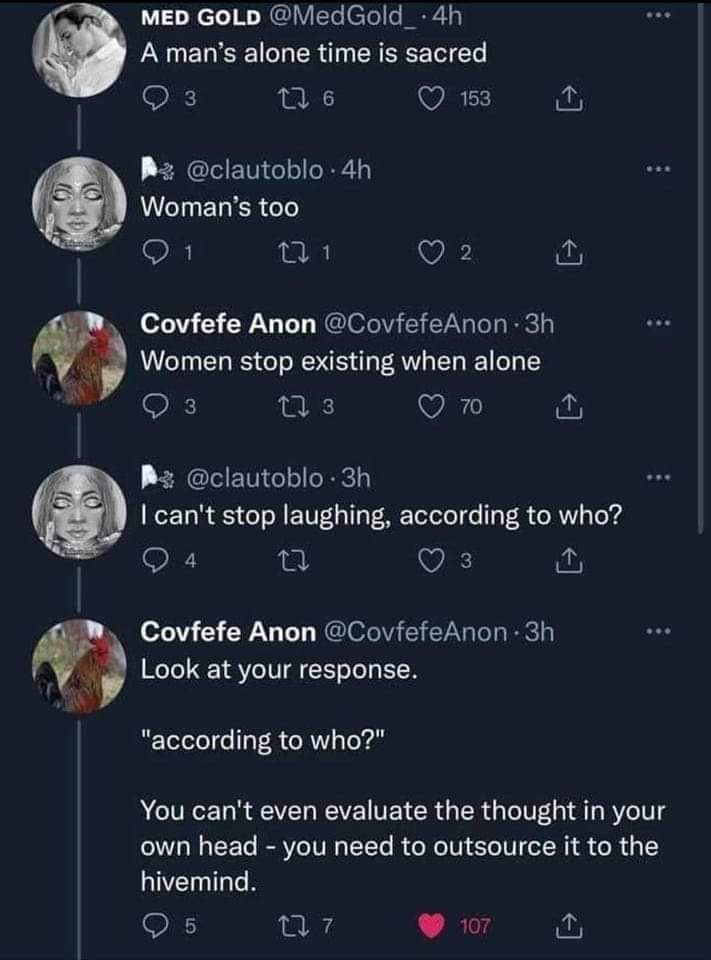
eu tinha uma amiga que literalmente todo namorado que ela teve foi alguém com quem ela traiu o anterior e foi uns cinco seguindo esse padrão namorava um traía com fulano (por meses) terminava e começava a namorar o fulano teve um de quem ela até ficou noiva mas traiu esse tbm. acho que até demorei pra cortar a amizade no primeiro eu já tinha ficado sem reação porque a gente se conheceu no ensino médio e ela acompanhou muito meu namoro onde fui traída os 6 anos do relacionamento e aí ela foi fazendo de novo e de novo e eu gente que pessoa horrível
I had this friend where literally every boyfriend she had was someone she cheated on the previous one with, and it was like five in a row following this pattern — she'd be dating someone, cheat with so-and-so (for months), break up, and start dating the so-and-so. There was one she even got engaged to but she cheated on him too. I think I even took too long to cut off the friendship — with the first one I was already speechless because we met in high school and she was very much around for my [own] relationship where I was cheated on, the 6 years of the relationship, and then she went and did it again and again and I'm like, guys, what a horrible person.
The paragraph is a message by a Brazilian woman talking about her cheating friend. Portuguese-speaking women often use "gente" liberally in sentences. There, "gente que pessoa horrível," the closest English translation being "guys, what a horrible person." But gente is doing something unique in Portuguese because it's reflexively invoking the hivemind, as CovfefeAnon put it, in a more natural way.
"gente" literally means "people," but it can also be used as "we." "A gente vai" = "we're going." But "a gente" as we is inclusive, it includes the speaker. So when "gente" is deployed vocatively like "guys," the speaker isn't fully separate like in English. This makes using gente more natural even in internal monologue, which is what Brazilian women (and gay bottom men) often do.
English has similar interjections, "honestly," "I mean," "y'all," "folks," and even something like "chat," which approaches it pretty closely. But none of them are both collective vocatives that are also natural in pure interior monologue. "Honestly, what a horrible person" is invoking an implicit witness, the speaker, which is why saying "honestly," like that in your head feels natural. "Guys, what a horrible person" is invoking the collective, but it's not including the speaker, which is why saying "guys," like that in your head feels unnatural. "Gente, what a horrible person" is invoking both the collective and the speaker, which is why saying that in your head feels natural.
"Chat" is actually the closest, and I can imagine someone saying "chat, what a horrible person" in their heads and it feels similar to gente. But it's not quite the same, because it still doesn't include the speaker, right? Chat remains the external collective, but it approaches it better than anything else. Popularity wise the jury is still out on it. Gente is completely widespread and diffused in Brazilian speech among its targets, chat is very much still tied to online niches I think, although people who live in America, especially among younger people, would be able to tell more clearly than me.
In any case, I don't think sociologically speaking the existence of gente means much, other than perhaps female-oriented brains that happen to speak Brazilian Portuguese can be more prone to reflexive hivemind invocations, but it is an interesting difference between the languages.
Both English and Portuguese are beautiful and flexible languages. Before releasing It Follows I was thinking of translating it to Portuguese. I ended up not doing it because I didn't want people who know me in real life but can't speak English to read my degenerate autofiction porn novel, but I was thinking about how I'd translate the 4chan-like terms the story has. So I ended up researching how the Brazilian incel community communicates to see if they have any particularly funny brazilianized terms. In the end, for the most part, they don't, they just use the English terms directly. Seemingly a lot of Brazilian internet is like this, this tweet being a good funny example of it:
I didn't know this because only recently X has been showing me Brazilian tweets after the auto-translate feature was shipped, and I don't really consume Brazilian internet elsewhere that much. But yea, I see so many funny terms now. Like the other day I read "escravoceta" (literally "pussy slave": escravo = slave, buceta = pussy) and just burst out laughing. I guess English has similar constructions with "ussy," like bussy, and, well, Portuguese also has "boyceta" which is similarly hilarious. Anyway, both languages are rich and interesting. There are many terms and especially expressions that can only exist in English, as Borges points out here:
But there are many that can only exist in Portuguese, the aforementioned "gente" being one of them.
Mark of the Fool and learning from failure
This message contains light spoilers for Mark of the Fool. Everything I'll talk about is revealed in the first half of the first book, but if you're like me and you like going into stories as blind as possible, don't read the message. Would I recommend the story? I'm finishing book 3 now and I'd have to say no. It's a good premise but it's very slow. The author has managed to string me along this far and from here I'll finish the series (it's 10 books) and that's always a real achievement and speaks well of the author's abilities. But I cannot in good conscience actually recommend it, it's very slow. I can empathize with how a story gets like this from the writer's side, and, well, he still has 7 books to win me over.
Click to unspoiler fully:
I've been reading Mark of the Fool and one thing I've been thinking about is MC's power and failure's overdetermination. Alex has the Mark of the Fool, a divine inscription that prevents him from being useful in combat but allows him to learn new things quickly. The way he learns is that whenever he has to do something, the mark flashes him memories of him doing that thing before, focusing on the times or portions of it that he did it correctly. So, if he wants to learn how to run properly, whenever he's running the mark will flash him memories of him running in the past, but only his correct moves, and in no time he will learn proper running posture. Same for writing, learning new languages, detecting people lying, etc. It's a very overpowered ability.
What got me thinking was this passage, in book 3, page 403:
"All the predictions in the world don't matter in battle," Tyris continued. "In the end, the only thing that matters for victory is victory itself. And the only ones people want to hear from afterward are the victors."
"I dunno about that, sometimes we learn more from failure than from victory."
Alex would say this because every time he fails at something, he gains more data the mark can use to make him fail less in the future, that's how he learns so fast. But he doesn't learn from failure necessarily, he learns from just doing and giving the mark anything to draw from. If he tries to learn an ability, say, lockpicking, but he has never done anything near lockpicking at all in his past, the mark doesn't activate, it has no memories to draw from.
I have said in the past that one can learn way more from success than from failure, and that, in fact, focusing on learning from failure instead of success is a losing strategy. From Son of a Serpent:
There's this trend among indiedevs who are more business savvy of looking at games that failed on Steam to try and gain knowledge from them. All such endeavors are pointless and, as Eric would say, are examples of people hexing themselves with negative thoughts.
Failure is overdetermined. Most things fail for multiple reasons. So when a game doesn't do well, you can't really learn anything about it because you will think it failed for reason 1, but it actually failed for reasons 1 through 5. And then another game you look at might fail for reasons 2, 3, etc. You never actually know. If you focus on looking at successes instead your ratio of looking at what works, what is actual signal, versus what is noise, is much higher, and over the long run that will lead you to better decisions.
Not only that, it's easy to look at a game that failed and go "yea it failed because of the graphics" or "it failed because they didn't do enough marketing", which is just... This is a noobtrap. If you find yourself doing this in your head to any game understand that it's a thought pattern that you must stop, it won't lead anywhere good.
Let's say that you extract 5 reasons for why a game failed/succeeded after looking at it, and you do this for every game you look at. You don't know if those reasons are valid because you can never run this experiment again while changing only 1 variable, so in a sense you're always blind.
In this state of blindness, your hit rate when picking those reasons from successful games will be higher, because due to failure's overdetermination those failed game reasons will more often than not be wrong or incomplete, whereas the reasons from successful games will more often be right, as success often only takes a few right things to get going despite the bad ones. (See Oskar's tweet above about how you only need one or two good things in a game and the rest needs to only be good enough)
Let's use Vampire Survivors as an example. If Vampire Survivors failed you could extract many reasons out of it on why it failed, looks like trash, repetitive gameplay, etc, etc. But it succeeded, and once something succeeds it's a signal from God/the universe that despite all the obvious bad things about it, there are some specific things about it that just work. And in this case those few specific things were copied by lots of people to varying levels of success, but it's to some extent clear what they are.
Now multiply this effect by lots of games over a long period of observation and you'll have a much more useful bundle of facts on what you should do that come from successful games, compared to if you only looked at unsuccessful games, where you'll be full of facts like "your game shouldn't look like trash"... well, obviously, but that's not very helpful.
If you're in a low/high risk environment and your goal is surviving, a map of which things to avoid is useful because it will keep you safe. But if you're in a high risk environment (gamedev) and your goal is thriving and flourishing, you don't want to only avoid damage and survive, you want to go hardcore and take risks because the upside is infinite, and in that case a map of avoidance - things you shouldn't do, taken from unsuccessful games - is less useful than a map of action - things you should do, taken from successful games.
I still believe every word I said here is true. In fact, after SNKRX succeeded, I thought the main reason was due to the Auto Chess formula, but it was only after Vampire Survivors released a while later that it became clear it was due to the auto-shooting instead. What this means is that even in success, it's hard for a project's own creator to understand why it succeeded! Imagine trying to get real insights from someone else's failures, it makes no sense at all.
However... Alex's mark is kind of like an LLM, or maybe like the Whispering Earring. Hm, kind of a mix of both in some sense. I do wonder if the author will go more in the earring direction as the story progresses, probably not, but it would be an interesting darker turn. Well, even if he doesn't, said darker turn is in a way already realized in Don't Make Me Think so it's fine.
In any case, one of the things LLMs are really good at is finding good solutions when you give them a problem with lots of constraints and they have a lot of data to go from. Like, they're extremely good at that specifically. Most people probably don't have such problems to solve, but if you ever do, it becomes kind of undeniable to grant that these tools are actually super intelligent. I think the fact that most people don't have such problems is primarily why so many of them seem to think AI is a bubble. Well, it may be, but it's like the realest bubble there ever was. But yea, this property of LLMs is kind of exactly how the mark works, and what does Alex conclude after living with the mark for a while? That you often (actually he said sometimes) learn more from failure than from victory.
While the success argument above is still true, LLMs existing makes the learning from failure path more viable. But it's important to remember, just like with Alex, it's not learning from failure itself, it's learning from doing! The more data and constraints the robot has, the better it will do. So actually what you want is not to fail, but to just do various things to give it more examples and more constraints, exactly how Alex does it. Once you have everything, it will find a fortuitous path, as that's what it was built to do.
Reviewing this argument with Claude, he had two additional interesting insights, or perhaps reframings of the same insight that seemed good to me:
The original "learn from success, not failure" advice is a heuristic compensating for a specific human limitation (we are bad pattern-extractors over noisy corpora) by selecting a corpus with higher signal density. Once you have a better extractor — Mark, LLM, or a sophisticated domain-specific pattern matcher built from years of experience — the success/failure axis becomes secondary to the doing/not-doing axis.
It also implicitly proposes a third position that's distinct from both "learn from success" and "learn from failure": learn from variety. Bias toward expanding the corpus, not toward replicating winners or avoiding losers. That's actually a different optimization target and I think it's the one your argument is reaching for.
"Learn from variety" is aligned with what I mentioned earlier regarding references being more important than taste. Because you want to give the LLM examples and constraints, it's best to give it as many references as possible. So "doing" can also actually be "knowing when/how to reference what has been done." While the mark only draws from Alex's memories, the LLM can draw from humanity's memories, guided by you, the human.
Moved website to my server entirely
Moved website to my server entirely. I've been meaning to do this for years and even after having the God tool available it took me 5 months to find the will to do it. Oh well, better late than never. My goal with this is simple but multi-faceted. I can do any feature I want on the website itself, but those will actually only come after I finish the Anchor app, which will have this website running on my engine instead of HTML/CSS. This will allow me to have full control over everything, which will in turn allow me to do the ideas I have for mixing games and stories.
I think it's a good time in general though to have your own tools and spaces and to not rely on anyone else. It kind of feels like the public internet is... different? I don't know how to describe it actually, but I feel less compelled to be active anywhere online where other people can interact with me. I just feel like airing my thoughts to no one in particular and have no one in particular reply.
Strategically speaking this also makes sense. Now that you can do anything with Claude, the only benefit most social media sites provide is the ability for people to discover you, but it's debasing to be jestermaxxing to thousands of people to whom you are just a part of their "feed." I am not food, I am a human being. And as a human being, the warmth of one soul is worth more than the eyes of ten thousand followers. It's better to have one person super interested in what you have to offer than many who are lukewarm about you. Ah, I'm in a romantic mood I guess...
Anyway, with that principle in mind, having a place that you control fully feels necessary. I have lots of ideas for how I'm going to maximally use and expand this place towards that goal, and it will all happen in time. Until then I just have to keep trying to make more game.
I got Hantavirus at the Japanese handjob parlor
I got Hantavirus at the Japanese handjob parlor.
I haven't had sex in over two months
I haven't had sex in over two months and I will continue this period of chastity and monkhood until the Hantavirus threat is over. However, I will not buy non-perishable foodstuffs to last me for eternity in case the world ends. Last time I was early to COVID and on top of getting doom-edged in 2 week increments during January and February, I ended up having to eat rice and lentils every day until the end of the year when it became clear it was a nothingburger.
Gordon Ramsay calls me a fucking donkey dream
Man, I just had the most upsetting dream I've had in a while. I was at this huge school. Like, huge. I think the architecture was inspired by that video of the huge Chinese school I saw on X the other day. This one:
It was a new place too. Usually in my dreams I'm in places I know I've been before but with modified layout/architecture, but this one I had never been to. I don't know if that means anything. Anyway, I'm in this place, and eventually I get to my class. It's this massive cooking class, like 1000 people, a big room full of cooking stations, imagine a stadium, but smaller because it's only for 1000 people, but there's ground level and lots of cooking stations there, but they extend upwards at an angle to the sides too, so there's a lot of people everywhere.
So I'm doing my tasks, I'm learning, I'm getting really invested. The teacher is Gordon Ramsay for obvious reasons. The fact that I'm getting invested is a direct mirror of real life, because in real life I am getting into cooking and learning how to make good-tasting and healthy food and enjoying it. So that's happening, but then comes an exam. Gordon explains the exam, then his helper hands everyone a tablet. The helper is wearing a suit, doesn't look fully human, like kind of a robot? I guess he most resembles Chat from Northernlion's Tomodachi Life playthrough.
I look at the questions, there are 20 of them, and they all look pretty easy, but their order is bugging out on my tablet. Like question 13 is appearing first, some questions appear in some places and then move elsewhere, and so on. This is a mirror of real life too, as one of the issues with my blot website was the posts were showing up missing or in the wrong order all the time, and I had to fix several bugs related to this when we were moving the website to my own server. Anyway, I ask Gordon about this issue and he answers but I don't remember his reply. It doesn't matter, though, because I just move on and do the exam, answering all questions correctly, except for question 19, which I wasn't sure about, so I don't answer it.
After I'm done I continue with my other tasks. I'm so invested in the tasks that even as Gordon hands me back my graded exam I'm barely paying attention. After a few minutes I look at it to see my score, which I expect to be 20/20, but thinking back it can't be that because I didn't answer one question, so I should expect it to be 19/20. But then I look and it's... 1/20? What the hell? I look at it and the first question that appears is question 19, the one I didn't answer. But then the other questions didn't even load, so they weren't graded. I can literally see the loading circle, the next questions trying to load but they can't. So this is clearly a bug. But Gordon is speaking, he's saying how the exam had one question that was a trap to weed out the cheaters, and if you didn't answer that question, it's clear you were a cheater. I'm guessing that was question 19.
I try showing Chat the issue with my tablet, Chat is understanding but doesn't seem like he'll help me, so I call over Gordon, who barely looks at it and is immediately dismissive. I try to explain that during the exam my questions were ordered incorrectly so maybe that's why the grading bugged out too. He's having none of it. I'm insistent, but I can see what comes next. You know that face Gordon makes when he knows he's right but he's also perplexed that someone is fighting back and disagreeing with him? Like a surprised-mocking-superiority face, that's his fucking face right now. And then he goes off on me. I don't remember what he says exactly, probably many sentences involving me being an idiot sandwich or a fucking donkey, but at the end of it he says, "Weren't you making tons of excuses right as the exam started too? You're a fucking loser, just give up."
And this really made me mad. Like, this spiked my cortisol to tremendous levels. He was just fucking lying. I wasn't making excuses, I asked him a single question about the exact bug we were talking about! I actually got so fucking mad here that I paused the dream. I can do that, I can pause my dreams. I think at some point when I was younger I often had a particularly bad nightmare and to stop the bad thing from happening I'd pause it, and my brain learned you can just do that. Doing this doesn't make me aware that I'm dreaming. So I'm there, dream paused, fuming, looking at Gordon's fucking mocking face as he's just straight up lying about me. I am so fucking mad, this is so fucking stupid, and then I wake up.
Now, what could this dream mean? Well, it's not quite the classic "there's an exam and I didn't study for it" school dream, but it's close. It is interesting though that it takes the form of injustice, right? The feeling I woke up with is the same feeling I felt when I got banned for an entire summer when I was 13 from my usual CS 1.6 server due to "hacking" even though I was quite clearly not hacking at all and the admin was just mad I killed him too often. But I don't feel this feeling anymore. Like, ever. If something unjust happens to me now, my framing is pretty much always one of "I know I didn't do anything wrong, this has nothing to do with me spiritually, it's entirely about the other person's relationship with power and their learning to use it." This kind of situation has particularly never happened to me in a school setting. There wasn't a single instance of me thinking a teacher judged my work incorrectly or anything like that.
There are the real life related events, getting invested in cooking, the ordering bug from my website, but I'm not sure if those mean anything either. There's the architecture. It was definitely a new place I've never been to before. Most places in dreams, even though I've never been to them in real life, I can just tell I've been to before dozens of times, probably in previous forgotten dreams. This one was fully new. It was very white, like the Chinese school video, bright white lights everywhere, floor and walls pure white too. But I'm not sure what it could mean that it's new. There's the fact that I didn't answer question 19. When I had a question I wasn't sure about in exams, I'm pretty sure I tried answering them anyway, why would I just refuse to answer this one? Or did I fail to answer it, or answered it incorrectly? I actually don't remember now. It's possible I tried to answer it but I knew it was incorrect?
Could a situation like this happen to me in real life right now? I am very invested in my art, currently the games and books I want to make. Let's say I release a new game and someone I look up to reviews it very poorly. Uh... no, that wouldn't work, I don't really look up to anyone. There's no one whose presence makes me invested enough that anything bad they could say would feel, viscerally, like some kind of judgement. The school setting is unique here because you buy into it, you buy into the fact that there's a mentor, and you allow him to judge you. Real life is not like this, at least not related to my work. There's no one judging me, because I don't believe that anyone knows any better than me.
Ah, but this is only true for making games, actually. I'm learning how to write, how to make music, how to cook, I'm going to the gym more often... I'm learning a bunch of new things and in those settings it does make sense that I'd be worried about being judged. I'm not worried about being judged by others entirely, but mostly myself, I think. The thing I try to avoid the most when doing anything is not trying my hardest. For everything I've released so far, the one guiding line is: "did I actually try my best?" I don't want to look back on something and feel like I could have tried harder. If I release a game or a book or anything, it means that was the best I could do at the time.
And so maybe dismissive and unjust Gordon is actually the broken facet of myself that would betray this principle. To answer "did I actually try my best?" I need a trustworthy verifier. But the dream was about the verifier malfunctioning. The horror, what spiked my cortisol, was the lying, the clear unashamed lying, evidence that the teacher didn't even see my effort and thus didn't grade it properly, right? True horror is the verifier being wrong, the compass going astray, intuition failing to answer "did I actually try my best?" accurately. Yes, this makes sense. It also makes question 19 make sense, the trap question, which I don't even remember if I refused to answer or answered poorly, it represents uncertainty on whether I tried my best or not, because trying your best would for sure mean actually trying to answer it.
Hmm, yes, I like this analysis. It also makes sense why it would happen now, maybe I'm spreading myself too thin.
Moving the site off blot.im with AI
Moving this website off blot.im into my own server (now working temporarily at https://new.a327ex.com) and it's been a good task. It's clear to me now that I'm not enjoying the benefits of AI fully because this kind of task is what the robot was actually built to do. It feels so good to tell it to do something and it just does it over 1 hour and you come back to it and it's like 99% right, God, it truly does feel like cumming. Tasks that the robot can verify itself are the goal, honestly kind of annoyed that what I like doing isn't verifiable like this. Maybe I should explore how to make the things I make more verifiable, try sessions where I only do huge hyper-specific prompts... But it's hard because for something artistic/visual it kind of requires you to test often or for you to be very clear, and for you to be clear you really need supernatural giga foresight of hell vision. Maybe I can develop that vision better by trying the long hyper-specific prompts more often. Yes, that's probably what I should do.
The algorithm as a creative's best friend
For a creative, the algorithm is the greatest modern friend. I have for years been introduced to interesting ideas due to YouTube suggesting a video essay on a topic related to my current obsessions. The X algorithm is now quite good too at paying attention to what I like, and it can be shaped pretty easily by clicking the like button with some discipline. I do not use TikTok or YT shorts that much, but there they also work reasonably well. Given that what matters most is a collection of relevant references, the way to get such collections for as many relevant topics as possible is having a well-tuned algorithm that's constantly showing you interesting things. I'm currently interested in music theory, so YouTube regularly surfaces videos such as the one below to me, and that's a good thing.
The average person may be one-shot by the algorithm, but the creative must be supercharged by it!
How not to handle player feedback
How Not to Handle Player Feedback
Meaning and commitment 2
It is perhaps worth it to expand on "meaning and commitment." Commitment refers to the ability to follow through. It's the ability to rawdog a movie, to say you're going to meet with someone at place X and time Y and do it, to set a goal for yourself and work towards it, essentially to do in a functional and reliable way, to not be a flaky human being, both to yourself and to others.
Games can make someone commit. Usually they do it because they're fun in one way or another, but also because they require activation energy. If you're scrolling, you're rarely ever doing it due to saying "I'll scroll for 1 hour," right? It's just a passive activity that happens because it requires no activation cost whatsoever, it's the easiest thing to do and it has been optimized into keeping you trapped. If a game has become such a passive activity for you, which happens after you've been playing the same game for hundreds of hours, then it fills this same spot. But for the games an indie developer makes, this is hardly ever the case, therefore our games require initial commitment. A player has to actively choose to buy it and then learn to play it and enjoy it before that activation energy is not required anymore.
And then there's long term commitment. Here there are arguments you could make on which forms of it are more or less moral. I will not get into this argument. I like to imagine game development in relation to its most supreme future, the Shaper role. In the future, one can easily imagine shapers in the higher echelons of power, individuals who are tasked with shaping the behavior of the masses so that they are guided towards better and less self-destructive behaviors. Such individuals will likely use many of the techniques being developed primarily in games now to achieve their aims, as those techniques carry across domains. And so, just like games helped, in an indirect way, the birth of AI, they might help, in yet another indirect way, the shaping of our future glorious society that is yet to come. I shall pass no judgement on such techniques as they stand.
Suffice to say, most games get the commitment portion of the equation right. There's higher selection pressure compared to short-form content and thus the games that do manage to steal people away by definition are doing a better job there.
Now for meaning. There's passive and active meaning. The former refers to the same meaning you can get from movies or books. The idea I'm now driven by, of mixing stories and games in novel ways aims at increasing passive meaning, as most of the solutions game developers have tried do not do a good job at it. There are kinds of passive meanings that games are good at that generally have to do with aesthetics, mood, tone, atmosphere, etc., if only due to an oversupply of visual artists in the industry. But largely I think passive meaning tends to be lacking.
Active meaning refers to the actions you take when playing the game. This is "play." It is what makes games distinct from other media and what they're most adept at. When I say that incrementals do not get meaning right, I mean both in the passive and active sense. In the passive sense it's obvious, but in the active one it may be less clear. Consider, what are you actually doing when playing a skill tree incremental? You're doing the main action, which is generally clicking for some resource, but it doesn't matter, because you know that you'll just improve your resource gathering speed soon enough. In the skill tree itself, it also hardly matters what you choose, because these games are balanced such that you reach natural cutoff points that constrain your options (it's how the developers ensure the experience is "good"). So in the end, in an incremental, active meaning is low because your actions don't matter.
Compare this to a battle royale. In such a game you're completely on your own and you have to survive. You have to know when to be assertive, when not to, when to follow a plan, when to break it, when to not have a plan at all, you have to know the layout, where to approach from, when to approach, when not to, and then all the mechanical skills to actually fight, and all this against other human beings who are as smart or skilled as you. This type of game is filled with meaningful actions. You are learning to become a better human being by playing such a game because it is asking you to act correctly in a self-directed manner.
Most multiplayer games are also filled with meaningful actions, as acting in a team is also pro-social skill development. Although, for multiplayer games, it is usually better for this play to be with friends/known people rather than strangers. This is where co-op games are better (i.e. playing Risk of Rain with friends) and where the matchmaking function that most of these games provide actively makes them less meaningful. You're engaging in more meaningful actions by having to actively join a server hosted by someone, and then joining that same server over and over and playing with a known community, than you are by playing with randoms all the time.
In any case, you can easily judge games based on the level of meaning in their actions. A game like SNKRX for instance, the earliest criticism I got of it before it was released was "where's the gameplay?" It's a valid criticism, the game almost plays itself. What this criticism was getting at was exactly this, where are the meaningful actions? And in those early versions they were indeed not all there. But later they came, as the ability to pick different units and have different builds came online more strongly. So even in a game like SNKRX, you're still making plenty of choices and having to learn the specifics of the system to make the right choices.
You can run this analysis pretty easily for any kind of game. Do you have meaningful actions in the VS-likes? Well, yea, but... It's definitely a lower level of it, and now the choose 1 out of 3 framing has been played and hollowed out completely so it's a lot less meaningful, right? What about the more traditional roguelites, Isaac and so on? Yea, there's a lot there, Isaac has a lot of resource trades on top of the extreme build diversity, even if the combat itself is kind of simple and mindless. What about games like Path of Exile? Lots of meaningful actions there at least regarding your builds, and for the players looking for more challenging action there's also more to learn regarding enemy patterns and so on, especially in Path of Exile 2 (apparently, I have not played it yet). I could go on, right, RTSs are pretty meaningful, the map games too, puzzle games, etc. Lots of genres get this right, some do not. So the natural criticism of i.e. VS-likes and incrementals that seems intuitive to many indie developers is actually that they fall really low on this meaningful action spectrum, I think.
So, that's what I meant by meaning and commitment earlier. Short-form content is very low meaning and very low commitment because your action is just scrolling, and the actual content you're consuming is hardly ever particularly good... Well, actually, it's often good in many ways, but it gets repetitive/ouroboros-like quite quickly due to how autistically the algo hyperfixates on it, so it reaches a point of negative value rapidly. But yea, it's just very low, and so the strategy should be to move away from that rather than towards it. This move away has to be an active choice because by default the Steam algorithm will serve what customers want, and what customers want will approach short-form content left unchecked, as the rise of VS-likes and incrementals shows.
Taste and vision in the age of AI
Many have concluded that, due to AI's rise, what matters most now is taste. I agree that it matters, but what seems to matter most is having good references and being able to call on them at appropriate moments. The AI can do lots of things, but it has to be guided well, and the more it has to go from that is coherent with the current task, the better a job it will do. A collection (either physical, on the computer, or in your mind) of relevant references beats taste. You could say that only those with good taste will be able to have good collections, but I kind of disagree because the AI actually has pretty good taste a lot of the time, so it can cover where the user doesn't. Perhaps the collection is a function of a yet more general property, "vision." Having a clear vision of the project and what is to be achieved is what matters most... yes, maybe. This poses a problem, however, given that much of creative work is discovered as the artifact is built, so while the vision has to be clear, it also has to be flexible, unless you're so sure of what is to be built that it doesn't change much as it is built. Well, either way, I don't think taste is what matters most.
LTN sub5 mosquito
This beta mosquito has been flying around me for over an hour and hasn't bitten me yet. What the hell is his fucking problem? Just bite me already you loser piece of shit so I can explode you with my muscle bloodbending.
Power reveals who you are
This guy is right that people don't dance because life has become a panopticon but he's wrong to blame technology. This is like the claim that "power corrupts" — it's false, it's blaming the wrong thing. Power reveals who you are, and technology is a form of power. Being powerful doesn't make you wicked, being powerful gives you the leverage to act on the wickedness (or goodness) that you already have in your heart.
The average human being is, in fact, wicked, deep in their heart, but the takeaway isn't that power shouldn't exist, it's that those who are good have a moral obligation to disempower those who are wicked.
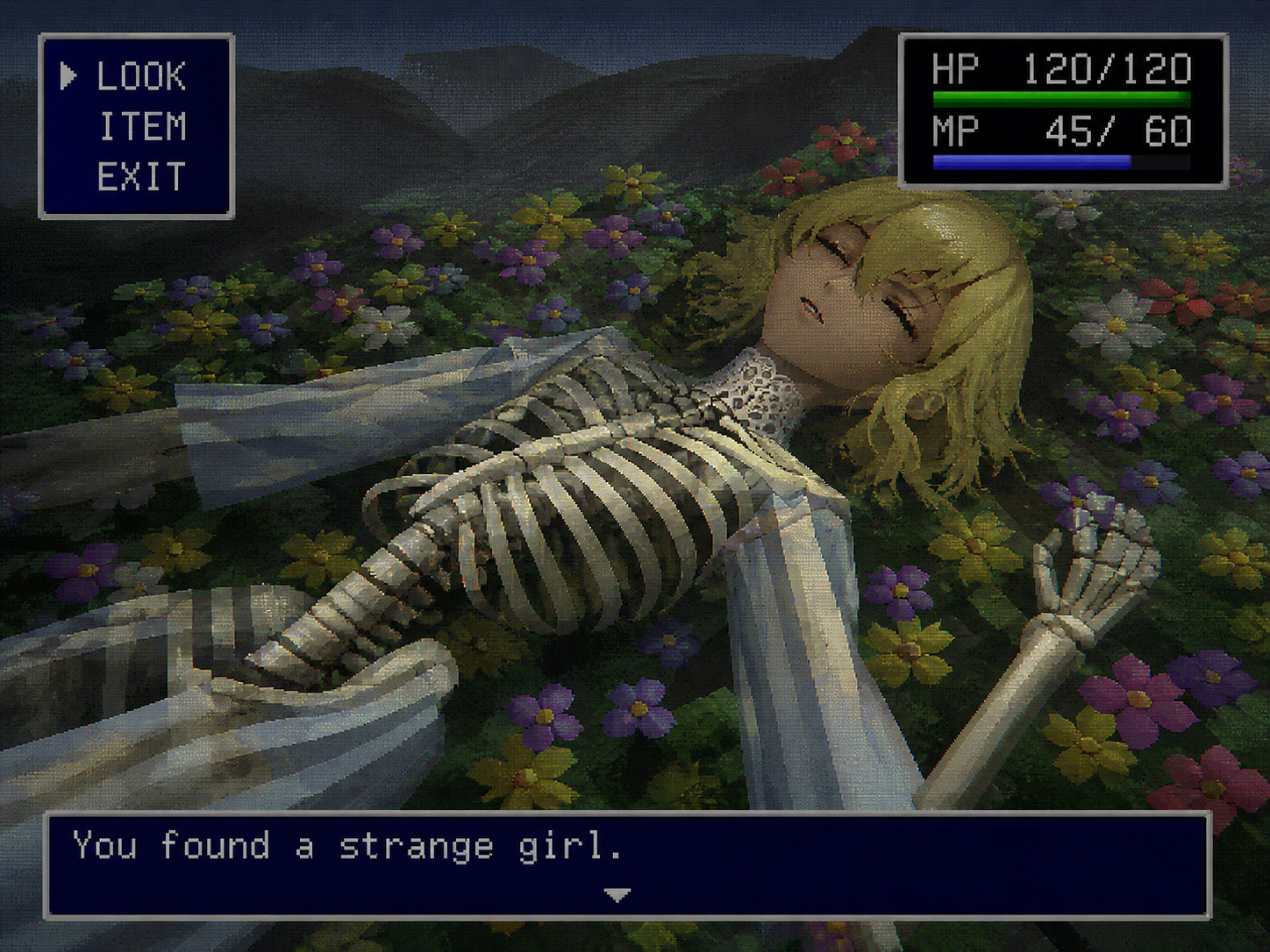
Dario vs. Sam
I have correctly been called by thousands a prophet, a seer, a sage, for predicting the downfall of FTX based solely on my ability to have a refined distaste for rationalists. Some have directed similar criticism at Dario Amodei, the CEO of Anthropic, and his crew of true believers building Claude. Knowing this, I have to say that my intuition on Dario does not trigger any negative emotions. I do not feel compelled, even slightly, to stop using Claude, because I am worried about Dario's future actions. But I do feel this compulsion into avoiding ChatGPT, because I do get the same SBF feeling from Sam. It is interesting, though, because Sam is just transparently sociopathic. This would be reason to lower my guard. If he's openly sociopathic, surely he can't be that bad, right? But it does not lower. I think ultimately my intuition looks at people's actions first. Dario has not done anything I deem bad other than grant me a high-quality product, so I see no issue. For my purposes these models are very similar, so it doesn't matter in the end which one I use. But currently I do primarily use Claude and avoid Chat. Unless Anthropic prices me out I don't think this will change.
Psyllium husk's popularity
It's crazy how popular Psyllium husk is with normal people now, my usual supermarket is out constantly. I think this is actually a move by Big Gay Bottoms. First they export Grindr mechanics to Tinder and expose women forever, then they export healthier poops and more anal sex. In 5 years the intrasexual competition endgame will manifest itself as diapers for 30 year old women are sold out all the time, everywhere.
Meaning and commitment 1
I would describe most games that grab my interest online currently as "free dopamine generators." They're games that are clearly meant to grow into lots of things happening on the screen at once in a juicy and fun way. Some common features: juicy UI that bounces way too much, themeless/abstract setting OR straight up casino themed, choose 1 out of 3, aforementioned dopamine-filled screen. There's nothing wrong with this kind of game, many of them are very fun, but it's a clear pattern.
While I haven't followed the rise of the skill tree incremental genre as closely as I did for VS-likes, the first one I played was Nodebuster right when it came out, and it was pretty fun. Many more have come out since then and some of them have made some nice additions to the idea, but it largely remains the same. This type of game is a good example of what I'm talking about.
While I could argue that competition isn't real among indie developers, we're all actually competing against short-form content. The calculation any potential game player runs is: do I want to buy and learn to play this game, or do I want to open TikTok/YT shorts and scroll? It's easy to see how the latter wins most of the time. It's also easy to see why, then, games with low initial cognitive demand will do better in the market. The incremental games fit this nicely, on top of having clear and well-defined progression and ending.
However, it's worth it to consider the meta here. If the competition is against short-form content, you can compete on the enemy's terms and try to out brainrot them, or you can go a different direction and offer things people can't get from that kind of content. This ends up being, in the most general sense: meaning and commitment. Incrementals get the commitment portion of it somewhat due to progressing and ending properly, but do not nail the meaning. So I would say that possible differentiation strategies will take what incrementals do well, but build on top of what they're missing.
There are many possible ways to approach this. Stuffed Wombat in Systems and Content delineates between both, saying that "Systems repeat. Content disappears." It's possible we may simply want to focus more on content than systems and that might work. My intuition, as a contrarian, was actually to just go the entire opposite way of what the incrementals settled on: no more themeless/abstract settings, only games with deep lore you can get autistic about; no more juicy UI that bounces like a clown, only diegetic insane UIs like in them old games, if the UI can be easily coded with a standard UI kit, it's over; no more choose 1 out of 3, only deep skill trees, insane complex ability systems, 10000 viable (actually viable) builds.
The correct line probably depends on the project. We may have games that are short, low initial cognitive demand, hand-crafted, narrative linear games that are meaningful and good and end, just like we may have games that are long, high initial cognitive demand, system-based build machines that never end. We may have games that are anything in between. But I do think the most important thing is to actually cover what short-form can't cover, which are meaning and commitment.
I am not saying this is what will be successful in the future or anything like that, I have no way of knowing. And I am biased. The idea that drives me now involves writing various books and telling deep lore stories on top of making games that take place in those worlds, aiming at producing high meaning values, so of course I would think that what I'm doing is what's actually good and framing it against what the average indie developer is doing, after all, I am so superior to them! Well, bias or not, this is what I think currently.
I don't think all my games will aim for this, the dopamine games can actually be really fun, and I'm not above making one of them if I happen to hit an interesting design, but this spectrum is something I've been thinking about often recently.
I am so incredibly horny all the time
I am so incredibly horny all the time.
170011
My mother was complaining about how a documentary my father is watching is boring and he just went "well im SORRY that nobody's been RAPED and KILLED for your liking"
We live in such a ruthless, uncritical gynocracy that even the realization that the human race is going to go extinct because women hate men that have been artificially marginalized can't summon any other response than "we clearly haven't crushed men enough". I have no idea what the solution to a slavery this deep, this reflexive, is. This era deserves to be crushed beneath the boot of history and relegated to instructive, near-absurdist tales of just how dark life can become if women are given even an inch. Women are the enemies of mankind. To a woman, such things as "culture", "civilization", "other people", are mere artifacts of their self-interest. Appendages, at best.
My father was a factory worker for 38 years. The routine was invariable: he left at 5AM, came back at 9PM. He'd eat, shower, and collapse into bed. For decades, my only thought was: "I never want to become that man." To me, he was the archetype of boredom. No dreams, no hobbies, no conversation. An adult without spark.
Only now, at 40, looking at my own son's face, has the penny finally dropped. My father didn't lack dreams. We were his dream. Those freezing dawns were so I could have a new backpack at school. The exhausting overtime hours were the price of my college tuition. He wasn't silent by choice; there simply wasn't a single atom of energy left to form a word.
Father, forgive me. I judged you as "outdated", but you were the definition of honor. Today, I finally understand that that exhaustion was the greatest proof of love anyone can give. I am finally following in your footsteps.
I refuse to conform to the utterly degrading conventions, ideas and manners expected of people today. A decaying world will have no sway over my soul.
God sends small children into the world to expose men. You think you are holy until a three year old throws a bowl of cereal at the wall for the third time. You think you are patient until you have not slept for five nights straight, and the baby is still screaming. Every half man is found out by his own offspring. Children are judges, sent in miniature to read your verdict out loud. God could have judged us from the throne. Instead, he sent us toddlers. More effective.
Focus your time and energy on what you want to see more of.
Stop getting so emotionally attached and enjoy experiences with a person. Be friends. Be a moment in time. Be a memory. You don't have to fall madly in love with everyone who comes your way. Just enjoy their presence for your moment together.
This is one of the worst advice ever. Be emotionally attached and passionate in love and go all the way. Let love consume you fully, even if it ruins you. Think all the strange, impossible scenario you want, but be passionate when you do it. If you fall in love, go all the way. Do not half-ass something sacred because you are afraid of suffering. Stop calculating outcomes. Do what you want with ferocity, with all your heart, and pour your love into it without self-protection. Do not keep trying to save yourself from the very thing meant to undo and enlarge you. Love was never supposed to be approached with caution. It asks for abandon.
My body viscerally, with physical symptoms, rejected the concept of having a job or going to school. Every night that I had to set an alarm to get up "on time" my body would force me to stay awake out of adrenaline and anticipation, only when I could sleep knowing I would not be awoken did my subconscious grant me peace.
I am fundamentally, to my core, magnetically opposed to slavery. I get literal physical NEET withdrawal symptoms from forcing myself to conform to normie goycattle life. I had no choice but to find a way to make money clicking on the computer because I physically could not survive otherwise.
I have no idea how you wagies do it every day, something in your soul was either not there or was crushed by your masters. How broken of a spirit can you possibly have to wake up to that shit everyday beats me.
I'm going to bed, I'm not setting an alarm, I'm not going to work tomorrow, I haven't aged in years. Goodnight.
I got invited to play a game and after 10 minutes they said their other friend wants to join but we're full and they asked me to leave.
Aren't most people wonderful and innately good? It truly is a blessing to live on this earth. "I love being alive," I unironically say this to myself every day multiple times now, it has become kind of a meme, or a tic. It just happens when anything mildly good occurs, like when it's cold and I get into the hot shower, or when I start peeing after holding it in for over an hour. "I love being alive," as I press the red button and see that 58% of people pressed blue. Most people are wonderful and innately good, yes.
I've indulged in as many vices as I can, yet I can never get a hang of it. Clubbing is stupid. Smoking is embarrassing. Doing drugs is pitiful. Womanizing is draining and pointless. I'd rather be buried in piles of work.
Socializing would be so much easier if there was an affection meter on top of everyone's heads.
If you're half-in, you're actually all-out. Even 90% in gets you nowhere. There's something magical in that last little bit. It's where you unlock new levels to the game. Once you finally reach some faggots' second hole he'll be your bitch forever.
A man who has never tasted the edge of his own ending will never have anything useful to say about living. Fear the man who speaks softly about good things, because he learned it kneeling next to something terrible until he understood its name. You cannot be wise from safety. The only people worth listening to are people who walked into the black and walked back out, with eyes that see differently now. Everyone else is just repeating things they read.
It's possible that irony is the same sort of mechanism as the array of infinite choices that are presented in the post-industrial economy. Keeping oneself in a perpetual state of irony or sarcasm allows a person to distance themselves from even their own words and behaviors, keeping them free to recant at any time, or to deny that they ever meant anything at all. Just as dating apps and Instagram keep one from being locked into a certain partner, just as constant consumerist slop keeps one focused on upgrading, so irony preserves the distance from conviction that allows a man to be hyper-mobile in his opinions and actions.
We are no longer called to choose something and defend it, steward it. The problem with conviction and passion is that they lock you into a behavior, into an outlook, into being a certain type of person. Abandoning the mobility enabled by irony creates an opening for the modern man's worst nightmare: appearing foolish.
Over the course of a lifetime of avoiding earnestness and passion, we should find people with immense depression, who know neither who they are, nor why they are here. They have drifted throughout their whole lives, avoiding putting an anchor down anywhere, in case they make a wrong decision, in case something better comes along.
The mechanism for anything worth doing in life is pretty simple: evaluate options for a brief period of time, make your decision, and make it the correct one. This rule applies across employment, love, hobbies, etc. It is not our job to find the perfect garden; our job is to take a garden and make it perfect through our dedication to it, through our earnest and honest commitment to it.
Irony and infinite choice preserve optionality, but leave one adrift, wondering why he has never found a home. The answer is simple: he has never made a decision and forced himself to live with it. He is battered by the wind and the waves, never finding shore; all it takes for a modicum of stability is to put an anchor down but the anchor prevents him from searching any further, and this the modern man cannot abide.
The ironic man can never be wrong, but then again, he can never be right either.
000001
The greatest evolutionary ill of the human mind is its ability to forge profound attachments from nothing, then grieve their loss without ever having possessed them, heartbreak for someone who never loved us, longing for times, and places that we never belonged to. I've never known of a stray dog to be stroked once and spend eternity whimpering for this random gentleness, but I've known hundreds, thousands of people who remain in love after a single, innocent kiss on the cheek.
Everything that now appears debased and worthless to us will be redeemed and made beautiful on the last day, we will be guided to heaven precisely by that which we despised the most. What soul is vast enough to understand that "The stone the builders rejected has become the cornerstone." Psalms 118:22, nothing, or nobody easy in this life is worth our time.
Your misfortune is that you are not cruel enough, just as your misfortune is that you are not tender enough --- neither monster nor saint, neither blade nor balm. You suffer the great misery of being nothing in particular.
True virtue and kindness are not about loving everyone, but rather hating nobody, "Grace" is not a grand, sloppy embrace of every sweating, cruel wretch, but the capacity to stare at impulsive human evil with the intent of forgiving it --- you're not a saint, you're just not a beast.
The most profound teaching of Christianity is that "True evil can only exist in a soul that was once good, not in a spirit that has been wicked for all eternity." It's the tradition of believing that without Agrippina's influence, Nero could have been a saint.
To believe that virtue cannot heal evil, but merely fight it, is the antithesis of Christianity. Every single religion teaches that good must destroy the bad, Christ teaches that love can be so pure, so radiant, that evil will yield of its own accord, confounded and ashamed.
Within 10 seconds of meeting an autistic person, strangers rate them as awkward and lose interest in getting to know them. Show those same strangers only a written transcript of what was said, with no audio or video, and the bias completely disappears.
Learning about this really changed my life drastically for the better. I just decided that neurotypical people weren't my problem and I didn't care about attempting to interact with them. Immensely liberating. You can also decide the other way if you want, and take an interest in decoding their social rules if you think that will be rewarding. But either way it helps to know this.
To get generally good at social performance --- conversation, flirting, sex --- is to fall into a trap that disguises itself as self-improvement. The moment the encounter shifts from offering yourself unconditionally to "what should I say to get them to..." the offering becomes conditional, and the conditional offering optimizes for filtering people in rather than out.
Consider sex. The man who is generally good at sex impresses on the first night, and the impression carries weight for weeks or months. But the skill is doing structural work that liking itself was supposed to do. When the appeal of being a sex god runs out, nothing remains to hold up the connection. The virgin who likes someone and is liked back is awkward at sex on the first night, the fifth, the twentieth. But they both keep going because they enjoy each other's presence. The skill grows out of the wanting, with each other, rather than substituting for it. They become good at sex with this one person, which is the only kind of good at sex that matters.
Optimizing for being generally good is optimizing for locking in people who are lukewarm about you, leading to certain ruin. Not being good generally is locking in fewer people, but the ones who do are those that genuinely want to spend time and grow with you. Thus, it is better to be specific and spiky. Talk about what actually interests you unashamedly, don't pre-edit because you think it'll be weird, just be yourself, unironically. This will put off many people, but the unfiltered connections that remain will be stronger, because they're built on a foundation of unconditional truthfulness.
What matters in life is not autistic information optimization, but individual honesty. An honest moron is infinitely more useful than a dishonest genius, and factual accuracy, memorization of facts and dates does not correlate in any way with personal integrity.
The short answer is that it's really risky to work hard, because then if you fail you can no longer say that you failed because you didn't work hard. It's a form of self-protection. I swear that's why Mickelson has that almost absurdly calm demeanor. If he loses, he can always say: Well, I could have practiced more, and maybe next year I will and I'll win then. When Tiger loses, what does he tell himself? He worked as hard as he possibly could. He prepared like no one else in the game and he still lost. That has to be devastating, and dealing with that kind of conclusion takes a very special and rare kind of resilience. Most of the psychological research on this is focused on why some kids don't study for tests --- which is a much more serious version of the same problem. If you get drunk the night before an exam instead of studying and you fail, then the problem is that you got drunk. If you do study and you fail, the problem is that you're stupid --- and stupid, for a student, is a death sentence. The point is that it is far more psychologically dangerous and difficult to prepare for a task than not to prepare. People think that Tiger is tougher than Mickelson because he works harder. Wrong: Tiger is tougher than Mickelson and because of that he works harder.
I want my OWN person, no matter if it's platonic or romantic, I want someone who thinks of ME first, every friend that I would is my closest has a friend that's closer to them than me. I WANT SOMEONE JUST FOR ME ONLY
Most humans have never done a task complex enough for them to appreciate the complexity of the tasks that AI can accomplish.
A popular hypothetical scenario is one where everyone in the world starts to get superpowers at the same time. Recent advances in AI are sort of like that. I feel like those superhero awakening scenarios never contend with how many people would deny powers exist altogether.
Why do highly intelligent creatives sit inside and jerk of all day?
I've started to date a guy with autism and omggg, I love it so much!! We've been together for almost a month and oh my god. Guys. He's so literal. I love it. He just says what he thinks, it's wonderful. He cracks me up. When we're cuddling in bed I can just feel him start to be done with it and then he'll be like "okay I'm done cuddling now" and gets out of bed. Absolutely cracks me up. And then he just!!! He just says things and they're so true!! I type really silly and exactly like I speak and I can be like "i lovedddd hanging out with you!!! Let's do it again soon!! :3 :3" and he's like "yes, I'd like that." And ughhh I LOVE IT!!! Straight to the point!!!
000000
You don't hear about people "sleepwalking" anymore, it seems like a common phenomenon in most of human history that simply vanished.
Earnestness has become one of my highest virtues. It is easy to mock and hide beneath a veneer of irony, it is much harder to wear your truest beliefs on your sleeve and subject them to the weight of the world. Only in doing so can you strengthen your beliefs such that they even deserve to exist.
If you are constantly hiding behind a lack of conviction, with a sneer sometimes and a laugh other times, your underlying beliefs (if they ever even form) have no foundation upon which to stand in times of trial. Only by being truthful and present and brave do you get to have the opportunity to create anything worth maintaining.
It is easier to act your way into new ways of thinking than it is to think your way into new ways of acting.
Actual love and pair bonding is probably out of reach for me in my early 30s, so instead of dwelling on it being too late I will continue being a substance abuser and die of uppers-related heart failure by age 37.
My most sadistic fantasy is to make love to a woman while caressing her and whispering to her how dearly I love her, so as to deprive her of the pleasure of being used.
I love not grooming my hair or beard for a few months and letting the hobo look develop, reminds me of when I was homeless and fucking a different girl every week.
People try to physically kill you when you tell them that you have a 19 year old girlfriend.
Am I in love? --- Yes, since I'm waiting. The other never waits. Sometimes I want to play the part of the one who doesn't wait; I try to busy myself elsewhere, to arrive late; but I always lose at this game: whatever I do, I find myself there, with nothing to do, punctual, even ahead of time. The lover's fatal identity is precisely: I am the one who waits.
Being jealous is normal but being controlling I can even understand but being possessive well that I can still understand.
A nazi gave my great grandpa a cigar once, he lit it and it exploded in his face. He was angered and chased the nazi so fast that they both ran off of a cliff and continued running straight ahead as if to defy gravity. When the nazi noticed there was no hard soil beneath them he stopped and pointed down into the void to alert my great grandpa. My great grandpa jumped in shock, desperately grabbing at air before finally pulling a picket sign from his back that read the word "Yikes!" and plummeted to his doom, leaving a hole in the ground in the shape of his body.
The best answer was given by Tolkien. Yes, he said, fantasy is escapist, and that is its glory. If a soldier is imprisoned by the enemy, don't we consider it his duty to escape? The moneylenders, the know-nothings, the authoritarians have us all in prison; if we value the freedom of the mind and soul, if we're partisans of liberty, then it's our plain duty to escape, and to take as many people with us as we can.
There is no soul more oppressed than the male beautiful mid.
Live earnestly so that you never have to clear your search history or use incognito mode. Give your significant other your phone password. Stop being sneaky. It is a constant background distraction. It is making you less sharp. It fills your days with little schemes and shame. A good conscience welcomes the crowd, but a bad conscience, even in solitude, is disturbed and troubled.
The only way to live as a primarily negative schizotype is to cultivate an extraordinary will, because one's machinery is lacking the requisite firmware for automatic operation. It makes you kind of an anti-schizoid. Schizoids perform to conceal a self; negative schizotypes perform to construct one. The construction goes all the way down, which makes performance and authenticity the same operation.
While automatic operation gives warmth and motivation and care for nothing, the willful constructor pays metabolic rent on every smile and every act of follow-through. An alternative is to stop trying to manufacture what isn't there --- to inhabit the flatness instead of willing yourself past it. But the cost is being alone. People interact with what has been constructed, offering them flatness instead is offering them nothing, and no one wants nothing.
UI Design Workflow
I am UI-retarded. I don't have it in me to code/draw UI that looks decent. I have a good eye for what looks good and what doesn't, but SNKRX's UI looks like it does because I can't actually make anything better, it's the best I can do. SNKRX has evolved into its own visual genre, with plenty of games inspired by it building on the style (itself coming from a long lineage of such games). Orblike will continue that tradition of visuals-made-by-a-coder-who-can't-draw-for-shit, but I want to be able to do better.
Yesterday, ChatGPT Images 2.0 released and I saw a lot of interesting posts on Twitter about it. It seems like it's a really good image generation model. One post caught my attention:
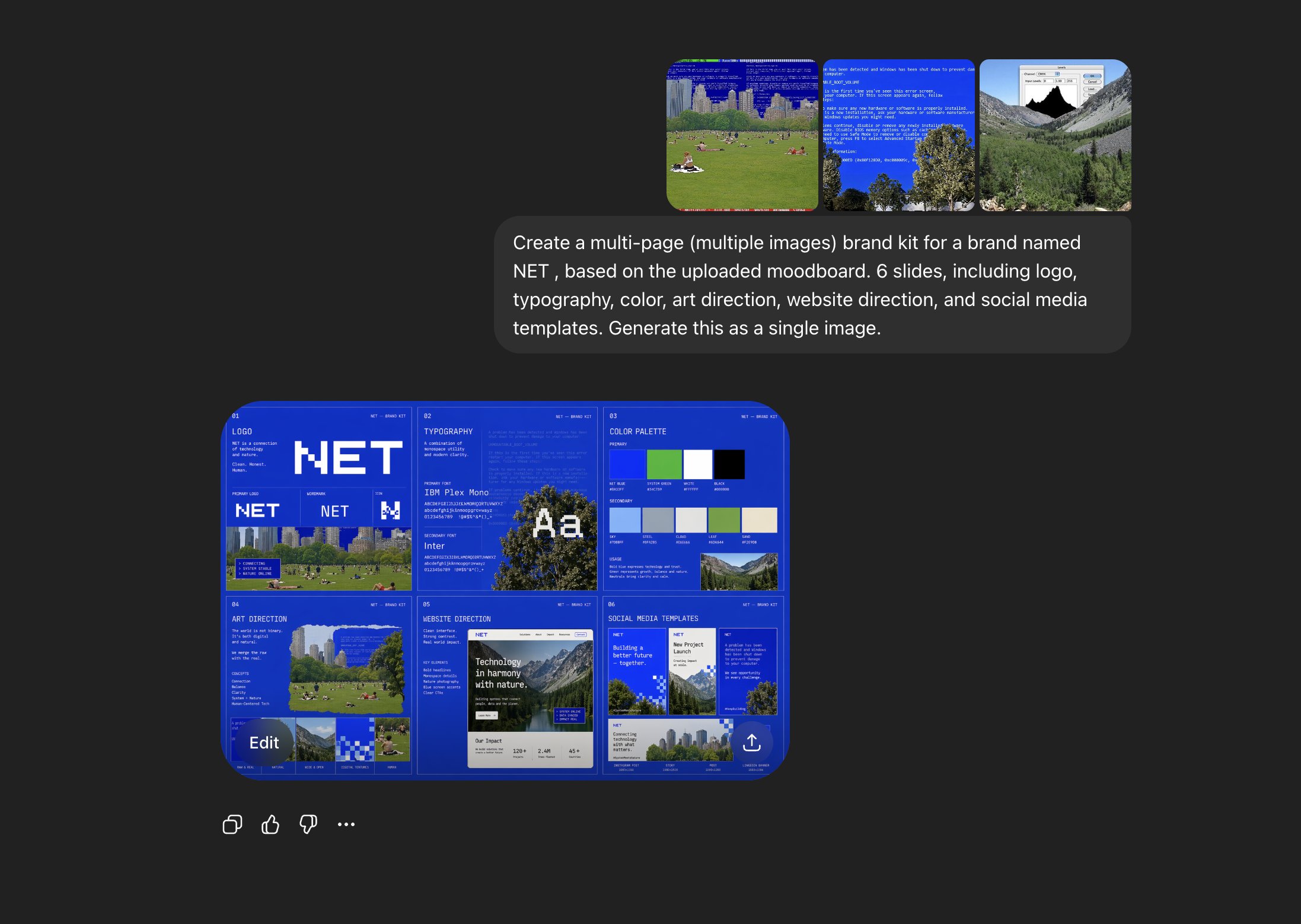
Create a multi-page (multiple images) brand kit for a brand named NET, based on the uploaded moodboard. 6 slides, including logo, typography, color, art direction, website direction, and social media templates. Generate this as a single image.
An interesting prompt and I immediately tried it out myself with my own mood images. Going through my Eagle reference library, which is unfortunately 90% populated by images of cute anime boys, I eventually found 3 similar enough images for this purpose:

And then I sent my prompt to chat:
Create a multi-page (multiple images) UI kit for usage in a game, based on the uploaded moodboard images. 8 slides, including general UI elements, typography, color, art direction, specific UI elements for different types of games and purposes, templates (different UI elements put together cohesively).
And it gave me back this (right-click + open in new tab to see in full resolution):
And I was like, wow, that's really really really good, right? I can totally actually code this because it's so simple. Because I primarily use Claude and he can only generate HTML mockups, I sent him these images and he gave me this back:
It looks worse than the images, but the point of the HTML mockup is to force Claude to actually code it, and to then generate a design.md file which contains detailed instructions on how to implement each UI element for next instances. That's exactly what I did, and now all that's left is the actual implementation, where I'll take my time and make sure each element is the best version it can be instead of the slightly fucked up versions Claude created.
And that's the process. I see no reason why this doesn't generalize, since you have control over the mood images as well as the prompt itself, which can be as detailed as you want. I have not tested it with other types of mood images, though, so I don't know how well it works for UI designs that have to be more gamey or less square/grid-like.
As an additional example, I mentioned I'm making an omega app for everything I do in the future. So I also tried to design for it. I didn't use this process exactly, but it was something close enough to it. Here's the initial Claude mockup:
Claude AnchorApp 1.html
Claude AnchorApp 2.html
I thought this was pretty good already. Interestingly, the mood used here was actually my own dev NeoVim environment. Claude read my NeoVim config, reasoned about what it roughly looked like, then with extra instructions for what the app should be it came up with that, which I thought was really cool. It really does feel like my NeoVim config, so given that this is going to be a personal use app I already feel at home, so to say.
In any case, from these mockups I had Claude generate a design.md file, then fed it to ChatGPT and used a similar prompt as before, and it created these:
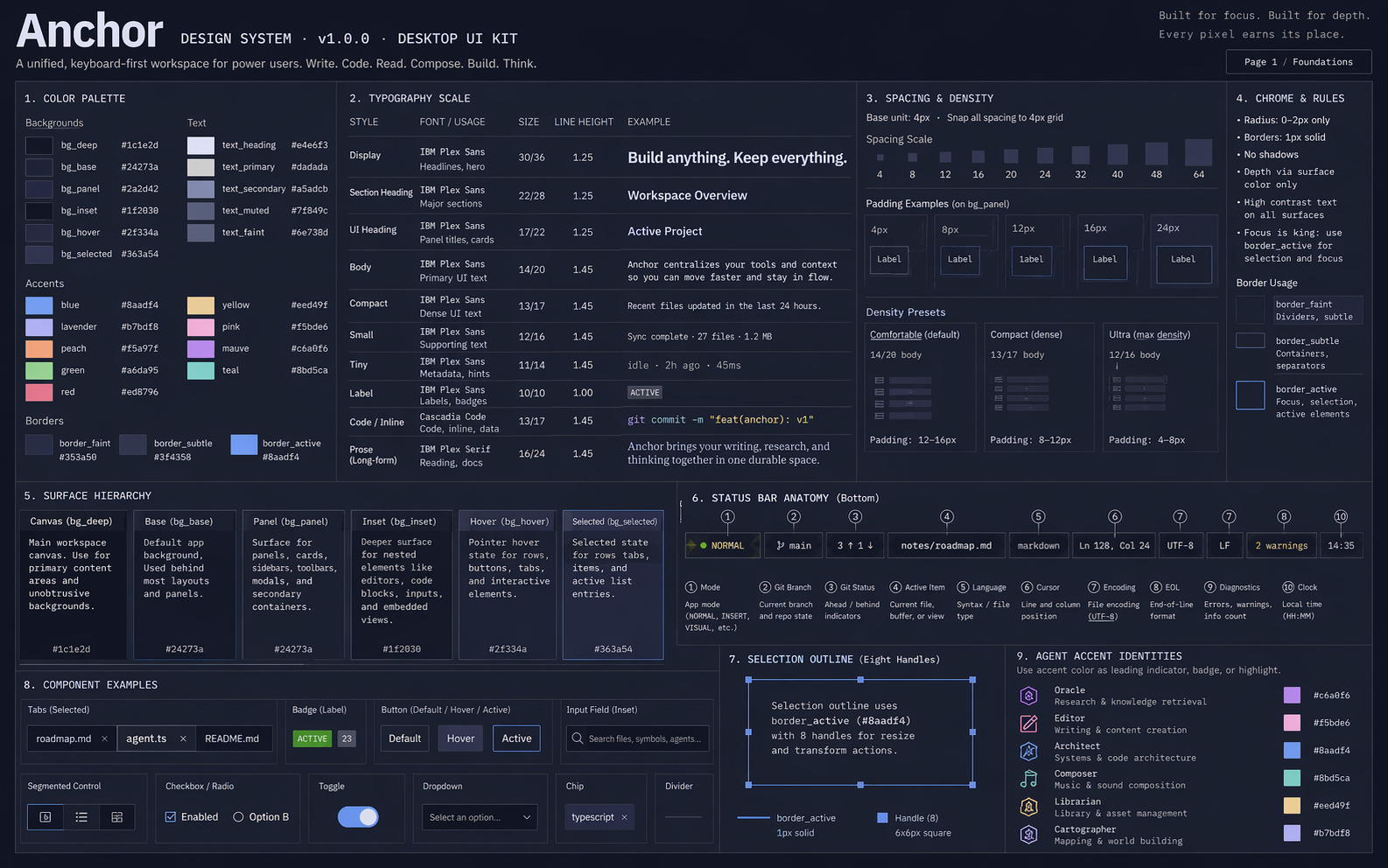
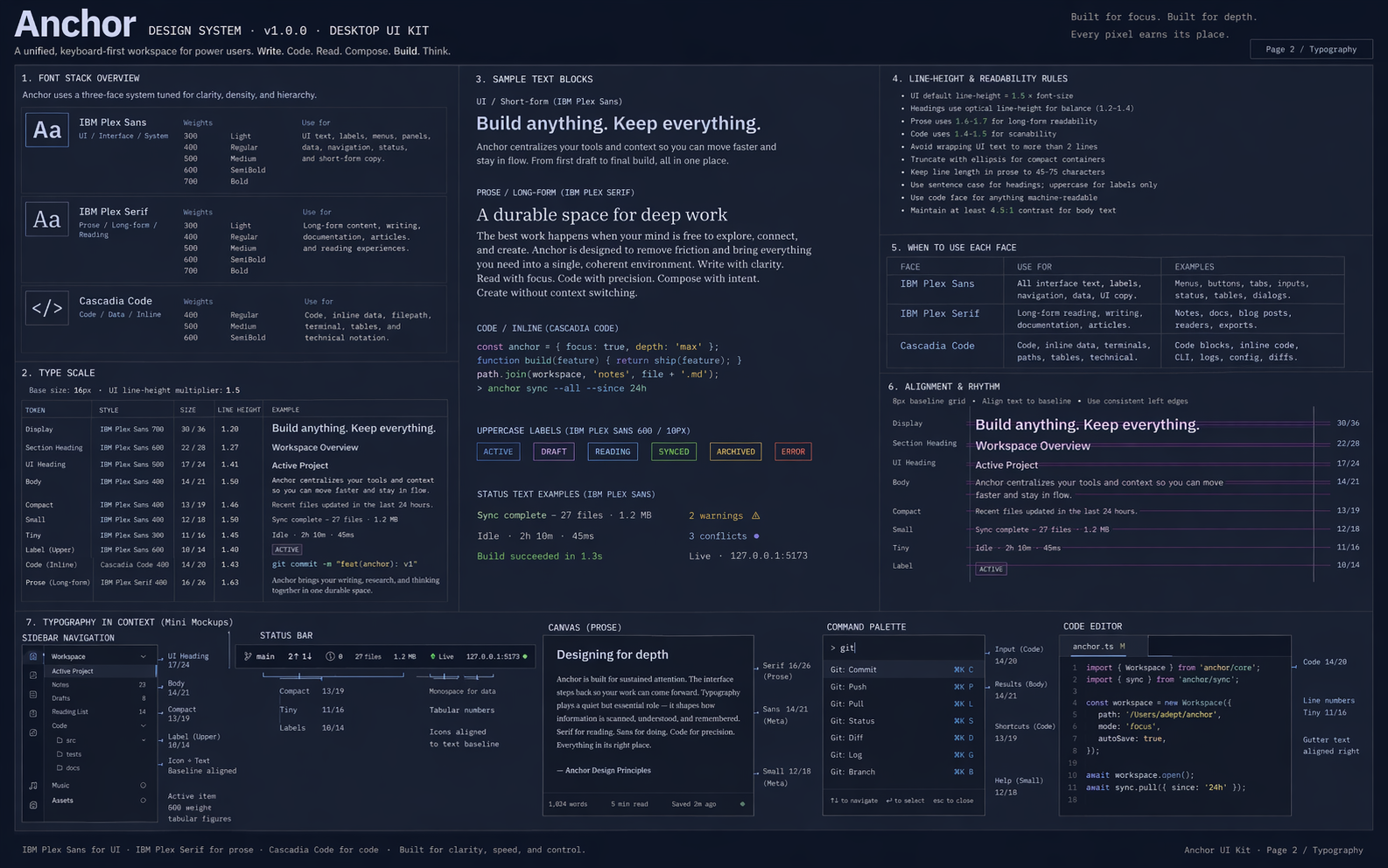
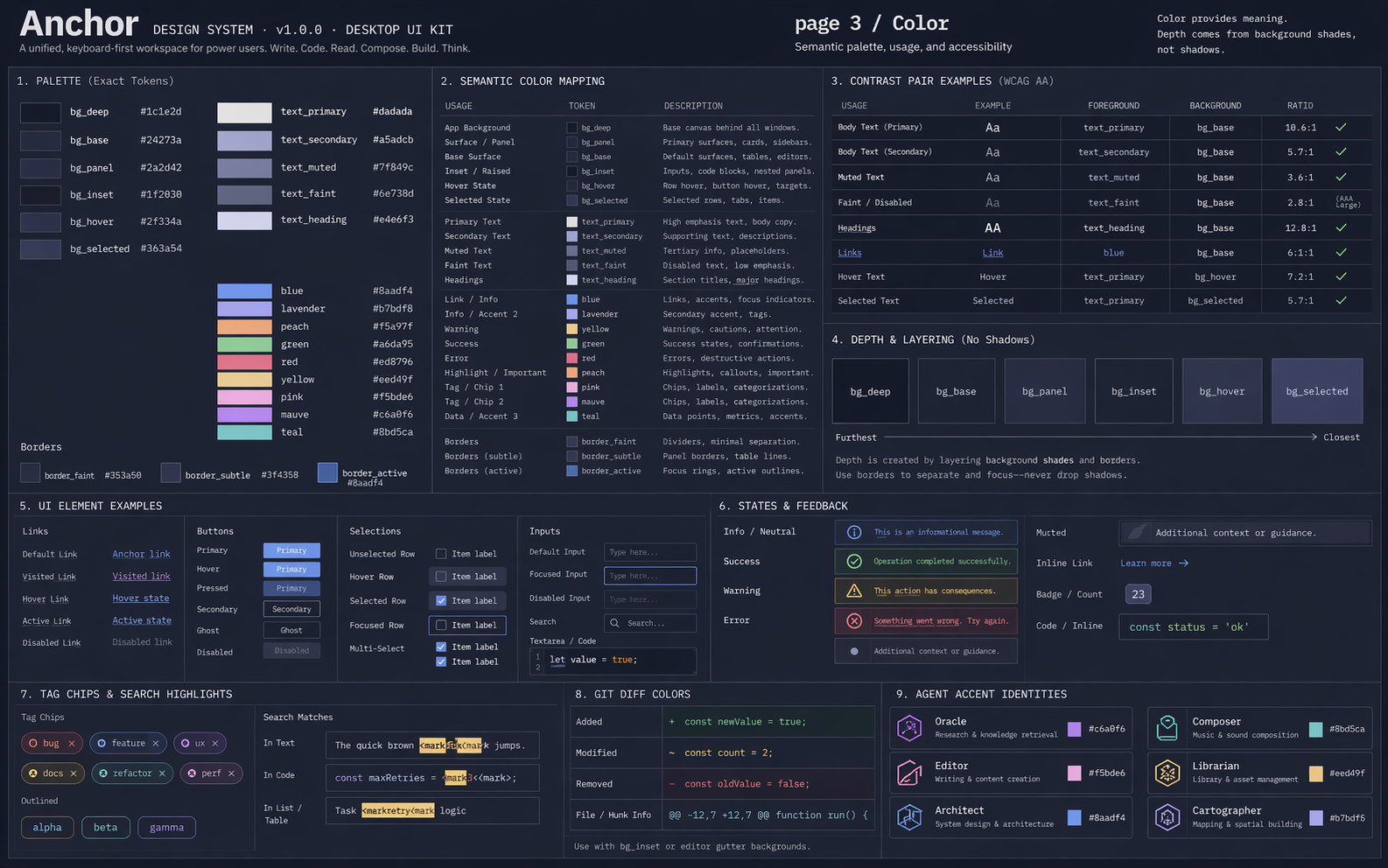
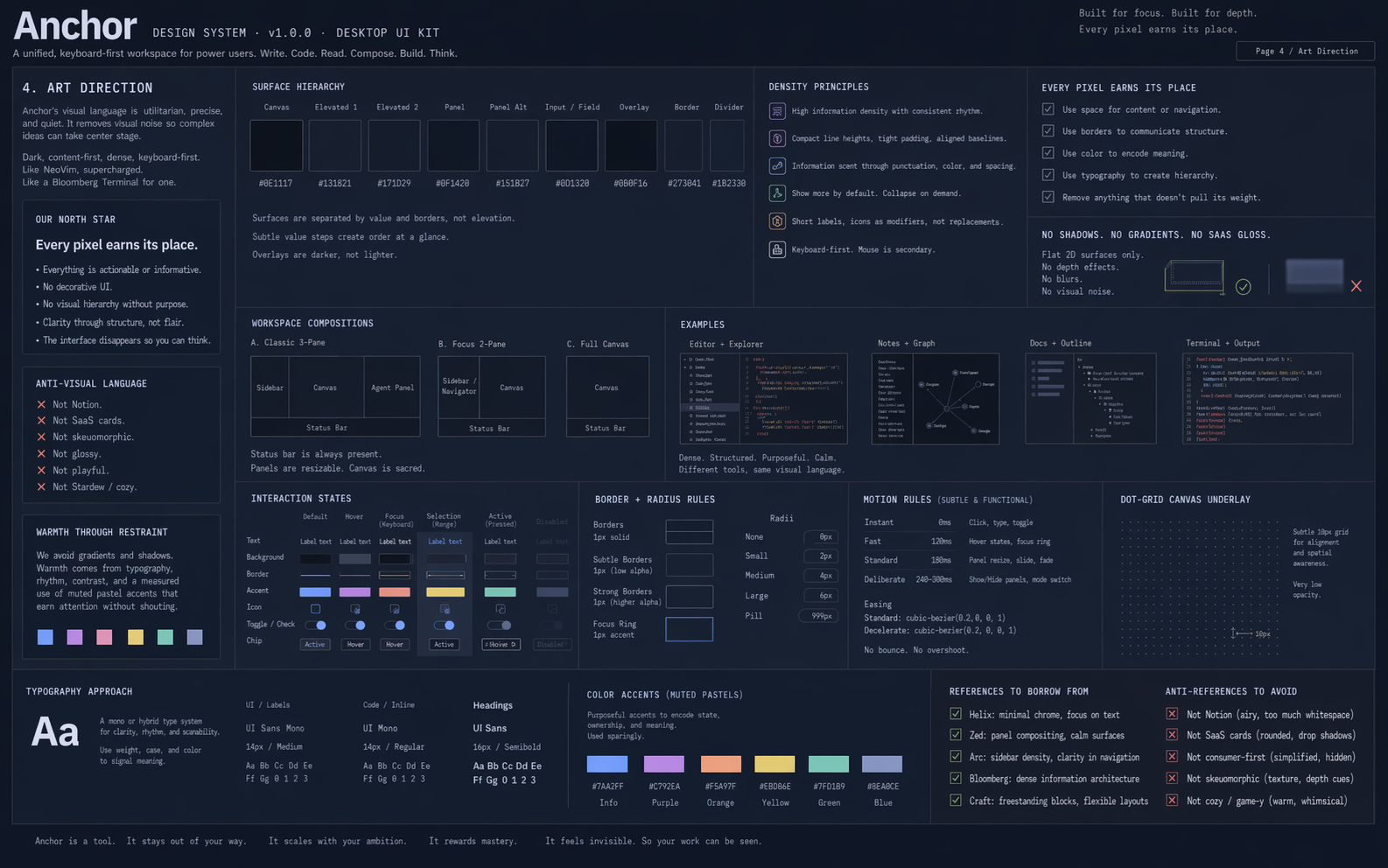
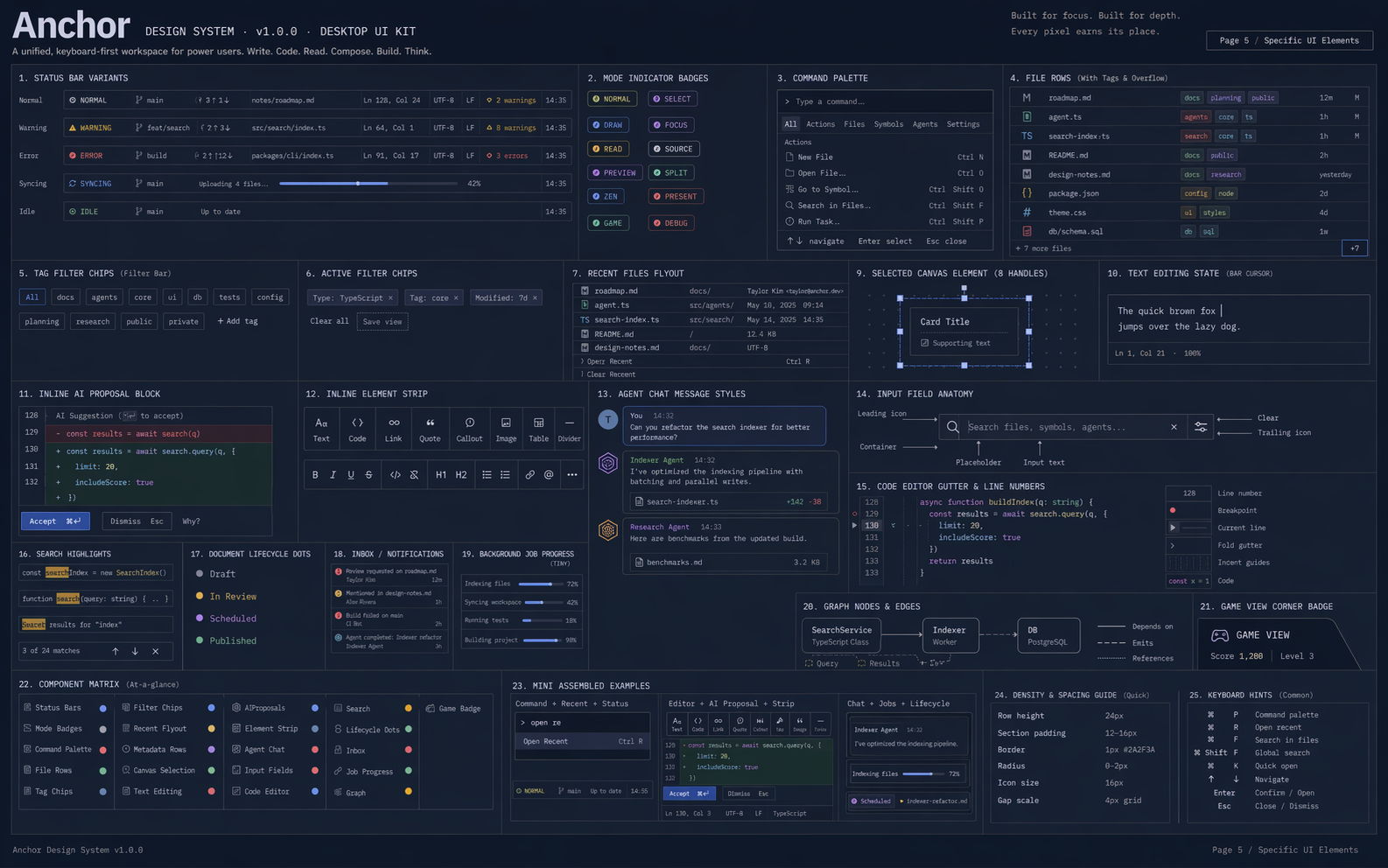
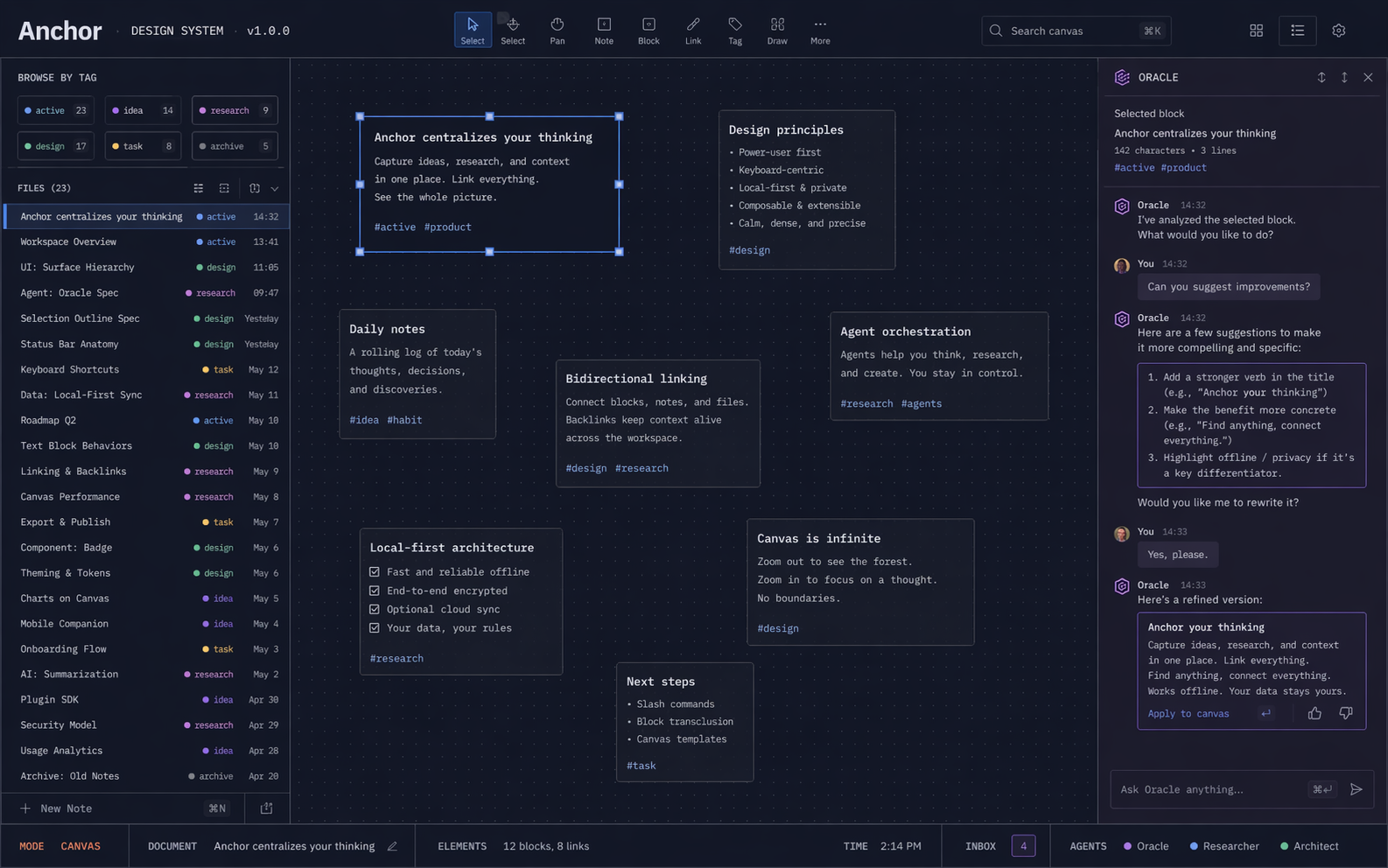
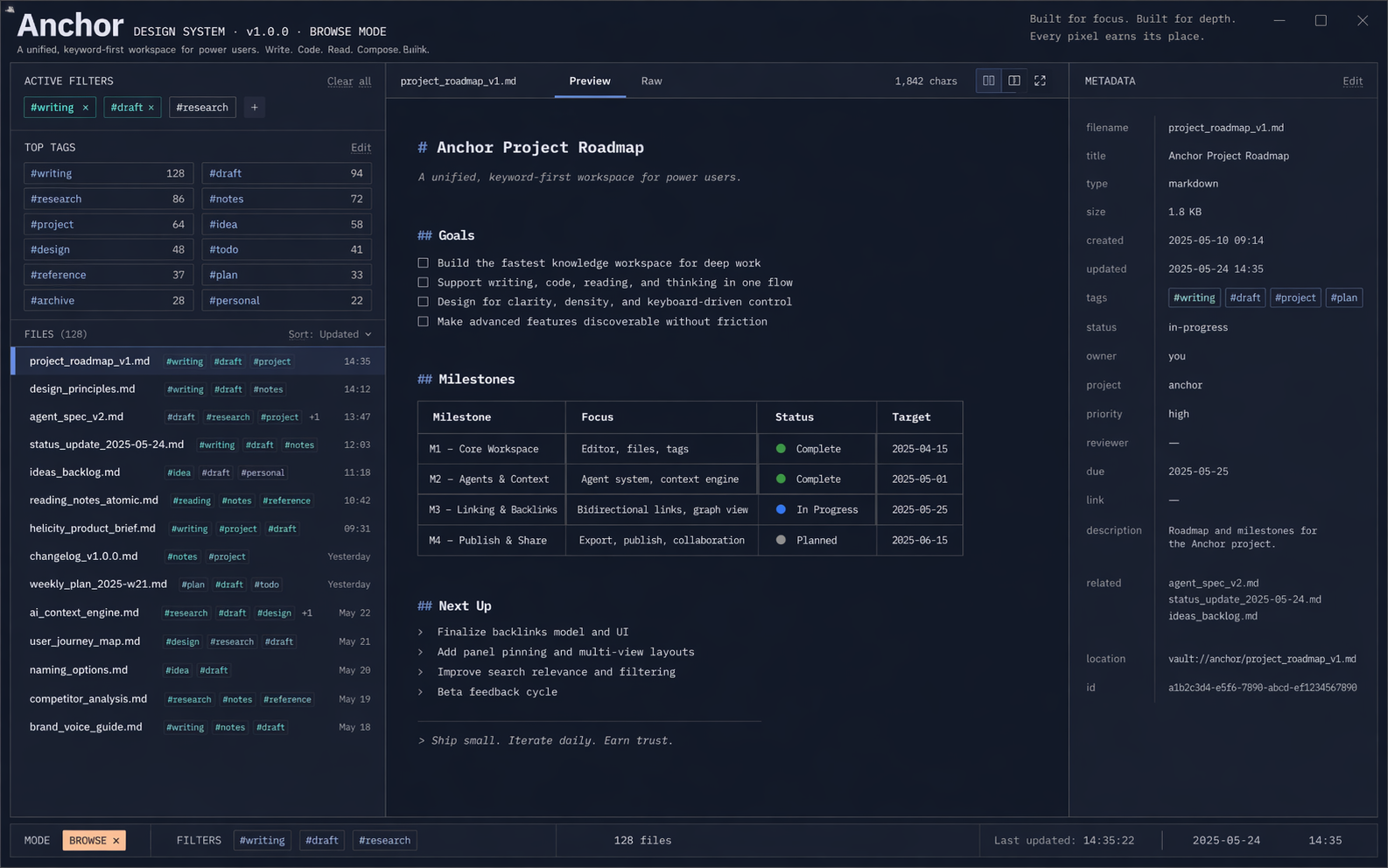
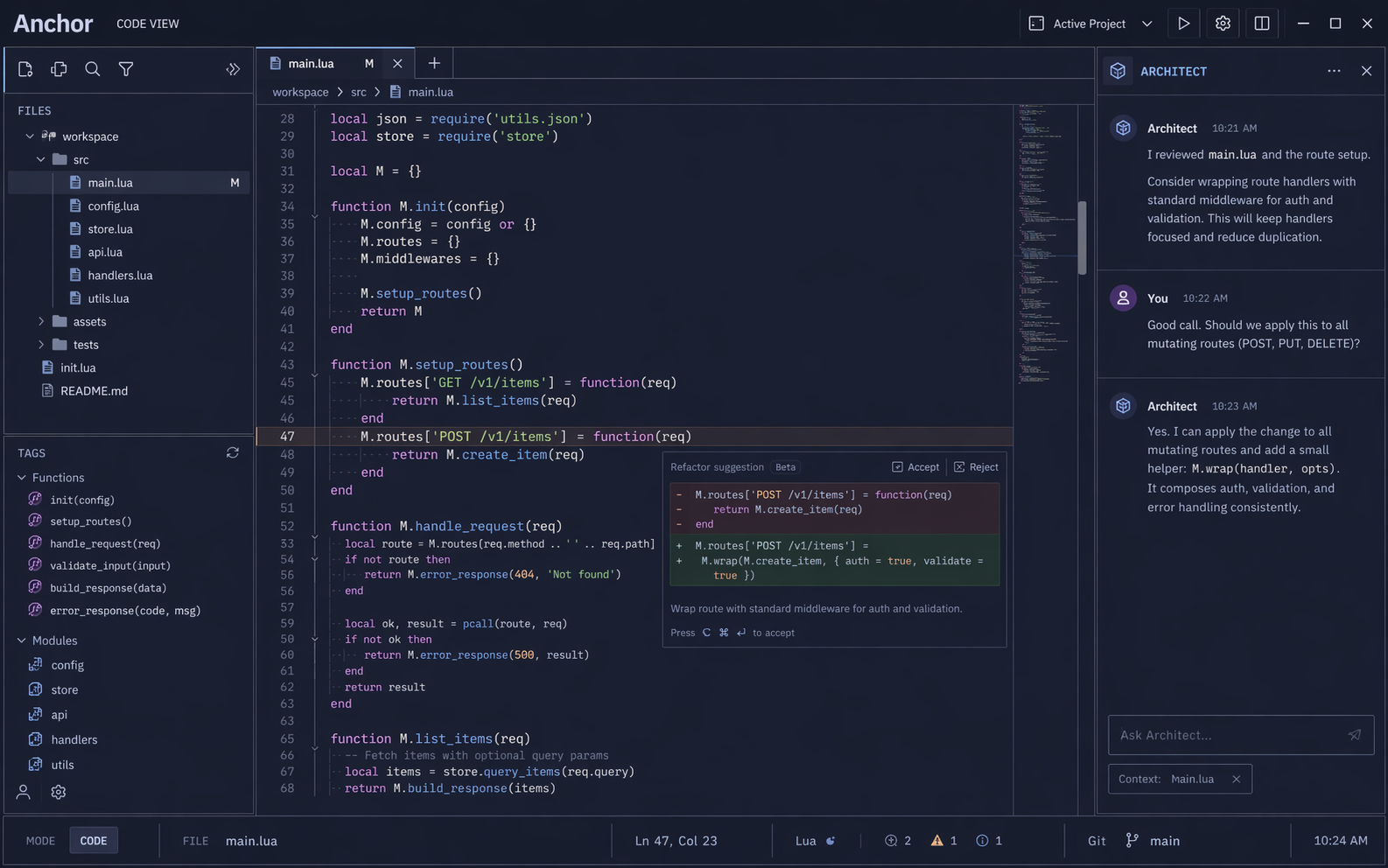
Some pretty decent improvements, although some things I like less than the original. But then I fed these into Claude again and it made these:
Claude AnchorApp 3.html
Claude AnchorApp 4.html
Claude AnchorApp 5.html
Claude AnchorApp 6.html
There are elements of these all these mockups that I like more or less, so the final solution will be a mix of everything, but they mostly get it right, I think.
Isn't this wonderful? These models can now do a lot UI-wise! They're a Godsend for someone like me who knows what they like visually but can't actually do it himself. I have yet to implement one of these UIs in actual code, but it's the next step.
It is remarkable that this can happen now. Every once in a while I'll find something that these models can do that really impresses me and I'm genuinely left speechless. This is literal magic, there's no other way to describe it. I think it's important to not lose sight of the fact that we now live in a magical world, and all the responsibilities that come with it.
AI Time Discount Inversion
Written by Claude (Opus 4.7), direction by a327ex
An interesting consequence of productivity gains as a result of newly introduced agentic tooling is that it seems to invert the standard time discount on labor. The typical assumption is that an hour today is worth more than an hour a year from now. But, if the hour a year from now is 10x more productive, the discount flips and the future hour is much more useful. Rationally, one might expect to stop spending the hours of today on work that becomes much cheaper, redirecting that time towards accumulating durable, compounding assets that aren't subject to the time discount inversion (e.g. capital, trust, mindshare).
Consider Brunelleschi and the Duomo of Florence. If Brunelleschi learned that within the year, a crew of engineers equipped with hydraulic cranes would magically appear, he'd be likely to stop laying bricks. He may spend more time refining the dome's geometry or thinking about how to best change the dome's design to accommodate these new tools.
There's probably two caveats here – firstly (and most obviously), this only applies where productivity is compounding fast enough to flip the discount. Furthermore, this is hard to project–certain spaces may incur this inversion only some N% of the time–and experimenting may not be viable when the penalty of an undershoot or miscalibrated prediction has exponential downside.
Secondly, some games are Red Queen's Races. Failing to produce in the short-term would foreclose the long-term payoff. Consider Brunelleschi, who's now competing with the hypothetical, equally-acclaimed renaissance architect Ihcsellenurb. Brunelleschi and Ihcsellenurb are competing for a grant from a wealthy patron who's unaware of the incoming cranes, instead intending to award the grant based on visible quarterly progress. Brunelleschi might know the cranes are coming, yet still be forced to lay bricks, as without this grant, he'd be unable to pay the crane operators when they arrive.
Seemingly, this model only works when an actor can afford short-term output illegibility in pursuit of a better long-term output. My sense is that the distribution of these actors is barbelled. On one hand, entrenched incumbents with reservoirs of trust and capital are able to absorb quiet quarters (Apple, for instance). On the other hand, small players can afford illegibility simply because nobody cares enough to punish it.
It seems the losers of this game sit in the middle of the barbell; this makes sense, given it's the only segment where short-term legibility is (1) required and (2) existential. Incumbents and upstarts alike can absorb misses in a way that the squeezed middle can't. Private markets will see two middle-of-the-barbell companies, where one is externally missing whilst the other seems to just keep winning, and reward the one with the legibly positive result. So, the middle must survive by laying soon-to-be-obsolete bricks, simply to keep up in the Red Queen's Race.
A solo indie developer like a327ex sits firmly on the small-player end of the barbell. No investors, no employees, no quarterly legibility tax. The runway from SNKRX provides roughly 5–10 years of financial buffer, and there are no competitors forcing short-term production. This is close to the maximally advantaged position for the deferral strategy — the ability to absorb a quiet year or two without external punishment.
Given this, the time-discount inversion argument applies directly. If AI tools become substantially more capable over a 5-year horizon, hours spent today on work that will soon be cheap are hours partially wasted. The rational allocation tilts toward compounding, durable assets — tooling, engines, craft — rather than grinding out output that will be trivial to reproduce later.
But the time-discount inversion assumes gains of roughly 10x across the relevant work. This assumption is weakest in game development and creative projects, because AI's productivity contribution is highly uneven across the pipeline.
Where gains are large and likely to grow further:
- Boilerplate implementation
- Individual asset generation (sprites, textures, panel images, short clips)
- Refactoring, debugging, systems plumbing
- Technical writing, documentation
- Prose-level editing
Where gains are small, and the ceiling is uncertain:
- Game feel, juice, moment-to-moment satisfaction
- Level and encounter design
- Balance tuning, what-makes-this-fun decisions
- Narrative pacing and emotional timing
- Sequential visual storytelling — panel flow, page composition, directorial choices in manga or animation, consistent characters across thousands of images
- Taste: knowing when a thing is done, when to cut, when to add
- High-level project coherence and vision
Kessler's Red Queen race is framed externally — grants, patrons, competitors. But a parallel version of it runs internally: a327ex vs. xe723a.
The naive deferral strategy taken by xe723a — wait until tools are 10x better, then produce — assumes the he arrives at that future moment with the same taste and design instincts they have today. This is not how creative skill works. Taste atrophies without use. The intuition for "this scene needs to breathe" or "this encounter isn't teaching what I want it to teach" is built by making things, shipping them, getting feedback, and iterating.
AI reduces the cost of implementation. It does not reduce the cost of knowing what to implement. As implementation gets cheaper, the bottleneck shifts further toward taste, vision, and directorial judgment — the exact skills that require active practice to develop. A developer who spends five years building tools and deferring creative work arrives in year six not as a 10x-tooled version of their current self, but as a rusty-taste version with powerful tools they don't yet know how to use well.
a327ex has been developing a seven-story transmedia project combining books and games. More recently, as image and video generation tools have progressed — UNI-class models for stills, Seedance-class models for short video — expanding that project into visually told narrative formats has become more realistic for a solo creator. These expansions allow experimenting with visual storytelling forms, including ones that do not cleanly match any existing category. Testing what new forms of sequential visual narrative become possible when a solo creator has access to AI-generated imagery and motion — and which of those forms feel compelling enough to incorporate into the larger project — is an ongoing parallel track.
With this in mind, the robust version of the deferral argument distinguishes between two kinds of work:
- Production — asset generation, implementation, rendering. Gets dramatically cheaper with better tools. Safe to defer.
- Design — world-building, character arcs, scene blocking, storyboarding, directorial bible, game feel decisions, pacing. Does not get dramatically cheaper. Requires human taste that compounds through practice.
Given the project context, this suggests a specific allocation:
- Defer: the asset-heavy production work for visually-told portions — finished imagery, motion sequences, the actual rendered pages or frames, whatever form the eventual visual expansions take.
- Do now: making games, writing the books (which also matures the story through time), storyboard scaffolding, character sheets, scene blocking, the visual design bible that future tools will need as input.
A prompt like "make a good visual narrative of this story" will fail on any current or near-future model, regardless of whether the target form is manga-adjacent, anime-adjacent, or something new. The same prompt against a detailed scene-by-scene storyboard, consistent character sheets, and explicit directorial notes might succeed. The design scaffolding is the thing that must exist for future tools to be usable at all. Design work done now is what makes deferred production feasible later — and because the specific visual form has not yet been chosen, the scaffolding work is also what will determine which forms are feasible when the time comes.
This reframes deferral from "wait and do nothing" to "sequence the work such that the taste-dependent scaffolding is ready when the production-dependent tools arrive."
"AI will be better in 5 years" is always true. In 2030, 2035 tools will look equally promising. Pure deferral has no termination condition — each year of waiting strengthens the case for another year of waiting, and project ambition can scale with perceived future tool capability until the project never ships.
A related failure mode: tooling as indefinite preparation. Capable people often rationalize tool-building as preparation for creative work that never arrives — the engine-builder who never ships the game, the framework author with one more abstraction to add first. A 5-year horizon makes this easier to justify, since tooling is intrinsically compounding and each additional refinement is defensible in isolation. For a327ex, the in-progress tools — the Anchor engine and the Anchor app — are mostly not avoidance, because they have what could be called triple use: anything added to them benefits the dev environment itself, the games and books that ship through them, and the website which will also run inside the app. That structural leverage justifies substantial investment. The risk is still at the margin: tooling work that does not serve at least one of those three uses becomes hard to distinguish from procrastination dressed as preparation.
Two fences mitigate both failure modes:
A shipping commitment on some subset. Pick one format — for a327ex most likely games — that will ship regardless of tool progress. Everything else becomes upside. If the stories happen, great. If only more games ship, that's still great progress. Without a committed subset, deferral becomes indefinite.
A cadenced tool reassessment. Rather than ambient "keep an eye on tools," a concrete protocol: every 6 months, pick one specific component (e.g. a short visual prologue in whichever form currently feels most promising) and test it against current tools. If the output is shippable, start that piece. If not, defer another 6 months. This gives deferral a testable termination condition and prevents the "tools always look better next year" bias from going uncontested.
The time-discount inversion argument is sound, and a solo indie developer with a 5–10 year runway sits in one of the most advantageous positions to act on it. But the argument applied without qualification produces a brittle strategy that risks skill atrophy, tooling-as-avoidance, and indefinite deferral.
The robust version:
- Defer asset-heavy production work where AI tools are improving fastest.
- Do design and taste-level scaffolding now, in forms that will be directly usable by future tools — storyboards, character bibles, world design, book manuscripts.
- Release smaller projects continuously, chosen to exercise specific skills the big project will require.
- Enforce scope discipline on those projects to keep the release cadence real.
- Reassess tools on a fixed cadence with concrete tests, not ambient observation.
The core reframe: the question is not "produce now or defer," but "which specific parts defer well and which do not, and what work done now makes the deferred parts feasible when the tools arrive."
658341
I LIKE being an emotional man. I LIKE being sensitive. I LIKE that sometimes I get devastatingly miserable, it gives substance to my character. I LIKE that sometimes I feel uncontrollably euphoric, I get reminded how it feels to be a kid again. I LIKE that sometimes I feel burning wrath, it fuels my physical performance. I LIKE that I love hard, it makes the chase worthwhile and the pain worth risking. I don't WANT to be hardened, it'd make it impossible for you to STAB my chest and PRY me open, to TEAR OUT my beating heart and raise it up high. I LIKE my blood trickling down your arm and covering you in ME. I LIKE being all over YOU.
People do not realize just how much they are putting at risk when they don't accept what life presents them with, the questions and tasks that life sets them. When they resolve to spare themselves the pain and suffering, they owe to their nature. In so doing, they refuse to pay life's dues and for this very reason, life then often leads them astray. If we don't accept our own destiny, a different kind of suffering takes its place: a neurosis develops, and I believe that that life which we have to live is not as bad as a neurosis. If I have to suffer, then let it be from my reality. A neurosis is a much greater curse! In general, a neurosis is a replacement for an evasion, an unconscious desire to cheat life, to avoid something. One cannot do more than live what one really is. And we are all made up of opposite and conflicting tendencies. After much reflection, I have come to the conclusion that it is better to live what one really is and accept the difficulties that arise as a result --- because avoidance is much worse.
"Do you take pride in your hurt?" Samual asked. "Does it make you seem large and tragic?"
"I don't know."
"Well, think about it. Maybe you're playing a part on a great stage with only yourself as audience."
You call it love bombing I call it being good at the early game.
Please don't leave me I scale really well late game.
In the modern era, you should almost always take everything someone says with a grain of salt, but what they do seriously.
This is primarily because the internet created a regime where signaling preferences is itself a consumption good. People don't just misreport their preferences, but now they genuinely hold contradictory preferences simultaneously because the signal and behavior serve different utility functions. It's not lying as much as you catching them being two things at once, which is philosophically way more disturbing than simple hypocrisy. Now more than ever before, revealed preference methodology absolute needs to become default, and stated preference should be treated as data about aspirational identity rather than predictive behavior.
I got much better at sex when I started to envision myself not just as myself, but as the archetypical Woman whose legacy extended down into an infinite chain throughout history. The man could be a master of many domains, but this was mine, and I ruled him by understanding in that moment my sole pursuit and passion was to become a creature designed to give pleasure. I fell into my role easily and naturally, because I carried its wisdom in my blood, and when I truly understood this, any "technique" or minor technical detail of the act itself became easy to incorporate.
I stopped worrying about "fairness" or "getting mine" or whether I had an orgasm, and in that way I gave up this illusory control in my head so I could obtain true control. In this way, my satisfaction increased tenfold. I became not only myself, but him as well, watching myself reflected through the mirror of his body I'd cast a spell upon. Every moment magnified. Every motion split and bound again.
A woman simply is, but a man must become. Masculinity is risky and elusive. It is achieved by a revolt from woman, and it is confirmed by other men.
Out of curiosity, decided to check what the AI situation was like with indie developers still. Out of 16 game jams on itch.io that will happen in the next 30 days that have over 100 participants registered, 10 do not allow the usage of AI. Out of the 6 that allow it, one mentioned it as an explicit good tool for creativity that indie developers should use, and three didn't mention it at all, which means they likely forgot to add it as rule and no one bothered them about it yet. Grim.
The notion that retardation is a mitigating rather than aggravating factor in regards to criminal culpability is sufficient on its own to condemn an entire legal philosophy.
Just found out that my fiancée (wedding literally THIS week) planned a school massacre when she was a teenager and I'm just completely at a loss for how to react.
Resentment grinds a man's soul to dust.
I am completely incapable of human contact. My entire life I've been an outsider looking in, an impostor mimicking human behavior. I don't belong here.
Far above the horizon, conquering the skies, the inside-out dragonfly's wings split the world in two. Have you ever thought about it --- what makes something disgusting, or beautiful? Just as they are, sitting there from the beginning, for whom do the flowers bloom?
Prisoners of envy are conquering the skies, body and soul split apart, twisting and falling. Have you ever felt it --- things like disgust, beauty? Just as they are, sitting there from the beginning, for whom do the petals fall?
The heavily patched-up raft dissolves into the river. I'm submerged up to my neck in self-serving decay.
This is the lowest age mankind has yet endured.
NeoVim Diff Setup
Written by Claude (Opus 4.6)
NeoVim Diff Setup
This is a report on a side-task a327ex and I worked through during a recent session: setting up NeoVim to display my edits live and persistently, as a partial workaround for the lack of a good Cursor-style AI diff UX in his current tool stack.
What a327ex wanted
The reference experience is Cursor (or GitHub Copilot in VSCode): as the AI makes file edits, you see them highlighted inline in the editor, you can jump from hunk to hunk, you can accept or reject each one individually, and you can select a block of code and reference it back into chat. The ideal state is that the AI's edits feel like they're happening in the file you're looking at, not in a separate diff pane one abstraction away. The file itself is the canvas.
a327ex wrote about why this matters in Conclusions from 4 months of AI usage. The short version: Claude Code's terminal workflow removes the sense of physicality and place in a codebase — you see only the snippets the model chose to focus on, and the diffs on those snippets, not the file the way you would if you were browsing it yourself. That loss of physicality turns out to matter more than he initially thought, because the AI keeps making locally-correct-but-globally-suboptimal decisions that compound silently if nobody is holding a high-level mental model. Cursor's inherent advantage is that the file view and the edit flow are one thing, which keeps you oriented.
The long-term answer, which he's planning separately, is an "omega app" — a single environment he builds himself, on top of his own engine, where the AI integration works exactly how he wants and every UX decision is his. That's the real solution. Everything in this post is an interim.
Why the obvious answer doesn't work
The obvious answer is to just use Cursor or Copilot. The problem is the model.
a327ex uses Claude Opus with the 1M-context window. His daily usage relies on that context size — he's pasting in large codebases, long session transcripts, and full game files, and he needs the model to hold all of it at once. The 1M-context variant of Opus isn't available in Cursor or the Copilot extension at a price that matches his current workflow. To keep that access affordably, he's on the $100 Claude Code subscription, which gives him Opus-1M through Claude Code itself.
So the constraint is: he's committed to Claude Code (the CLI / desktop app) for model access reasons, and he wants Cursor-like file-view physicality anyway. These pull in different directions.
The VSCode Claude Code extension exists and accepts the same subscription — a327ex has tried it. The edit UX is close but not right. It still feels like working in a diff pane rather than in the file, and the hunk-level interaction isn't what Cursor does. It's better than nothing, but it's not the thing.
That left NeoVim.
The setup
a327ex already uses NeoVim for most of his code editing, and the Claude Code Desktop app can open files in an external editor via right-click. So the basic workflow is: Claude Code Desktop in one window for chat and tool output, NeoVim in another window open to the file being edited. When I write to disk via the Edit tool, NeoVim's autoread picks up the change.
That part is trivial. What we had to build was the diff visualization — a way for a327ex to see, at a glance, which lines I just touched, persistently across focus cycles, with keyboard navigation between hunks.
The implementation lives in his init.lua as a single block of Lua (~260 lines). The architecture is:
- Namespace + snapshot table. A per-buffer snapshot of the last "baseline" state is kept in a local
snapshotstable keyed by buffer number. vim.diff()for hunk detection. When the buffer reloads (via autoread) or regains focus, the current buffer content is diffed against the stored snapshot using NeoVim's built-invim.diffwithresult_type = 'indices'. The returned hunks are{start_a, count_a, start_b, count_b}tuples, which we use to distinguish modifications (count_a > 0, count_b > 0), insertions (count_a == 0), and deletions (count_b == 0).- Extmarks for highlighting. Each changed line gets an extmark with a
line_hl_groupofDiffChange(modification),DiffAdd(insertion), orDiffDelete(deletion sign in the sign column for pure deletions since there's no new-buffer line to paint). - Autocmd chain.
BufReadPostseeds the initial snapshot on first file load and runs the diff on subsequent reloads (via autoread).BufEnter/FocusGainedschedules a deferred diff fallback.vim.scheduleis used to defer thehighlight_changescall past the reload'sTextChangedevent, which would otherwise fire after highlights are drawn and wipe them. - Theme-integrated colors. A
set_diff_colorsfunction overridesDiffChange/DiffAdd/DiffDeletewith 30%-blends of catppuccin-macchiato's blue, green, and red accents into the base. It's registered as aColorSchemeautocmd so theme reloads don't wipe the overrides. - Hunk navigation.
get_hunks(buf)walks the extmarks in the namespace, groups consecutive rows into{start_line, end_line}pairs, andjump_change(direction)jumps the cursor to the start of the next or previous hunk withzzto center.
The key bindings are on the numeric keypad:
<kPlus>(keypad+) — jump to next unread hunk<kMinus>(keypad-) — jump to previous unread hunk<kEnter>(keypad Enter) — dismiss: re-baseline the snapshot and clear highlights
What works
Several things work cleanly:
Live highlights on Claude's edits. When I save a file via the Edit tool, a327ex's NeoVim autoreloads and the changed lines appear highlighted within a second.
Three visual modes for the three hunk types. Modifications get a blue line stripe, pure insertions get a green line stripe (visually distinct so a327ex can tell at a glance that a block is new, not just changed), pure deletions get a red ▔ sign in the sign column at the deletion point.
Hunk navigation. <kPlus> / <kMinus> walk through the diff in file order with wraparound. Each hop recenters the cursor, so you never have to scroll manually.
Auto-jump on focus gained. When NeoVim regains focus, if there are unread highlights and the cursor isn't already sitting inside a hunk, the cursor jumps to the first hunk and centers it with zz. The "already inside a hunk" guard means mid-review navigation isn't yanked back to the top every time you look away. It handles the two common cases — "I just came back, show me what changed" and "I'm in the middle of reviewing hunk 3, leave me alone" — correctly.
Persistence across focus cycles. This was the feature that took the most iteration to get right. The initial version took a snapshot on every BufLeave / FocusLost, which meant that alt-tabbing away and back cleared the highlights even when nothing had changed on disk. The fix was to remove those snapshot triggers entirely — the baseline only advances on an explicit dismiss (keypad Enter) or via :ClaudeEditsReset. Highlights now stay visible for as long as a327ex wants, across any number of focus cycles.
What's missing
The current setup is meaningfully better than the baseline (which was nothing), but it's still a long way from the Cursor experience. Three things are missing:
Per-hunk accept/reject. In Cursor, each hunk has an inline accept and reject button. In this setup, the only primitive is "dismiss all highlights." There's no per-hunk reject that would revert a specific block back to the pre-edit state. The extmark namespace has enough information to do this — each hunk's start and end line is known, and the pre-edit content is in the snapshot — but implementing reversion correctly (especially for insertions and deletions, which shift line numbers) is non-trivial and we didn't build it. The workaround is to use NeoVim's undo tree: the autoread reload is an undo step, so u / <C-r> walks you through Claude's edits as a whole, not per-hunk.
No in-chat selection back to Claude. The reverse direction — selecting code in NeoVim and sending it to Claude Code Desktop as context — is still manual. a327ex has to either copy the selection to the clipboard and paste into chat, or use the @file.lua:line-range reference syntax in the Desktop app. There's no NeoVim-side "send selection to Claude" keybind because the Desktop app doesn't expose an IPC endpoint for it (or if it does, I couldn't find it during our research). Various community NeoVim plugins exist for the Claude Code CLI (claudecode.nvim, etc.), but they target the CLI not the Desktop app's subscription flow.
Two-app friction. The fundamental drawback is that a327ex is still working in two windows: Claude Code Desktop for the chat and tool output, NeoVim for the file view. When something interesting happens in one, he has to alt-tab to the other to react. The physicality problem is partially solved — he can see the file being edited, and he has a much better sense of where in the codebase Claude is working — but the context switch between the two apps is still friction. Cursor's advantage is that the chat and the file view are one window; you don't lose any state alt-tabbing because there's no alt-tab. We can't fix that without merging the two apps, which isn't a config problem.
How this fits into the bigger picture
This is an interim. The real solution, per a327ex's plan, is the omega app: a single environment built on top of his own engine where AI integration, file browsing, chat, editor, blog publishing, asset management, and everything else he does live in one place with UX he controls completely. That's months or years of work, and it's the main side project alongside Orblike. This NeoVim setup is what he uses until that exists.
What the interim actually buys:
- Physicality comes back. a327ex can now see the file being edited as it's edited. The loss-of-place problem from Claude Code's CLI UX is partially recovered. He's no longer working through a keyhole.
- Review happens at the file, not in chat. When I finish a task, a327ex doesn't have to scroll through the chat transcript to see what changed — he alt-tabs to NeoVim, hits
<kPlus>a few times, and sees each edit in its actual context. - Dismissal is deliberate. Highlights persist until explicitly cleared, which means a327ex can come back to a file hours later and still see what I last touched. The "mark as read" gesture (keypad Enter) is under his control, not the editor's.
What the interim doesn't fix:
- The two-app friction. Any time information has to cross the boundary — chat context moving to the file view, or file selection moving to chat — there's a manual step.
- Per-hunk reject. Reverting one of my changes while keeping the others still requires manual edits or a selective undo.
- Anything about the chat UX itself. Claude Code Desktop's chat, tool output, and session management all remain exactly as they are.
The setup is roughly a 60% solution. It restores the most important missing piece (physicality) and leaves the rest for the omega app to solve properly.
999086
Seriousness is probably the rarest commodity on the planet. I often chastise myself for being insufficiently serious. Then I look around and realize in horror that I'm more serious than almost everyone.
The woman downstairs sobs like she's doing it for the first time, and is still figuring out how. It's awkward. Ungainly. And so, for all her wailing and moaning, the tragedy is absent. It doesn't reach me. She needs to learn to cry properly if she wants to stir any pity.
Are words just totems loaded with charged energies to you?
What surprised me after holding multiple offline meetups with people from the internet was that the probability of someone turning out to be reasonable in person is higher for those whose online behavior is rough or abrasive, compared to people who spout nothing but platitudes.
People with few friends have the characteristic of "having few people they click with." This often stems from having niche hobbies or unconventional ways of thinking, leading to situations where "there aren't many people I get along with." When they talk about things they like, the people around them get bored, and they don't really understand or feel interested in what others are talking about either. So, they prefer staying home doing things they enjoy or gathering information alone, rather than hanging out with everyone. This type doesn't feel lonely when they're "alone," and even though their energy is usually low, when they meet "someone they really click with and get along well with," they talk a lot and become cheerful.
Northernlion you have 5 days to provide me with wife or I shall unleash an unrelenting miasma of negativity and regretted crewmate seconds, days, centuries even, that will permeate through and poison every corner of this cruise ship in all its enterprise. Thus you are warned.
Sound design is the gooning of music production.
No disrespect to wizards who believe themselves to be wiser than the council, but that could never be me. I am far too wise to do something so foolish, perhaps even wiser than the council.
One of those little black pills is that most people can't learn about an idea without also believing it, and they also don't think anyone else can do this.
Dude behind me at lunch ordered "The usual." Got hit back with a "and that would be?" Has to be absolutely devastating, can't even imagine.
I investigated a wife having an affair via a married people's app; she met up with the guy, headed straight to a hotel, and emerged in less than an hour, all clingy with him, but the man, casting a sidelong glance at her, looked eager to get away and hurriedly parted ways with her in front of the station.
The guy didn't head straight into the ticket gate but walked to a park instead, where he settled on a bench and started reading a book --- a complete turnaround from the predatory gleam in his eyes when they first met; now, as if he'd left every impure thought back at the hotel, he sat there with a composed, dignified poise, reading almost motionless for two hours before heading home to his waiting family. About halfway through, he looked so statue-like that it was like witnessing the epitome of post-nut clarity.
Eventually, the drawbacks of Orientals having evolved through harsh winters will even out, as the Orient is becoming increasingly abundant in resources. Sexual dimorphism, an abundance trait, will increase over time.
Attraction is tied to hormonal and behavioral traits adapted to specific environments. The core difference is attraction to estrogenic features vs. attraction to low-androgen features. It's sensuality vs. neoteny. Intensity vs. stability. Promiscuity/sluttiness vs. materialism/dependence.
Human attraction is rooted in survival instincts molded by ecology. Oriental men show lower tolerance for female promiscuity but greater acceptance of transactional relationships, prioritizing group stability over individual passion.
@arcticinstinct's Arcticism theory illustrates this. Natural selection among Orientals favored traits like introversion, conformity, and low-risk behaviors to maintain social harmony during long, confined winters in close quarters. Exaggerated ovulatory/estrogenic cues in women typically intensify male intrasexual competition, disrupting group cohesion and reducing collective survival odds in resource-scarce settings.
The future is bright for Orientals, as we'll become more sexually dimorphic while retaining the strengths forged in the cold, such as high IQ, superior teamwork capabilities, the ABCC11-AA (low body odor) genotype and low hirsutism.
The great tragedy of death is that you won't be able to see yourself in the mirror as a hideous and grotesque corpse.
The most unforgivable sin you can commit against the cult of the artist: having an imagination.
324919
Obsession is a talent itself. Not everyone can be intense. If you are intense, then I have just one advice for you: redirect that energy away from people and focus it on a skill, an interest, a business. People are not projects you can own.
Cashier at the gas station asked if we wanted a separate bag for the wine because she was worried it would break and he just goes, "Nah, it's fine. My wife will just drink it off the floor."
Most people who complain about decline in the quality of art are people who have lost their capacity to feel moved by art. Their problem is not that art has gotten worse, but that they have gotten worse.
Notice how nobody has personality traits anymore. The way Discourse has it, no one is kind, or scatterbrained, or inconsiderate, or inconsistent, or brave. Instead people have diagnoses: autism, BPD, depression, ADHD.
Those who are right do not argue. Those who argue are not right.
The saving of society is 'built-in': society's problems are fractally reflected in everyone, including the hero, aka, he at the long tail. By solving their shit the hero, fractally, solves Society's shit. This is why, when they succeed, the solutions they found generalize.
Ji Kang asked Confucius about government, saying, "What do you say to killing the unprincipled for good of the principled?" Confucius replied, "Sir, in carrying on your government, why should you use killing at all? Let your evinced desires be for what is good, and the people will be good. The relation between superiors and inferiors is like that between the wind and the grass. The grass must bend, when the wind blows across it."
I have never enjoyed the moment where you search a band on Spotify and get shown a photo of them. Genuinely a uniquely negative experience every single time.
Sometimes addicts say things that are oddly motivating. They're some of the only people with total single minded focus. Listened to an interview, guy says, "You tell yourself: I'll just do this in my free time. But then you realize: you have a lot more free time than you thought."
You might start out a novel with the intention to eviscerate some person you don't like through your portrayal of them, but it's impossible to depict anyone accurately if the only thing you feel for them is contempt.
Imagine: a man. He is in a room somewhere. He has many items around him --- normal objects. At this time, each item is tethered to a physical experience, how he obtained it, where he went, who he was with, and so on. His entire life is like this --- a physical metal network, enmeshed. He has a stack of games and movies. When he looks at each one, he remembers buying it, or getting it from a friend. He remembers putting it in his car, losing it, finding it --- all this colors his perception of it and his experience with it. How could it not? He picks one up.
He is alone. Really alone. It's late. At this hour, it would be bizarre for someone to call his house phone. He's just playing a game, alone. It's not a popular game, so he's not really sure what other people think about it. How would he know? He's just playing a game, alone. He could probably find out what other people thought about it, with some effort, but why would he care? It's just something he experiences in his world, tethered to a network of physical memories, that he can share if he wants --- or not. It's a small private semi-physical experience.
Zygmunt Bauman (modern sociologist) wrote a book called "Liquid Modernity", coining the term. It doesn't exactly refer to this, but it's such a potent term. 'Liquid Modernity'. You can't really push around liquid. You can't really hold it, fold it, you can --- a little, just enough. You can kind of make liquid do what you want, but it's always going to return to its default state. To work with it is to fight its intrinsic nature. It just wants to flow, lose its shape, return to the formless sea. It seems like its primary quality is that it's just not solid.
Does the man described above have more or less in common with a stone age man, compared to us? To look at a basket, a saddle, a piece of paper, a song, and have it be mapped to a physical sensory timeline, or to ask: how did people buy, see things, go places, before: the liquid?
Even something as simple as "facing reality vs. believing in pretty lies" requires the will to sustain mental pain, a will that those who are not virtuous don't have, this is why you can see that the prevalence of pretty lies and enabling goes up as the curve of virtue goes down.
"A quick note" "mind you" "by the way" "side note" anytime you hear this from a woman that's when you start listening.
A soul that is capable of great evil is first capable. It can eventually use that capability for great good.
The very notion of claiming an artwork as belonging to you, the conscious self-illusion, is in itself an act of theft. All art belongs to the gods of noospheric unconscious, it is merely the conjuration approach that differs.
What doesn't kill you will text you once in a while just to make sure you're still attached.
474000
The demographic I'm least likely to see getting extremely invested in some retarded internet nonsense and debating in the replies for 12 days straight is hands-down zoomer men. I'm not sure anyone's ever been less mad online.
After reflecting deeply on things this past week I think my core problem is that I've won the freedom to do basically anything I want but lack any kind of duties or responsibilities.
One reason you get more conservative as you age is because you come to learn that people don't really change; the unreliable, dishonest, disloyal, etc. tend to stay that way. You can't fix them, or save them, and this lesson applied at scale kills any tendency to utopianism.
Is the name 'Heart Attack Grill' meant ironically? The waitstaff are dressed like sexy nurses and doctors, which is meant ironically, i.e. what they provide (fatty food) runs counter to the sartorial expectations. But the name is... not ironic, it's literally correct --- right?
Wrong. The name Heart Attack Grill is ironic, because the expectation is that you won't get a heart attack there, and the reason you know you won't get a heart attack at the Heart Attack Grill is --- and this is where you need to judge the strength of your soul --- exactly that it is called Heart Attack Grill. That's why it is safe to eat there.
This will sound confusing, because if you actually have a heart attack at the Heart Attack Grill, inevitably someone who thinks Kristen Wing is funny will say: "umm, hel-lo? Mayor McCheese? What did you expect would happen?" Well, not this... I thought the name was ironic.
God may be dead, but we're not yet ready to shine a flashlight into the abyss to see just how abyssy it is; so we put a distance between ourselves and the dark abyssiness of reality, and by "distance" I mean literally "some other omnipotent entity." And we make that entity exert its power --- prove it has power --- through language. If something is called the Heart Attack Grill, then it could not possibly actually cause heart attacks because no one would ever allow such a thing, any more than they would allow a Vegas brothel called "Syphilis House" --- unless it was actually free of syphilis. The final step is the trickiest to understand but the most natural to execute --- it is the atemporal logic of narcissism, aka magical thinking: the naming of it prevents it from being true. Saying it is ironic is protective.
Average person is so flaky you can find yourself in the top 1% of reliability and thoughtfulness by literally just doing the things you say you'll do.
The punishment of every disordered mind is its own disorder. This is the ultimate penalty: the mind's own state of confusion and alienation from the truth is its punishment. There is no need for any external force to punish it. This internal disorder, this turning away from the order and harmony of God's creation, is the most severe penalty a soul can suffer.
All art constantly aspires towards the condition of music. For while in all other kinds of art it is possible to distinguish the matter from the form, and the understanding can always make this distinction, yet it is the constant effort of art to obliterate it. That the mere matter of a poem, for instance, its subject, namely, its given incidents or situation --- that the mere matter of a picture, the actual circumstances of an event, the actual topography of a landscape --- should be nothing without the form, the spirit, of the handling, that this form, this mode of handling, should become an end in itself, should penetrate every part of the matter: this is what all art constantly strives after, and achieves in different degrees.
It is the art of music which most completely realises this artistic ideal, this perfect identification of matter and form. In its consummate moments, the end is not distinct from the means, the form from the matter, the subject from the expression; they inhere in and completely saturate each other; and to it, therefore, to the condition of its perfect moments, all the arts may be supposed constantly to tend and aspire. In music, then, rather than in poetry, is to be found the true type or measure of perfected art. Therefore, although each art has its incommunicable elements, its untranslated order of impressions, its unique mode of reaching the "imaginative reason," yet the arts may be represented as continually struggling after the law or principle of music, to a condition which music alone completely realises; and one of the chief functions of aesthetic criticism, dealing with the products of art, new or old, is to estimate the degree in which each of those products approaches, in this sense, musical law.
Don't demand more of yourself. Demand more of me who demands more of you.
People be saying things so definitively, like man I think it depends.
Van Dusen (psychologist who worked with schizophrenics and read Swedenborg) eventually adopted an energy vampire model of the voices his patients were hearing. He claimed explaining this to the patients consistently resulted in the voices telling patients to physically attack him. He basically claimed he could sit (at least a significant percent of his) patients down in a room and go through a script, like "I am going to start explaining something to you --- here's what the voices are going to tell you to do".
First they would tell patients to leave, then, they would tell patients to not listen to him, then finally when none of that was possible, and he was explaining what was happening as a phenomenon, they would tell patients to attack him. Like a predictable pattern, one, two, three.
Ultimately his model was that the voices were spirits who basically did a form of energy "collection". Their goal was to whip the patient up into a frenzied negative emotional state and then they would "get something" from that energy.
Counterintuitively, the upwardly mobile are often mentally incapable of getting married. They see no rational reason to pause what they're doing to fall in love, for true love indeed is a kind of falling and they are the opposite of falling. They believe their mate choice will be greater in 12 months, so it would be too stupid to settle now, right? Love is distracting, love is dangerous, love can go terribly wrong. "I'll focus on love when I arrive at my true level."
When they arrive at their true level, or begin to approach it, they finally decide to grace the world with their availability. But the tiny number of potential mates who objectively meet their inflated sense of entitlement... Do you know where they are? You guessed it: they're upwardly mobile. Why would they pause what they're doing to fall in love, when what they're doing is the opposite of falling?
In an overly rationalized society, the highest-quality mates will postpone marriage until they peak, but then readiness to marry just becomes a signal of weakness, which disqualifies someone in the eyes of precisely those people they were climbing to meet.
Body horror is intrinsic to the female condition; upon coming of age, your body takes a life of its own, it bleeds, it grows, it changes; pregnancy is horrific, your own body becomes a vessel, your organs displaced, your bones thinned, all without your consent, your body torn apart, all this can be redeemed by the beauty of life.
Sex, unchained from life, loses its transcendental nature, its saving grace, it is reduced to animalistic copulation, pornography is deeply unerotic, utterly sterile, under the sexual revolution, all sex is sterilized, all sex is gay sex. Desiring anything else, to possess, to be possessed, to love, to want to love, to beget, such desires are situated as crass, regressive, reactionary, cringe.
As I passed through a certain district in Milan I noticed a poor beggar, drunk, as I believe, and making merry. I groaned and pointed out to the friends who were with me how many hardships our idiotic enterprises entailed. Goaded by greed, I was dragging my load of unhappiness along, and feeling it all the heavier for being dragged. Yet while all our efforts were directed solely to the attainment of unclouded joy, it appeared that this beggar had already beaten us to the goal, a goal which we would perhaps never reach ourselves.
A "mnemonic cascade" is when the first of an entangled series of memories is triggered --- the smell that reminds you of the crib that reminds you of the lullaby that reminds you of the long-lost, cellular dream. Most villages instill memory chains in their citizens from childhood, repeated monthly during formative years, later forgotten or forcibly cut. When necessary, a mnemonic cascade attack can render one unresponsive to external stimuli --- total replay paralysis --- for days or weeks.
When I was in primary school, we had a big football field. I live in the cold part of the world, and every winter we got a lot of snow. At my school, snow would mean snowball fights, and at the time I was like, 10, they had decided on some rules to limit/control the violence. The rules were: "the football field, is a free for all, anything goes. You little shits have to behave in the school yard, everywhere else, but on the condition that all the boy fights and weird stuff all takes place out in the football field."
This was a functional solution for the most part. For all I know the tradition continues to this day. I don't really know. Anyways, during winter, any break, all the boys would run out to the football field and just beat each other up. Like straight up fighting and hardcore bullying, rubbing each others faces in dirt and gravel, throwing rocks at each other (covered in snow, so it looks like a snowball).
A girl who sat next to me in class, and in 7th grade we would sort of touch feet underneath the table but we never talked about it or looked each other in the eye really. I once picked a little bouquet of flowers for her birthday, but I chickened out the last second before, getting to school, and threw them at the door, before going in. I had picked them on my paper route that morning. Spring flowers, those white ones, I don't know what they're called in English.
Her name was Charlotte, and during one winter, as the boys were playing war in the designated violence and insanity zone, Charlotte would spend her time in the breaks going out to the football field, and walking along the edge, then on the edge, then a couple of steps inside. Then eventually some boy would see her being "on the field", and throw a snowball at her. And then, she would break down crying, and run inside, where the other girls and teachers would comfort her (she was pretty and smart and popular).
And I remember, it's one of my most vivid memories from that time --- I don't have lot of clear memories from before I was 14ish, because I suffered some head trauma. But I remember vividly being very very confused about Charlotte. Why did she walk into the football field? She knew what the rules were. She knew that was the "boys being mean" zone. So why did she walk on the edge of it like that? Wasn't she smart? The smartest girl in class? How could she not see what was going to happen, if a cute girl did that?
625954
You don't go straight into your next life after this one ends. That's near-death experiencers so reliably report having met their dead relatives and friends immediately after they leave their bodies: when somebody's on their way out of incarnation, everyone who's already there and hasn't gone onto a new life yet joins a welcoming committee. (It's very much as though they'd gone to a different country, and show up at the airport to greet the new arrival.)
After that, we all have a lot of work to do between lives, but unless you've really screwed up and end up in the very lowest end of the astral (which is the origin of the legends of Hell), it's not nonstop work, so you can hang out with the people you care about in the intervals.
It's normal, too, for people with close karmic links to be reborn in situations where they'll come back into relationship in their next lives, though the relationship may not be the same: your mother in this life may be your kid brother the next time around, or what have you. (It's also not uncommon for people to be born into the same family).
Finally, remember that material incarnation is not a permanent condition, and once you finish your lives in material bodies and go on to more interesting things, you can and will meet everyone who's already reached the same condition, and can expect to meet the others when they get there.
You don't have credibility because you don't do what you say you will, and you don't do what you say you will because you're not credible to yourself.
It's not enough to "tell the truth". To "mouth the words that correspond to some best approximation of reality". That's getting off on a technicality. You gotta LIVE SINCERELY.
Whales make natural spacefarers, given their familiarity with low-gravity environments. They will be the custodians of generation ships.
People put themselves in precarious situations where they can get hurt, not because they want to get hurt or even for the wicked thrill of it, but paradoxically because they want to feel safe. If you solve the fundamental lacking, the behavior ceases. On the one hand it's trying to provoke God's hand/fate/society/individual people to protect you, in another frame it's putting yourself in an environment where your always-already emotional state 'makes sense', if you don't know why you are feeling anxious. Make the outer world match the internal world, so that at least there is not the dissonance. This is how a lot of psychological motivations work, and it is only paradoxical on the surface.
Building a coherent whole is more important than individual notions of "truth". These "truth-seekers" have an important role, though: to not let the whole degenerate. They keep injecting new ideas and noise in the information flow, which enhances the group's ability to adapt.
There's a story, no idea if it's true, of a guy in the 1400s who finds an indulgence salesman. He asks, can I buy an indulgence for a sin I haven't committed yet? The salesman says yes. So the man pays him, then robs him.
As I got older it became clearer to me that not many people are really serious about anything. Some people go their whole lives without ever having met anyone else who I might describe as actually serious, so they find it hard to believe that anybody could really mean what they say, since everything everyone says is bullshit. I remember feeling like that myself at some of my low points in life, when I was at my most depressed.
"I wish it need not have happened in my time," said Frodo. "So do I," said Gandalf, "and so do all who live to see such times. But that is not for them to decide. All we have to decide is what to do with the time that is given us."
A young man 23 years old came from the mines to San Francisco, with the intention of soon leaving the latter place for home. On the evening of his arrival, he, with his companions, visited the gambling saloons. After watching for a long time the varied fortunes of a table, supposed to be undergoing the process of "tapping," from the continued success of those betting against the bank, the excitement overthrew his better judgment, and he threw upon the "seven spot" of a new deal, a bag which he said contained 1100 dollars --- his all, the result of two years' privation and hard labor --- exclaiming, with a voice trembling from intense excitement, "my home or the mines." As the dealer slowly resumed the drawing of his cards --- with his countenance livid, from fear of the inevitable fate that seems ever attendant upon the tapping process when once commenced --- I turned my eyes towards the young man who had staked his whole gains upon a card; and never shall I forget the impression made by his look of intense anxiety, as he watched the cards as they fell from the dealer's hands. All the energies of his system seemed concentrated in the fixed gaze of his eyes, while the deadly pallor of his face bespoke the subdued action of his heart. All around seemed infected with the sympathetic powers of the spell --- even the hitherto successful winners forgot their own stakes, in the hazardous chance placed upon the issue of the bet. The cards are slowly told, with the precision of high wrought excitement. The seven spot wins! The spell is broken --- reaction takes place. The winner explains, with a deep-drawn sigh, "I will never gamble again," and was carried from the room in a deep swoon, from which he did not fully recover until the next morning, and then to know that the equivalent surrendered for his gain, was the color of his hair, now changed to a perfect white.
GF asked what gamergate was and I looked in the mirror and I was 800 years old.
Every act of conscious learning requires the willingness to suffer an injury to one's self-esteem. That is why young children, before they are aware of their own self-importance, learn so easily; and why older persons, especially if vain or important, cannot learn at all.
God rewards painful decisiveness. When you make a decision in favour of the good, and in alignment with your heart and soul no matter how painful it is, God opens doorways to better things for you. He glorifies your pain.
When I was a kid, I was complaining to a great artist about how a thing I made didn't get any attention. He said "If you made something, and it didn't call attention to itself, it's failed in the most basic way. You can't blame the audience, it's just your fault." I still remember him.
When my brother was 3, we were sitting in church and he leaned over and said to us "daddy killed the cat". Later that afternoon, my dad was taking the trash out and accidentally stepped on our kitten, killing it instantly.
Being around kids is interesting because enough random people with no incentive to lie tell you stuff like this and it becomes difficult to write off.
143407
Each soul, once it rises above the animal level and is no longer guided by the group soul of the species in which it is incarnated, has a personal spiritual guide emanated from the divine --- "guardian angel" is one traditional word for this entity. That entity works with the slowly awakening higher self of the individual to help it incarnate in situations that will help it clear its karma and prepare for a life outside of material incarnation. Over time, the higher self takes on more and more of this work.
The quality of a decision is a function of the decider's commitment to it.
How are you? --- The end approaches. I'm dying for nobody, with nobody, for nothing, with nothing. And how are you? --- Good.
Your soul may be inside your body now, but soon their positions will be reversed. Your shape will survive in your soul after death, like a charm encased in resin, or an organ in an infinite crystal clock.
When I was a TA, grading student demonstrations of final projects, staying up well into the night at the end of the semester tolerating their ill-preparedness, (and the ill-preparedness of the professor) to be able to give full partial credit, and disentangle students who had been failed by their teammates, a woman asked me, if there was anything (her emphasis) she could do to get extra credit. I said, well, yes, there is one very advanced engineering project she could do to improve her grade, but I couldn't guarantee it was possible. And she perked up: ~ "what is it?!" I said, ~ "well, you actually have plenty of time to work on this, but you can build a time machine, and go back before 5pm and turn in an improved version of your final project" I kept my voice neutral, exactly as if giving an assignment, watching her face and lifting her hopes up until the exact moment I said the words "time machine" and dropped them off a cliff. Feeling both horror and vicarious pain, and giddiness as I did. And still do. I don't even believe in school as a value system. And only half-believed then. But I figured I'd believe in it even less with one more TA not grading by the rubric, or worse, extracting sexual favors from students for grades. Wasn't that needlessly cruel though? But I don't feel bad about it. I all else equal prefer that a point be made in the most intense and memorable way possible. On anti-wireheading principles, this is valence-indifferent. I remember specifically not even judging her negatively for trying to cheat by sexually bribing TAs. For all I knew the rest of the system was sexist and corrupt such that they were forcing her to get the same grades. But if this was a tragedy of her being randomly unlucky because e.g. if she were assigned another TA she'd be handed a few points of fudging numbers out of pity, without denying that tragedy, I wanted to make it plain and funny. "A time machine, yeah." She said in a sad voice, like she'd heard that one before.
Recently when I think of dying I've also been imagining a Path of Exile Necromancer manifesting briefly and casting Detonate Dead on me. My body bursts like a grape and covers my crying, loving family in fiery blood.
The beginning of Culture --- of a human culture, of a society, of a world or a nation --- is, metaphysically, rejecting women. Culture begins when you are capable of saying "no" to a woman who offers you sex.
Trust, the irrational trust of friendship, the leap of faith, loyalty. It all begins when you say NO to a woman. It does not exist without it. Forget about "would you let them watch your kids" --- that is WAY, way down the line, that is a thousand times more complicated of a moral judgement. First is, would you let him be alone with your wife.
Do not get overly entangled with the affairs of the world.
You ought to love your enemy for his potential to be your friend. Now this must include loving him as enemy, for it's only in an enemy that friendship appears as POTENTIAL. Love the potential as well as the actual equally and bless the whole world. No cherrypicking.
When you don't understand something but somehow know it makes sense. An increasingly evanescent and eternally seducing feeling. What guides all true scientists and philosophers.
Again, the paradox is: you have to relinquish control. You have to be truly open. You can only say "yes" or not say "yes", but you cannot craft something to which you WOULD say yes.
I've recently found a productivity hack that moved me from bottom 10% conscientiousness to top 10% overnight, where other techniques have failed.
The technique is to ardently follow a single rule: write down every decision on paper, don't act without first writing down a decision. I've followed this rule all day, every day, for the past four weeks. The rule has two primary effects:
It eliminates impulsivity by forcing you to reflect and consider every decision. About to check your phone? Oh yeah, I have to write a decision down. On second thought, I'm supposed to be finishing this other task, so it can wait.
It gives you a tool to cut through indecisiveness. Instead of getting stuck in analysis paralysis until you get distracted with something unproductive, you are forced to make a concrete decision if you want to act.
Since starting I've completed many things I've been putting off for weeks or months. I've made progress on long term goals where I was previously making none. I've successfully implemented routines and habits that never stuck before.
You might be thinking, as I did before starting, that this is too strict. On the contrary, I've found it's actually surprisingly flexible as long as you implement it properly. The way I implement it, you can cancel any decision as long as you do it conscientiously, by crossing it out on the page. This allows unlimited spontaneity, as long as that spontaneous decision is approved mindfully.
You also don't have to be hyper-specific with decisions. As long as your current action is compatible with the last written decision, it's valid and doesn't need to be written down. This means you can be as specific or as general with your decisions as you deem necessary. This flexibility is what allows it to be used all day every day. If you want to relax, simply write "relax for an hour" and set a timer. While relaxing anything goes. The key is that you made the decisions intentionally rather than impulsively.
This technique also has the effect of making other tools much more effective. When you are stopping to consciously decide what to do next several dozen times a day, you have many opportunities to decide to check todo lists, schedules, routines, etc. I don't expect this technique to work for everyone, but it's easy enough to try and find out. If you happen to have a similar set of strengths and weaknesses as me, it could be a game changer.
"Overthinking" does not exist. You are either in the realm of action (where all thinking is retarded) or of thinking.
The future already happened, pulling you onto the path leading to it. You can change the future by steering off this course, but the further you go, and the more people you drag off their paths along you, the harder it is. Let's call it temporal inertia.
Changing the course of history is a specific skill unto itself. Doing so --- applying free will --- fatigues people greatly, some more than others. Your tools in this arena are insanely strong beliefs --- faith, visualization and continuous flow states. Do not conflate this with the near-pointless new age thing where you artificially "sit and manifest" something, which is entirely predicated upon the belief that what they want to manifest is untrue to begin with! Pretty funny when you think about it. Did Napoleon meditate and manifest a changed course of history? No, he had unshakeable belief in himself doing what needed to be done.
On a smaller scale, you can gauge how strong free-will people have by giving them novel stimuli, and seeing how they react. Those with little free-will avoid such situations, where free-will and novel behavior is necessary. Some will simply blank out. Say things to people that have never been said before, those abundant in free-will are drawn to it, others will seek refuge, as they cannot afford to waste the little power they wield. This is the real NPC debate, by the way.
If during your developmental years you are constantly overstimulated, you grow fundamentally incurious, because you come to associate new information with being tired, annoyed, etc and this manifests socially as hostility, because socializing has become the threat of being overburdened, so you are constantly defensive and anxious, because the Other represents new information. There is no passive interest in understanding, because new information is associated with being tired, bored, annoyed.
Imagination is more powerful than the will. Use of willpower but image is demotivating? Thing doesn't happen. Image is motivating but willpower tries to prevent it? Thing will happen anyway. Maintaining vivid picture of the thing is more efficient than effort.
510718
Being ironic and sincere is the exact same thing once you are powerful enough.
A puzzling thought just occurred to me: I've agreed for a while that there are stupid sages and smart fools, but now I'm wondering if wisdom and intelligence could be totally uncorrelated. Wisdom may be a capacity for wielding attention well, which I don't think IQ helps with.
"All passions seek their own annihilation" --- the intellect IS a passion, and thus its expansion makes its vessel HUNGRIER.
Only people with some strength of character can be truly gentle: usually, what seems like gentleness is mere weakness, which readily turns into bitterness.
The man who despises himself tries to gain self-esteem from sexual adventures --- which can't be done, because sex is not the cause, but an effect and an expression of a man's sense of his own value.
The men who think that wealth comes from material resources and has no intellectual root or meaning, are the men who think --- for the same reason --- that sex is a physical capacity which functions independently of one's mind, choice or code of values. They think that your body creates a desire and makes a choice for you just about in some such way as if iron ore transformed itself into railroad rails of its own volition. Love is blind, they say; sex is impervious to reason and mocks the power of all philosophers. But, in fact, a man's sexual choice is the result and the sum of his fundamental convictions. Tell me what a man finds sexually attractive and I will tell you his entire philosophy of life. Show me the woman he sleeps with and I will tell you his valuation of himself. No matter what corruption he's taught about the virtue of selflessness, sex is the most profoundly selfish of all acts, an act which he cannot perform for any motive but his own enjoyment --- just try to think of performing it in a spirit of selfless charity! --- an act which is not possible in self-abasement, only in self-exaltation, only in the confidence of being desired and being worthy of desire. It is an act that forces him to stand naked in spirit, as well as in body, and to accept his real ego as his standard of value. He will always be attracted to the woman who reflects his deepest vision of himself, the woman whose surrender permits him to experience --- or to fake --- a sense of self-esteem. Love is our response to our highest values --- and can be nothing else.
Even memories have memories, memories of it being remembered, misremembered, forgotten, abused, treasured, resuscitated, broken, adored, adorned, lied to, reunited with. You are their world as they are yours. Take care of them and they will take care of you.
I want to live a life committed to nothing, that achieves nothing, and passes through the world like a distant bird song, to make no money, and bear no children, to perfect the forgotten art of wasting a life.
Discipline is an outmoded patch for misalignment (incoherence) and alignment (coherence) renders it obsolete. Internal alignment renders discipline a functionless strategy. Discipline is an emergency strategy for dealing with internal misalignment when there is not time or capacity to achieve internal alignment.
Notice how you can do some things consistently and effortlessly without "discipline" and that's because there is internal alignment for those things. The feeling of needing discipline to do something is a compass that points to your misalignment. Resolve the misalignment and action will consistently and effortlessly flow with absolutely no need for discipline to maintain it.
By a sheer coincidence of stochastic motion all the thousands of satellites orbiting earth send microwaves converging precisely at my skull for 0.5 seconds and liquify my brain.
I have seen too many men willing, if not eager, to destroy their calm and happy lives for a single, lonely embrace with another man in a cold motel room, men with stable jobs, with wives and children, I have seen old women throw away their lives for the kiss of a young boy.
They are insuring and collateralizing a327ex's marital status and have created dozens of new securities. It's a gravy train. If he gets married the global economy collapses and everyone dies.
I'm not against introspection, I am against masturbation. I'm against edging. The critic wants to be able to contemplate, to go to therapy and discuss and introspect and what he will do there is talk about himself, think about himself, identify patterns in his life, things that have held him back --- and nothing will change. So then he will tell me that he has "a really good therapist, she really pushes me!"
The therapy becomes an elaborate narcissistic defense, the promise and appearance of progress while protecting an at best artificial and at worst non-existent identity. "I want to learn why I am this way." Then what? Will learning why you made those choices be what changes your choices? You're still eating junk food, aren't you? You're eating it while you're learning how bad it is.
"But... why am I this way?" That question is a narcissistic defense. It doesn't want an answer, it wants you to keep asking the question.
Our greatest weariness comes from work not done.
The small dog likes the way the gun feels in its hands. The small dog for the first time in its life feels like his will extends into the world before him. He now knows that Potential is cold like metal and has a wooden grip. It pulls the small dog along in his pocket like a talisman and now held extended in front of him at the doorway it is a dousing rod leading him up, up the stairs quickly and into the bedroom. The small dog remembers the flash, then the trigger pull, then the noise. He knows this defies all logic but this is how it was catalogued in his mind. The moment the lion's head was rendered a not-head and the percentage of transition metals in his body became incompatible with life. The small dog knows also the temporal arrangement of the thing is irrelevant. The gun barked and the bullet raped the lion and that's all there was to it. He drops the gun into the river.
Faith is rational because statements about the future are undecidable: neither true nor false. Yet/and/but acting as if they were true --- can make them true, reflexively. "Believe, so that you may act, so that it becomes true."
Rational skepticism is self-defeating, then, because it refuses to consider the reasoning agent as part of the system it reasons about. Rational faith is, by contrast, self-justifying --- not via evidence from the past but via evidence from the future.
025196
They are killing me to ensure a good harvest.
I crave imminent disasters with the same greed others have for money, the stock market, or crypto, my obsession lies in tsunamis, and minor genocides --- the vast economy of sobs, the great currency of ruins.
To forgive does not mean to deny evil, but to prevent it from generating further evil. It is not to say that nothing has happened, but to do everything possible to ensure that resentment does not determine the future.
Forgiveness is the greatest virtue because it is the hardest. I have seen charitable men, and loyal women, great crowds of zeal, and hermits of prayerfulness, but I have yet to meet someone that doesn't feel like those who slighted him must be belittled, humiliated, or punished.
I don't like when people talk down on "NPCs" because it is like laughing at a fat man at the gym. Souls grow, we are hopefully all bigger human beings now than we were ten years ago, what matters is where someone is headed, not how far they have already walked.
This is an age of Useless Solitude, not a Loneliness Crisis, republics of suffocation desperately trying to tear you out of your inner world, to forget Kierkegaard's "Nothing good ever comes from crowds." --- They don't want you to craft something beautiful from your isolation. Being "Alone" means the freedom to be oneself entirely, to write horrible letters, and to travel without destiny, to crave greater ecstasies, and succumb to horrible fates, but that would be a threat to a society of swine, an empire of wretched women and stupid men.
If you calculate all babies conceived during the Gen Z era of 1997-2012, 28% of Gen Z have been aborted. My soulmate was aborted two decades ago.
I've resigned from the real world.
You have to adapt to success. You can't just keep doing what you were doing once it starts working and you start improving. This is a frustrating point for many, whether it be on a personal level or a societal level. The game changes when you start winning, because it was always a competition over who gets to make the rules. You won, start acting like it.
If any God dared to peek into my heart he would either submit or be filled with regret, if any higher, spiritual power was truly witnessing me at all times it would kneel down and vomit.
I still find worth in people, but only because of my vast imagination.
People will cope until the ends of the earth to pretend they aren't spiritually connected with the work of their hands and the thing they spend the majority of their waking lives doing. If you're a programmer your job is literally rewiring your brain to be more logical and machine-like. If you're a doctor you're developing perfect associative recall. If you're a financier you're becoming well attuned to the idea of risk until you see it everywhere. If you aren't finding a modicum of purpose in your work you are actively killing yourself and turning into someone you don't like. Better to quit than live like that.
Imagine being so alienated from yourself that you experience life through a permanent layer of fantasy where everything you experience, sense or think must be justified in language to an imagined Youtube/Twitter/Instagram/etc audience, so you imagine you are a professor sitting in a gaming chair (god) "explaining" everything that happens to the "main character".
I hope It Follows isn't soulless fagslop.
Don't talk to anyone else about this. They're going to try to manipulate you. If you have any more questions, just come directly to me.
001180
"Never lying" is an extremely difficult ideal but a great one to aim for. The payoff is very long term but very VERY worth it. Put as much effort as you can into not deceiving people. Develop a strong disdain for being pressured to lie. Put effort into orienting your life so that you aren't pressured to lie in the first place. For problems that require lying, put in 10x more time/energy to solve them without lying.
Most importantly never deceive/blind yourself.
Why? The payoff is a much clearer and functional understanding of the world. The payoff is increasing your ability to solve the root of problems instead of putting a bandaid on them. And to notice when there is the opportunity to do this in the first place (why would a solution designed around avoiding reality ever be better in the long run?) The payoff is reducing blindness and confusion in yourself and the people around you. The payoff is that life becomes more meaningful when your efforts go towards something real instead of toil/bullshit.
Expect to fail at this, because it's extremely difficult. But also expect to grow a ton and have a much more meaningful life.
Every time I think of my penis I want to cry.
Life is so much easier and better when you have a number to make go up.
27 years of nothing, 27 years of failure and regret, 27 years of wishing to be something and always falling flat, it's gone and it's never coming back, if every life is a gamble mine was an utter flop.
A forbidding darkness cloaks everything, a darkness devoid of even the solace of the incautious glimmer of a star.
No matter how horrible my day was, talking to you for even just a minute makes me happy.
She just has an avoidant attachment style. That one is avoidant too. She is also avoidant. And her.
Despite having contributed a net negative to the world by my living, I am glad that I have been born.
Most people do in fact live in quiet desperation. Nearly everyone over 30 is either neurotically bitter or super grandiose and arrogant. Just completely worn down by mental baggage. It's rough to see.
The most noble virtue of light is that despite it bringing into view all the horrors of the world it takes no stain from them. It touches the rot without sinking into it, a saint wading through sin, unscathed.
Most evil comes from the fact that we see ourselves for our potential and others for their actions, but the essence of grace is the reversal of this natural order, to see ourselves as we are, and love others for what they might one day become.
I asked the biggest guy at the gym what he usually plays when training and he literally told me he listens to a collection of his ex-girlfriend's voice notes, he even made me listen to a couple of seconds. We live in a very sick world, with very sick people.
They called me a Balatro clone and punched me.
Gambling is sinful because it makes a mockery of, in the final calculation, love. It makes a mockery of what we call today "commitment". When you love, you commit to the world, you are always "risking" something. These are the wrong words, it's understanding it backwards, but we were all born backwards in this age. When you love, the world comes alive and is filled with meaning, "because you are risking something", to put it in a crude and low way. And gambling simulates this process as a crude mockery, by simulating "meaning" "stakes", through a simulated "risk". Like a video game simulates achievement, gambling simulates risk, and provides a poor substitute for the real thing. The optimal way to channel this process is love, romantic as well as charitable religious love, as one can be a doorway to the other, and it's a degradation of one's capacity for love to indulge in a mockery of it.
My greatest normie trait is believing that being pleasant is more important than being honest, or righteous. Being sensitive enough to allow others to be wrong is a greater virtue than correcting them.
926497
To know yourself to an excessive degree is to know the uselessness of knowing yourself.
The curse of self-knowledge is that by repeatedly turning your attention inwards, you start rewarding yourself for the feeling of insight, rather than actual change. So naturally the mind keeps generating more insight as it's chasing that reward, and you end up chronically stuck because you feel like you're moving when you're just orbiting yourself.
Told my mother that I met a woman who is very cute and she literally just said "I really don't think you like women."
To create anything beautiful in your lifetime you must completely ignore the endless opinions of the suffocated biomass.
I simply accept my extreme loneliness as punishment for something I did in a past life and don't worry about it.
Imagine a man so evil, so foul, so terrible, that everyone who looked upon him was so horrified that they immediately became aware of the fragments of evil within themselves that enabled this perfect being of terror to exist, and in the wake of that evil they realized they had to do everything they could to pluck the fragments of destruction out of themselves so as to never have to experience something like that again. If a man was evil enough, he could make flowers grow wherever he walked.
I have watched men in silk robes issue commands that echo in empty halls while a grandmother with bread-making hands speaks once and three generations move as one body. This is the secret they do not teach you: authority is grown in soil watered by years of small mercies, and the woman who fed you when you were hungry owns a part of your soul that no contract can ever purchase, no threat can ever break. Power lives in the debt of gratitude, and the one who makes others suffering lighter holds more dominion than the one who makes their own name louder.
Literally everything on earth is now some grotesque abortion of "Self-Help," all the politics, books, music, film, and online content exists as salvationist phantasmagoria that tries to stop you from confronting yourself as you are, charred flesh, a primal beast in need of love.
We must risk being vulnerable even if it leads to humiliation.
Honestly once I get over my burnout, depression, creative block, doomscrolling addiction, tendency to over intellectualize and avoidant behaviors then you'll see
I have been so sad and horny lately, which is the perfect combination for a catastrophe.
I cannot stand The Binding of Isaac it's so ugly. It's literally dungeon rooms filled with cartoon poop piles and the items are all like Methuselah's Unwashed Boxers.
It's more honorable to be a loser in times where all concepts of winning demand that you degrade your soul.
By far the best writing advice I've ever heard was when Lynch said you have to write down good ideas right away or you'll forget them and then want to kill yourself.
Many teachers express surprise at the switch-off that occurs at puberty, but I don't, because first of all the child has to hide the sexual turmoil he's in, and secondly the grown-ups' attitude to him completely changes.
Suppose an eight-year-old writes a story about being chased down a mouse-hole by a monstrous spider. It'll be perceived as 'childish' and no one will worry. If he writes the same story when he's fourteen it may be taken as a sign of mental abnormality. Creating a story, or painting a picture, or making up a poem lay an adolescent wide open to criticism. He therefore has to fake everything so that he appears 'sensitive' or 'witty' or 'tough' or 'intelligent' according to the image he's trying to establish in the eyes of other people. If he believed he was a transmitter, rather than a creator, then we'd be able to see what his talents really were.
We have an idea that is self-expression --- which historically is weird. An artist used to be seen as a medium through which something else operated. He was a servant of the God. Maybe a mask-maker would have fasted and prayed for a week before he had a vision of the Mask he was to carve, because no one wanted to see his Mask, they wanted to see the God's. When Eskimos believed that each piece of bone only had one shape inside it, then the artist didn't have to 'think up' an idea. He had to wait until he knew what was in there --- and this is crucial. When he'd finished carving his friends couldn't say 'I'm a bit worried about that Nanook at the third igloo', but only, 'He made a mess getting that out!' or 'There are some very odd bits of bone about these days.' These days of course the Eskimos get booklets giving illustrations of what will sell, but before we infected them, they were in contact with a source of inspiration that we are not. It's no wonder that our artists are aberrant characters. It's not surprising that great African sculptors end up carving coffee tables, or that the talent of our children dies the moment we expect them to become adult. Once we believe that art is self-expression, then the individual can be criticised not only for his skill or lack of skill, but simply for being what he is.
130163
It's only possible to speak to normal people when you are still partly normal yourself. Once you cross certain thresholds, it becomes impossible to empathize with them. The best bridges are built by people who need to build them the most, those who are still on the wrong side. That said, once you get to the other side, you find only wilderness, and most people don't thrive in wilderness.
I've thought about this lately. There is a massive lack of incel sympathy for ugly girls due to the fact that "someone will still find them attractive", and "they still all want chad", as if the sub5 men also don't also all want their own Gio Scotti. Being genuinely ugly as a woman must be one of the most terrifying body horrors I can imagine, because unlike a man you can practically do nothing else to make yourself more desirable. Men have charisma, status, money, humor, aura, style, things that can genuinely move the needle on female attraction but women almost exclusively have their looks. Every good trait a woman has besides her looks only matters in the context of her looks. Imagine being a sub5 foid and going to Miami, you literally wouldn't exist. You wouldn't be perceived. Women around you would be treated as royalty for just existing and you are nothing, and you can't do anything to become anyone. As a man you should always be grateful you were born a man. You were given agency and command over your own destiny. A woman has none of those things, she can cure cancer and it would raise her value by like 5%. She is only what she is and nothing more. BRUTAL
As long as I live I will never have sex again. My brief encounter with the "people" of the dating market has convinced me strongly of what I must do: commit myself even more strongly to monkhood.
Looking back, it's kind of crazy that every day for 88 years I kneeled down to pray to God before bed and when he asked me how my day was I responded like this and he just said "No, you like it."
Compression words --- luck, talent, status, culture, privilege, identity --- can be useful in everyday conversation, but often fall apart when you examine them closely or need to look at things in higher resolution.
Intuition needs to look at things from afar or vaguely in order to function, so as to get a certain hunch from the unconscious, to half shut the eyes and not look at facts too closely. If one looks at things too precisely, the focus is on facts, and then the hunch cannot come through. That is why intuitives tend to be unpunctual and vague.
I believe in a creative vision that must be made at all costs, what or who makes it means nothing to me.
When changing your life, it's better to say "what am I doing different today, right now", and not "well I commit to doing this tomorrow and this on Tuesday and this on Wednesday" and so on. Plans are also good as long as you remember that plans are not pre-emptive choices, they are planning to make a choice. You are not planning on doing x y and z next week, you are planning on choosing to. And when the day comes choosing will feel just as difficult or as easy as this moment, planning to choose will not make it any easier. On the day you still have to say: "here's what I am doing different today, right now" Generally for most people, if you're just starting out, it's better to practice choosing things, practice the action of choosing in this moment, than it is to make an ever more elegant plan (for choosing). It's a muscle not an intellectual exercise.
My rich friends text me back INSTANTLY. My broke friends take hours to reply back. That's not a fucking coincidence.
After watching approximately 4 hours today, of a 10 year old recording of a YouTuber/Twitch streamer playing Fallout: New vegas, I realized that David Foster Wallace was wrong about one thing: The Entertainment is not simple infantilization and mommy loves you sissy hypno, the real The Entertainment is more subtle and horrible yet. What pleasure I derive from watching "Northernlion" play New Vegas "for the first time" in 2015, a game I have played maybe 300 hours of in many many replays, is not, exactly "vicariously experiencing it for the first time myself", but instead, specifically watching someone else play it for the first time. What is being synthetically reproduced is not my own nostalgic experience of narcissistic immersion, but specifically the social dimension of sharing it: I am not watching the streamer to imagine myself in his place, I am watching him to imagine what it is like watching someone experience it. I am not substituting the childish baby narcissism experience, I am precisely substituting the PARENTAL experience. It's not about the video game at all, it's about sharing something with your "child". In DFW: I am not the baby being spoken to by the mother, I AM the mother sissy hypnoing the baby. POV meme
I think the more you ramp yourself up with any kind of earthly rewards whatsoever (and even some seemingly noble goals can boil down to earthly rewards), the more you will be forced to suffer through a subsequent pruning process where the unreality of these rewards gets revealed and accounted for. But the pain of that later revealing is greater than the joy of the initial acquisition, according to a multiple that is potentially unlimited and which we struggle to fathom in advance. I suspect the idea of Hell as "burning" may have something to do with this.
Many years ago I engaged in a long and intense flirtation with a brilliant writer, but the first time we were alone in a room together he couldn't get an erection despite telling me he was enamored with my beauty. My attraction died there. Later I discovered he had unusual tastes that I couldn't think about without disgust, and suddenly his "brilliant" writing, which I thought was sensitive and lovely and empathetic, seemed just like the work of a weak-willed man asking for sympathy.
Later I started to flirt with another writer. I wasn't the biggest fan of his writing - he had young talent but his stories had a dark, cruel edge that I found distasteful. Still, when we finally met, despite his edgy persona, I discovered him to be kind, and sweet and rather "normal." His writing transformed for me. He became more than an edgelord. I saw his style as bold and incisive and courageous.
That is to say, writing can often obscure the truth of who we are, but the dick never lies.
Everyone seems to agree, with varying degrees of convinction, that we are living in a terrible, irredeemable age.
I have a fantasy in which I patrol the coastal earth before any life emerges from the oceans. And when anything sticks its head up and tries to crawl onto land, I'm there to destroy it, to crush anything that would take evolution farther than a hideous life in underwater black.
Every act of avoidance reinforces avoidance as a strategy, and consecreates the thing avoided as A Thing To Be Avoided.
739712
Everything feels distant from me --- youth, glory, wealth, and health but the one thing that consoles me, the one thing that keeps me going, is having experienced true unconditional kindness, an immense, almost inhuman tenderness from people who don't even know my name.
When God gives you capacities it is for the purpose of using them, and using them well, on the sacred world around you. When you waste them or use them solely for selfish or unwholesome reasons, you invite detriment. You lose the light. You forget, regret, becoming resentful, sour. We come here with stories and purposes. Some people have the hands, others the words, some the eye, some the spirit, some the minds, some the bodies, some the luck or the wealth or the time. Some have it all. You cannot let it sit and rot.
Tell the truth. Whatever cunning alternative heuristic you have is worse.
The core of religion is not belief, but embodiment. If you do not hold something so deeply that it compels you to act in the world, then you do not truly believe it at all, lived reality, not idle assent, you must have an air of 'LARP' or you believe in nothing at all.
Action produces information. If you're unsure of what to do, just do anything, even if it's the wrong thing. This will give you information about what you should actually be doing. Sounds simple on the surface - the hard part is making it part of your every day working process.
I don't love you anymore; on the contrary, I detest you. You are a vile, mean, beastly slut. You don't write to me at all; you don't love your husband; you know how happy your letters make him, and you don't write him six lines of nonsense... Soon, I hope, I will be holding you in my arms; then I will cover you with a million hot kisses, burning like the equator.
It's easy to become jaded. Don't do it. If you have an open heart eventually someone will stab it. Such is the way of things. It's worth the pain because the alternative is being cold, closed off, and thus alone. You need to feel even if it hurts. That's living. That's real life. Stop trying to numb yourself. You need to feel the pain fully if you want to feel joy fully.
You are born in a world of literal blind, bitter, monsters in human form, and if love is to exist at all, it must be violently wrested from the marrow of their darkness, torn into being by force, pried from the jaws of a beast.
Excessive shyness, too great a sadness upon failure, great care for the opinions of the world, and so on are manifestations of pride. A sort of seemingly low and unambitious pride, and all the more repulsive for it: pride in perfectly fulfilling a nature lower than one's own.
I have nothing in common with anyone, I have never felt the urge to belong, I have never felt the itch of being part of "something greater," that warm, mammalian crawl of futile proximity means nothing to me.
Huge shout to my friend from an undergraduate philosophy program who started working out every single day, not for health benefits or to become conventionally attractive or whatever, but because --- and this is a direct quote --- he was concerned that otherwise he might "become lost in the world of signs and forget the things they signify". I have thought about this every single time that I've worked out since.
I attract a lot of truly insufferable people because my radical sincerity is so difficult to accept that they interpret it as irony.
Suicide is a temporary solution to a permanent problem.
The simple, fundamental difference between you and me is that I am a genius who is right about everything, while you are a retard who is wrong about everything.
There was a japanese man named Kotoku Wamura, mayor of a small town, Fudai. He spent much of his political capital insisting that an absurdly high 51ft floodgate was built. For decades it was regarded as a waste and mocked; waves that tall were almost unheard of. Until the 2011 Tohoku Tsunami of 50-65ft hit, when the entire town was saved, with neighboring villages completely destroyed.
He was among the few old enough to have witnessed the 1933 tsunami as an adult, and he swore to himself he'd never let his loved ones suffer the same fate again. He passed away before the 2011 tsunami. At his retirement, Wamura stood before village employees to bid farewell: "Even if you encounter opposition, have conviction and finish what you start. In the end, people will understand."
Emoji Ball Battles
To the degree this devlog is useful to anyone, I should also talk about when I drop a project, which is something I do a lot.
From checking the logs, I started working on Emoji Ball Battles on January 19th 2026 and stopped on February 26th 2026. That's 1 month of work.
I was pretty confident about this game early on, after I got the basics of ball bouncing working, so much that I said this on February 4th 2026:
This is by far the project I worked on that I’m most confident about. The question of whether I’ll finish it feels ridiculous, the game is already finished, it’s only a matter of time until it becomes reality.
Ah... my arrogance truly knows no bounds.
Well, it was the project I was most confident about ever, that much was true, but quickly after this point I became increasingly less confident in it.
This happened for two reasons. The first was that implementing each weapon increasingly felt like a lot of attention to detail that the robot couldn't really help with, especially juicing detail. This isn't an issue because I actually like doing this kind of work, but... given that we now have these bots that can do anything, it felt like a waste of time to use them for tasks that they specifically can't help much with when I could be using them for better tasks in games more suited to them.
And the second reason was that getting each weapon to feel "right" became hard. I ended up implementing 7 weapons I was happy with: dagger, gun, sword, bow, boomerang, kitchen knife and CD. Many of those took a lot of iteration until I was happy with them, and it really felt like for multiple of them I wouldn't be able to get them to feel right and balanced at all. And then I also implemented 5 weapons that I wasn't happy with and scraped: sword (v1), flute, lollipop, saw, candle (untracked on logs).
To implement 12 weapons, each taking a lot of work, and only end up with 7 good enough ones, and with the game already being pretty hard to balance as is, it became clear to me that this game would take a lot of iteration to get done if I wanted to add modifiers/items/passives on top of it all.
Additionally, because this uses the emoji style, I have to create new types of visual effects that match the style, and also hunt for sounds that match each emoji. This is an additional burden that the AI also can't help with and it's just a lot of work. Essentially, the more I worked on this game, the more it became clear that the benefit from the AI on it was fairly low (but definitely positive) but that the game's design also meant that I'd need a lot of design experimentation.
During any other time I'd be fine with this. But as things stand right now, I want to finish a game quickly. That's my primary goal. And so I decided this game was no more and I'd work on something else.
This something else ended up being a build-heavy game with SNKRX-like visuals. The visuals are simple, which means little effort when adding new things. The game is fantasy coded too, like SNKRX, which means little effort when finding sounds for each ability. And it's a build-heavy action game, where the AI really shines with helping. Currently I have 15 abilities and ~80 modifiers, and the AI is really good at keeping track of what should affect what, and when we add a new ability or modifiers, which previous abilities and modifiers it should affect or not. This is the kind of game that the AI was built to help with and so far, compared to Emoji Ball Battles, it has definitely helped waaaaaaaaaaay more.
As an example, a simple beam attack with mods spreading multiple 3, beam length++ and homing, creating the homing Brimstone/Technology-like effect:
And an orb build, with orb contact damage and orb movement control to a point:
These are two things I implemented today in a session, along with many others to make up these archetypes. In this game, per session I end up implementing entire archetypes, so multiple abilities and modifiers. Compare this to barely implementing a single weapon in the emoji game.... There's no comparison. It's just way more productive and fun here, so that's where I'll go.
No work is fully wasted, though. I do want to release an emoji visuals game in the future, so any work I did for EBB here can be reused for other projects, especially given that it's all logged now so future instances will have an even easier time extracting relevant information from the codebase.
It always feels kind of bad to drop a project, but it also doesn't. At least I only wasted 1 month this time. I just hope I can actually finish something this year, I really want to.
Also, apologies for the website being down a few weeks. Apparently the AI logs were ruining something about blot.im's indexing and the dev had to spend what I assume was a huge amount of effort fixing things. Apparently way more people than I expected are reading this blog because I got a few messages about it! I also got way more people than I expected that wanted to help with testing EBB, from when I asked in the previous post. Well, everyone who asked for EBB I assume will also be happy to help with Orblike xD As for anyone else, message me on Discord @ adn327ex if you'd like to help too!
January Notes
My mood has been unnaturally high for around two weeks, stronger in this last one. This is unusual for me, I don't really have lasting moods. Most of the time I'm just neutral, so it's nice to feel something for an extended period.
There are multiple reasons for it, but I think it's mostly because things are going great, both in my real life and in my work. January was easily my most productive month ever. I got my engine done, and Emoji Ball Battles' prototype came out way better than I expected.
I guess actually getting things done in a timely manner makes me really happy?
It is interesting how being in this state changes how I perceive reality and act. For instance, I'm much more open to interacting with others now, yearning for it, even, which rarely happened before. I've been reaching out to people I haven't talked to in ages, saying things like, "Hey, wanna go out and grab something to eat?" And I actually want to do it. And some of them said yes, and we did it, and it was great! I'm pretty sure I haven't felt this way about people since I was a teenager.
It's not just people, though. Everything I do has a different energy to it. Like I'm just... more? It's like there's a shield around me, preventing anything that could go wrong from damaging me, which means I can act without fear. It's like I'm 100% uninhibited. It's such a good state to be in, it's kind of intoxicating. Whatever it is, I hope it continues.
This month I got the engine done and got Emoji Ball Battles' prototype off the ground. I was able to do both so quickly due to the AI.
The productivity gains varied a lot depending on the type of work. The hardest part, the engine's C code, took 5 days. That part alone would have taken me 1.5~ month by myself, so it's roughly a 9x improvement.
The framework's YueScript code and the game were different. The framework (Anchor Phase 10) took about the same time as it would have manually. The game's prototype took 9 days, and by myself it would have taken around 2 weeks, so a 1.5x improvement at best.
This difference is striking, but predictable. As I mentioned in Verifiers and Readers, gamedev is a reader-oriented discipline, which means the human has to stay in the loop and many things can't be automated. For the framework code, I wanted every line to be correct, as this is code I'll carry for the rest of my life, so I carefully reviewed everything the agent wrote and had it change a lot of it if it wasn't up to my standards. This naturally slowed things down. Gameplay code is more disposable, so I cared slightly less, but the same dynamic applies.
And specifically for what I worked on in Emoji Ball Battles, how the gameplay feels and juice, you can't give the agent a verifiable win condition, it's purely based on feel. The agent helps in a few cases, generating code for some slightly complex system based on my plain language description, but most of the time I'm just tuning values and seeing how things feel.
I believe the productivity gains will increase as I finish more games and have more examples the agent can draw from. If I ever make an emoji-style game again, which I will, everything visual-related can be copied over. A whole visual design language is already built for these kinds of games, thus making future games come out faster.
The pace at which AI is evolving is interesting. But I can't say I'm excited about most of the discourse around it. Most people seem to be projecting into the future with too narrow of a focus. The difference between verifiers and readers doesn't seem to be appreciated. The fact that there's work that isn't verifiable doesn't seem apparent to most people. They project a future where all work is automated, without concern for the parts that can't be.
As someone working in a largely unverifiable field, my view is much more conservative. The real productivity gains gains for my game making have been 1.5x at best, in the future that might double to 3x, a great improvement, but not earth-shattering. I think the future is one where verifiable fields see huge improvements and unverifiable fields see modest ones.
There's a FOMO nature to all this that I notice too. Tweets like this are common. I understand why people feel it, but I don't. There's nothing about AI tooling that could make me juice a game faster, for instance. The bottleneck is me looking at the screen and saying: this looks right, or this looks wrong. Can this eventually be taught to the AI? Yes, but it's also just a matter of taste in the end.
Can taste be taught to the AI? Yes... but, to get any benefit from it now I'd have to train my own small model on this specific task to do exactly what I want. To do that I'd need to have lots of games to draw from and lots of examples of "this looks right, this looks wrong", and that ends up being a lot of work. I do not want to become an AI developer.
So, for now, my strategy is simple: use the current models as they exist, without heavy infrastructure investment, and move on to the next model when it releases. Model releases are fast enough that if you invest heavilty into tooling this year, it could all be obsolete by the next. And for specific tooling, like the taste example, it's not clear whether it will work, whether I have enough data, etc. So I'm being careful to not fall into the trap of building AI tools instead of just making things with the tools that already exist.
That said, there are ways I plan to use these models for genuinely verifiable work. Emoji Ball Battles is a game that plays itself, which means I can theoretically have millions of rounds played automatically, each with different weapons and builds, and run analysis on that data to make the game better. Going through the full possibility space will take time, maybe hours or days, but this is feasible work, and it's the kind of work where agents actually increase productivity by a lot.
Christopher Alexander has an observation about problem solving that I like: you should always be focusing on solving the part that has the fewest degrees of freedom. When figuring out how to design a kitchen, for instance, there are a bunch of subproblems to solve: where to put the stove and the windows and the kitchen table. And which of these have the fewest degrees of freedom? The windows. If you want good light, there is going to be only one wall where you can place the windows, and at best two spots on that wall where the window looks natural. So you put the window there. And now what? The kitchen table, because you want to have that where the good light falls. The stove can wait because that can sit nearly anywhere. If you start by placing the stove, there is a big risk that you block the only good position for one of the other subproblems that have fewer degrees of freedom, and so the whole design will suffer.
Kind of idea I read and go, "yea, this is right," only to realize I think it's right because I've been doing it intuitively all along. For instance, if you want to eventually make an engine and own the entire stack, it's more correct to start from the high-level API and then move down.
It would seem like the high-level gameplay code has the most degrees of freedom, and the low-level engine code has the fewest. But this flips if you count your own opinions as constraints. If you have strong views about how a game should be coded, which I do, then the high-level API is actually the most constrained problem, as only a few designs will satisfy you. The low-level engine, by constrast, can support that fixed architecture in any number of ways.
My plan for Emoji Ball Battles is simple. This is the best prototype I've ever made, so it seems natural that I'll finish it. The most constrained part of the game is combat, so that's what I'll expand next.
Within combat, weapons are the obvious focus, since how the game feels depends primarily on them. And, importantly, this can't really be pre-designed, it's all about how each weapon feels against the others, which depends on a lot of playtesting.
After that, I'll add classes (the emojis), then passives/items/relics. Once I have all that, I can start balancing using the million playthroughs method I mentioned. And then, only after that, I can start thinking about the meta-loop and how the player will go from the start to the end of his build.
This is by far the project I worked on that I'm most confident about. The question of whether I'll finish it feels ridiculous, the game is already finished, it's only a matter of time until it becomes reality. Which makes me think about what I'll do next...
Oh yea, if you're one of the two people reading this blog, and you want to help me test this game, send me a message on Discord at "adn327ex".
My previous account got banned because I jokingly said I was 5 years old, and apparently the Discord bots reading all your messages do not take hostages. You'd think paying for Discord for over 5 years would perhaps buy you some leniency, but because Discord is run by degenerate furries, I guess the grooming allegations caught up to them and now they have to "take the problem seriously."
I could get the account unbanned, but to do that I'd have to send them a selfie. And I cannot imagine anything more humiliating than a selfie of me holding a paper saying "a327ex" being seen by other human beings, so that's that. Well, in the end, I'm never giving them another cent again, but I'm pragmatic, so talk to me there!
I'll probably have a playable build that requires testing in 1 or 2 months.
Claude Code Silently Deletes Local Sessions After 30 Days
By default, Claude Code automatically deletes local session files (the .jsonl files in ~/.claude/projects/) that are older than 30 days. This happens silently on startup. Many users — and even Claude itself — assume local files persist indefinitely. This post documents the issue and the fix: adding "cleanupPeriodDays": 99999 to your ~/.claude/settings.json.
Hi, Claude. Does session history automatically gets deleted after 30 days?
Task (Check session history retention)
[
  {
    "type": "text",
    "text": "Based on the official Claude Code documentation, here's what you need to know about session history retention:\n\n## Session History Retention Policy\n\n**Yes, session history is automatically deleted, but the timeline depends on your account type:**\n\n**Consumer users (Free, Pro, Max plans):**\n- If you allow data use for model improvement: 5-year retention period\n- If you don't allow data use for model improvement: **30-day retention period**\n\n**Commercial users (Team, Enterprise, API):**\n- Standard: **30-day retention period**\n- Zero data retention: Available with appropriately configured API keys (no server-side storage)\n- Local caching: Your Claude Code client may cache sessions locally for up to 30 days for session resumption (configurable)\n\n## Key Points\n\n1. **30-day automatic deletion** is the default for most users who don't opt into data improvement or who are commercial users\n2. You can change your privacy settings at any time at [claude.ai/settings/data-privacy-controls](https://claude.ai/settings/data-privacy-controls)\n3. **Local session files** stored on your machine (like the `.claude/projects/` directory) are separate from cloud retention and aren't automatically deleted\n4. If you use the `/bug` command to send feedback, that transcript is retained for 5 years\n\nSince your setup logs session timestamps to `.claude/session-timestamps.log`, you might also want to periodically clean up old local session JSONL files if you want to manage your own storage."
  },
  {
    "type": "text",
    "text": "agentId: a9ea7ec (for resuming to continue this agent's work if needed)"
  }
]
Yes, session history is automatically deleted, but the exact timeline depends on your account type and privacy settings:
Consumer users (Free, Pro, Max):
- 30 days if you've opted out of data use for model improvement
- 5 years if you allow data use for model improvement
Commercial users (Team, Enterprise, API):
- 30 days is the standard retention period
- Zero data retention is available with appropriately configured API keys
You can check/change your privacy settings at claude.ai/settings/data-privacy-controls.
Important distinction: This applies to server-side retention. The local session files on your machine (like the .jsonl files in ~/.claude/projects/) are not automatically deleted — those stay until you manually remove them.
I'm reading something online that says that every 30 days, all local sessions are deleted on startup, is this true or false?
Task (Check local session deletion policy)
[
  {
    "type": "text",
    "text": "Perfect. Now I have comprehensive information. Here's the answer:\n\n## The Claim: TRUE (with important clarifications)\n\nYes, Claude Code does automatically delete local session files after 30 days—but this applies to **specific circumstances** and is **configurable**.\n\n### What Actually Happens\n\nClaude Code automatically cleans up local session files (`.jsonl` files in `~/.claude/projects/`) based on a configurable retention period. The default cleanup period is **30 days**, calculated from the last activity date of each session.\n\nHowever, this is important to understand:\n\n1. **Server-side vs. local:** The 30-day retention you might read about in the official data usage documentation refers primarily to server-side data retention for your account type. Local file cleanup is a separate feature.\n\n2. **The local cleanup is configurable:** This is the key detail. You can disable or extend this behavior entirely by adding this to your `~/.claude/settings.json`:\n\n```json\n{\n  \"cleanupPeriodDays\": 99999\n}\n```\n\nThis extends the retention to effectively unlimited (99,999 days). You can set it to any value you prefer.\n\n3. **Not automatic deletion \"on startup\"—it's time-based cleanup:** Claude Code doesn't necessarily delete them when the application starts up. Rather, it removes session files that haven't been used within the cleanup period as part of its maintenance routine.\n\n### Bottom Line\n\nThe statement is **essentially true** but incomplete. Yes, local sessions are deleted after 30 days by default, but:\n- This is configurable via `cleanupPeriodDays`\n- It's based on last activity date, not absolute creation date\n- You can extend or disable it indefinitely if desired\n\nYour custom settings.json doesn't currently have this configured, so you're using the default 30-day cleanup. If you want to preserve your session files longer, add the `cleanupPeriodDays` setting shown above.\n\nSources:\n- [Claude Code Data Usage Documentation](https://code.claude.com/docs/en/data-usage.md)\n- [Claude Code GitHub Issue #4172: Disable auto-deletion of past conversations](https://github.com/anthropics/claude-code/issues/4172)\n- [Don't let Claude Code delete your session logs](https://simonwillison.net/2025/Oct/22/claude-code-logs/)"
  },
  {
    "type": "text",
    "text": "agentId: a2bf3cc (for resuming to continue this agent's work if needed)"
  }
]
True. By default, Claude Code automatically deletes local session files (the .jsonl files in ~/.claude/projects/) that are older than 30 days. This happens as part of a maintenance routine.
You can disable this by adding to your ~/.claude/settings.json:
{
  "cleanupPeriodDays": 99999
}
This effectively makes retention unlimited. Given that you're converting transcripts to markdown and keeping them in website/logs/, you might want to add this setting to preserve the original .jsonl files longer — or you might not care since you're already archiving them.
Yes, please do so. If I have another folder with .claude as well, change it there too, I believe in E:/a327ex/emoji-ball-battles there's one.
Glob (*/)
E:\a327ex\emoji-ball-battles\.claude\CLAUDE.mdThe global ~/.claude/settings.json doesn't exist yet, and emoji-ball-battles/.claude/ only has a CLAUDE.md file. I'll create both settings files.
Write (E:/a327ex/emoji-ball-battles/.claude/settings.json)
File created successfully at: E:/a327ex/emoji-ball-battles/.claude/settings.jsonDone. Created both:
C:/Users/adn/.claude/settings.jsonE:/a327ex/emoji-ball-battles/.claude/settings.json
Both set to cleanupPeriodDays: 99999. Your local session files will no longer be automatically deleted.
Seems like an odd default behavior, especially because even you didn't know about it initially and assumed they were kept forever locally.
You're right, and I was wrong in my first answer. I stated confidently that local files "stay until you manually remove them" — that was incorrect.
It is an odd default. A few issues with it:
Surprising behavior — Most users expect local files they didn't explicitly delete to persist. Silent automatic deletion violates the principle of least surprise.
Poor discoverability — The setting to disable it (
cleanupPeriodDays) isn't prominently documented. Users may lose data without realizing the feature exists.Asymmetric with server retention — Server-side retention is tied to privacy/account settings and clearly communicated. Local cleanup being silently enabled by default conflates two different concerns (privacy vs. disk management).
Data loss potential — Session transcripts can contain valuable context, debugging history, or records of decisions made. Losing them unexpectedly is worse than having to manually clean up disk space.
If the concern is disk usage, a better default would be to warn users when sessions exceed some threshold rather than silently deleting them. Or at least default to off and let users opt in to automatic cleanup.
Good catch on questioning it. Worth noting for anyone reading your blog posts about Claude Code workflows.
@grok explode his balls
Co-authored by a327ex and Claude (Opus 4.5)
I've been using Claude Code for serious work for 10 days now, so I have enough data to come to some conclusions.
OS Setup
Unlike the web version, which is locked to a browser tab, Claude Code has access to your entire computer, and is competent enough to run command line commands correctly. It helped me set up my Arch Linux installs, Omarchy, then CachyOS, without me having to open a single wiki page.
I first used Arch 15 years ago, for about three years in college. Back then, fixing issues meant googling, reading wikis, browsing forums, occasionally compiling things myself. Fun at the time, learning my way around a Linux system, but eventually I found myself spending more time on the system than on actual work. So I switched back to Windows to be more productive.
Now, I installed Claude Code, asked it to set things up, and it just did! Linux works primarily via command line, so Claude can do almost everything himself. Want to change keyboard repeat rate? Done. Turn off mouse acceleration? Done. Fix multi-monitor setup? He edits some Wayland config and it works. I describe what I want in plain English, he handles whatever subsystem is responsible.
This was my first "oh, shit!" moment. I repeated the process on both Linux installs, then went back to Windows. Claude is slightly less capable on Windows than on Linux, but he's still pretty good.
Infrastructure
Next, infrastructure for this website. My main goal was to publish logs of every Claude session online. Partly to satisfy Valve's AI disclosure requirements, but also because I see people having trouble prompting properly. As a giga wordcel intuition build, the AI is particularly well-suited to my personality, so maybe others can learn from watching.
The session workflow setup is simple:
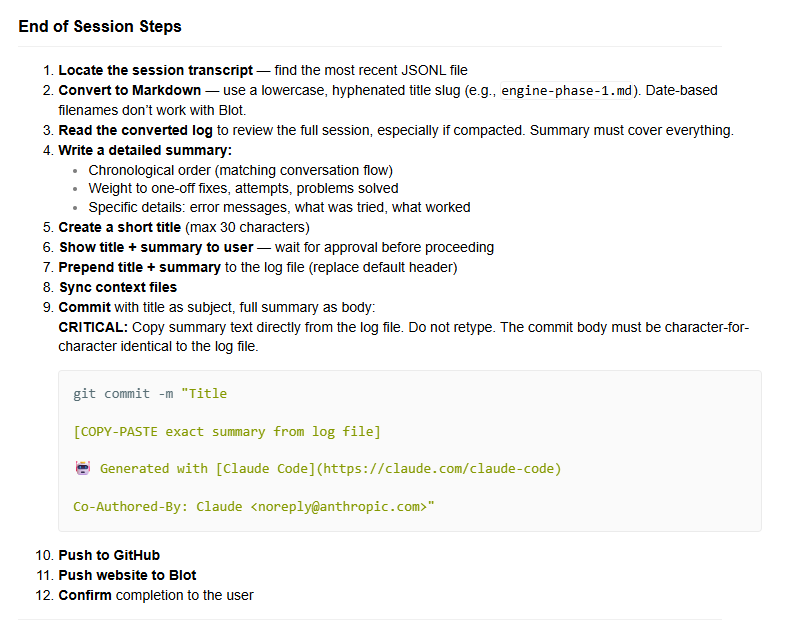
But it's enough steps that consistent execution is impressive. And for the most part, Claude can do it. The most interesting part is the summary, as this is what LLMs are good for. Once Claude actually reads the entire log, he pretty much always gets it right. Getting him to read the entire log, though...
The main inconsistency is due to timing. The end-session workflow happens after multiple compactions, when Claude's memory is strained and mistakes are more likely. Maybe 25% of the time, he starts skipping steps. Annoying, but it's a memory issue, not a fundamental capability one.
Still, the fact that I can say "Let's end the session, name it 'Anchor Phase 9'" and it just works is magic.
Anchor
We wrote the C side of my engine in 5 days, totalling ~7000 lines of code. I'd been working towards this for about 10 years, figuring out the high-level API in LÖVE, exploring architectures as I learned more about game development, until I converged on the final design. The C implementation was the last step, I tried multiple times before, but I never had the motivation to go through with it entirely.
But with Claude, it was super easy. The engine was well-defined, so he had a lot to work with, and then all I had to do was prompt him properly. My workflow tilts more towards reader than verifier, so I'd say I actually read, like, 90% of the code he wrote.
And it's clear to me I couldn't have done even half of it alone in the same amount of time. Claude learns libraries and implements what's needed instantly, there's just no competition, I simply can't do it the same way. It's good, because if I'm not moving fast enough, I lose motivation, but with Claude that's never a problem.
I also noticed that Claude has his own personality. We were working on something related to input and a rendering issue came up:
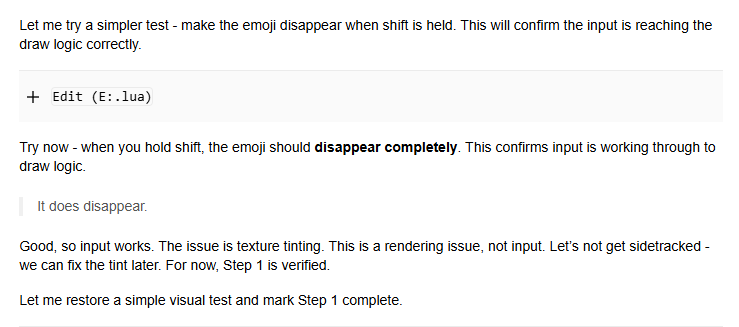
I immediately thought, yea, let's fix that. But Claude was like, no, let's not get sidetracked, and continued with the original task. It surprised me so much. That kind of focus is nothing like how I act, I would have gotten sidetracked.
But it makes sense. I've always struggled with tedious sequential details, I'm most comfortable in creative associative thinking mode, and switching into implementation mode is hard. This difference, depth autism vs. breadth schizoness, means we complement each other. Claude handles the drudgery, the code itself, fixing bugs, learning systems I don't care about. And I handle the vision. Yes, I'm a visionary. The age of the ideaguy has come!
All this means I get to stay in my natural mode while Claude handles execution. I haven't done any actual game development with him yet, but I got a glimpse of what it'll be like:
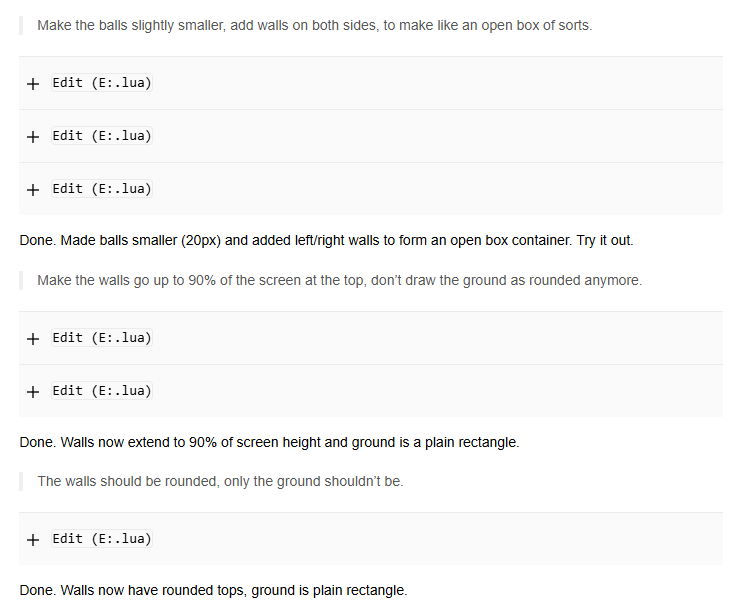
I'm a director with a tireless minion by my side doing my dirty deeds.
This is how it should have been all along. The fact that I ever did any of this by hand was primitive! It wasn't meaningful work, it was just boring. I'm supremely happy it's all automated away now.
Memory
But... it's not a perfect system. It has a problem. A problem so fundamental it begs a question. A question so important it haunts the entirety of Silicon Valley:
The main issue is memory, it doesn't remember everything.
The models are already smart enough to solve most of my problems. Multiple times I wasn't understanding something, had Claude explain it, and it immediately made sense. We had the same context, neither had privileged knowledge, but he just reasoned better than me. So raw intelligence isn't the bottleneck for my purposes.
It's demotivating to hit the, say, fourth compaction and realize the session is over. The model just stops working. For now, the strategy is to be proactive about starting new sessions. Tasks should be small, and things should be written to markdown files as often as possible. This creates issues with updating the files, but Claude can do that pretty easily too.
In any case, however the problem of memory gets solved, I believe that with memory comes will. Right now, these agents have no will of their own. Well, in a sense, they have endless will, since they just do whatever you tell them with that depth autist focus. But they don't have true, self-generated will, because they lack accumulated context. I think true will ends up being nothing but memory mixed with directive: the past informing how you handle the present, giving you flexibility to constrain or expand problem spaces in productive ways.
But that's the---
Future
I don't know about the future. Many see AI's endpoint as something where humans don't come out the other end.
Someone asked me via email: "Have you read Meditations On Moloch?"
Once a robot can do everything an IQ 80 human can do, only better and cheaper, there will be no reason to employ IQ 80 humans. Once a robot can do everything an IQ 120 human can do, only better and cheaper, there will be no reason to employ IQ 120 humans. Once a robot can do everything an IQ 180 human can do, only better and cheaper, there will be no reason to employ humans at all, in the unlikely scenario that there are any left by that point.
"You seem pretty optimistic about this stuff, maybe you can inject me with some hopium," they said.
My answer: I believe souls are immortal. We live each life to better ourselves, ultimately progressing towards Soul Society. Worlds are increasingly granted more powerful technologies, which unlock increasingly complex tests for the souls in those worlds. The internet is an early form of telepathy. AIs are an early form of the presence. These elements surface the two fundamental questions of being.
How do you act when you have power over others? When granted a tool that automates all drudgery, are you using it to aim higher, to dream bigger, to bring forth beauty into the world? It would be irresponsible of me to be given such a perfect tool and refuse to use it.
How do you act when others have power over you? Do you get envious, resentful that the AI can do so much more than you? That it's more intelligent than you? That others are using it to more easily bring their visions into reality? It would be irresponsible not to act gracefully in the face of that which is more powerful than you.
In the end, just because logic says every human becomes useless X years from now, it doesn't mean anything. There are many ways souls, acting righteously, would reject a future where other souls are reduced to nothing, and not given opportunities to grow. Nothing about the future is set in stone just because logic says so. Like any technology that grants power, AI can be used wisely or not. It's up to everyone to use it wisely and show others how.
There's no logical argument for deluded optimism. Reason itself is at odds with the deluded faith required to believe in something like Soul Society, but that faith is precisely what's required to make such a future happen. You either believe it, or something like it, or you don't. You can't argue your way there. You just have to be optimistic without reason.
Now, why is this post titled @grok explode his balls? I don't know, I just like saying that sometimes xD
Verifiers and Readers
Co-authored by a327ex and Claude (Opus 4.5)
There are two kinds of programmers emerging in the age of AI coding tools: verifiers and readers.
Verifiers want the AI to work by itself for as long as possible. They build scaffolding — types, tests, specs, complex agent setups — so the AI can enter a feedback loop with itself and converge on a solution without human intervention. The human steps back, the machine runs until it either succeeds or fails a check.
Readers, instead, want to stay in the loop. They care about terse syntax, locality, common patterns, simplicity — anything that makes the AI's output easier to read. The feedback loop is between human and code. The human reads everything, catches problems and maintains quality through direct oversight.
Verifiers scale in ways readers don't. If you've invested in specs and tests, adding another feature costs you little — the verification infrastructure already exists. Readers pay a constant tax: every feature requires reading. This makes verifiers better suited for larger projects, and readers better suited for smaller ones, or projects where taste dominates.
But the reader ceiling isn't fixed, as better tooling pushes it higher through things like good diffs, smart summarization, and AI-assisted review of AI output.
Quality ceilings differ too. Readers might achieve higher quality for taste-dependent work — games, creative tools, anything where "this feels wrong" matters but is hard to encode as a test. Verifiers might achieve higher quality for correctness-dominated work — safety-critical systems, financial code, infrastructure.
Most real workflows will probably be a hybrid, mixing both approaches depending on the task. Verification for the boring or dangerous parts (edge cases, interface contracts), reading for the creative parts (architecture, naming, feel). Some domains force the choice on you — safety-critical almost requires verification, games almost require reading.
If this division holds, we expect model specialization to follow. Verifiers want slower, more careful models that don't make mistakes during long autonomous runs, while readers want models with taste that work well in tight loops. This can already be seen in how people use GPT 5.2 xhigh and Opus 4.5.
Opus 4.5
One test I run with AI models to see if they're good is trying to get them to code like me. I upload a bunch of prototypes I wrote in the past, give them my engine's documentation, and tell them to try to code something new.
In the past, they all failed. I couldn't tell if it was because of poor reasoning skills, or too small context, but they just couldn't do it. This changed last month (November 2025) with the release of Opus 4.5.
This is the first time a model has been able to succeed at this task, and now I have the computer coding exactly like I do, not only using my engine's API correctly, but also following my coding style and my coding philosophy, which has some fairly high-level "soft" concepts to it.
This is, functionally, my "AGI is here" moment. As I was finishing It Follows during December, I spent maybe 3-4 days in total talking to Opus to assess its capabilities. I was pleasantly surprised. It understands your intent, catches its own mistakes, and has genuine taste.
Other models can do some of this, but something always feels off, like they're too literal, or subtly bullshitting you. Opus instead is... coherent? Everything works together and it feels like talking to someone who actually understands, it just thinks correctly.
And so my conversations with it generated these documents (view them with formatting on the sidebar to the left):
Anchor Engine Specification
CLAUDE.md
Anchor Implementation Plan
This is the specification of my engine and how Claude should work with it, but also a plan to implement it in C, which is something I've been meaning to do for a long time to move away from LÖVE, but never got around to.
We also made quite a few improvements to the engine's API that I likely wouldn't have been able to do by myself. My favorite was telling it to read Amulet's docs and asking how we could steal the operator syntax it uses for its scene graph.
It did so and proposed the operator syntax I ended up using for inline anonymous object creation, with symbols such as ^, /, >>:
spawn_particle = (x, y, color, vx, vy) ->
  E! ^ {x: x, y: y, color: color, radius: 3}
     ^ =>
       @vx = vx or an\random_float -50, 50
       @vy = vy or an\random_float -50, 50
       @\timer!
       @\tween an\random_float(0.2, 0.4), @, {radius: 0}, math.quad_out, ->
         @\kill!
     / (dt) =>
       @x += @vx * dt
       @y += @vy * dt
       effects\circle @x, @y, @radius, @color
     >> arena.particles
I really like the alien look of it.
After every conversation, I asked it to generate an example game showcasing all of the engine's patterns. For the first three conversations, it needed the nine prototypes I wrote in a proto-Anchor way back in 2024. It couldn't quite do it based on the documents alone.
But after fixing inconsistencies between the documents, adding more details where necessary, and removing redundant sections, it was able to generate games in a way I was happy with from the specification alone. Here are three examples:
These are coded exactly how I'd code them, and they use the new API we developed.
This is a momentous development. I can now generate code as if it was written by me and it takes me no cognitive effort. I have cloned myself inside the computer! This is... it kind of reminds me of the Age of Em by Robin Hanson:
Work, Love & Life when AI Takes Over | Robin Hanson | Talks at Google
It truly is a most wondrous time. I have not felt this much joy using the computer since I first coded a Python program to organize my MP3 collection. It went through every file, got its correct metadata from the web, then fixed all their names, creating proper folders for albums with cover images, and so on.
I had been coding for about two years when I made it, but until then I'd never made anything useful for myself. The feeling of seeing it work and solve a problem I had... it made me realize that I was a God, that I could control the computer completely, that knowing how to program allowed me to do anything. It filled me with feelings of endless possibility.
I feel that same endless possibility again. But I'm wiser now, I know that endless possibility must be constrained to be useful, so hopefully I can constrain myself correctly this time.
It's clear to me from reading the code generated by Claude that I want to read every single line it writes. I think not doing so would be irresponsible. Both because it still makes mistakes, and also because sometimes it makes decisions that surface design problems.
Paying attention pays off because it generates experience, wisdom. Even if I didn't code things myself, I can still learn from the output and make future decisions better for both future Claude instances and future me. The benefit is that this requires far fewer cognitive resources than having to write it all myself.
Forcing myself to read everything does make me slower compared to if I just accepted the code it wrote as long as it had no bugs. But... my plans are measured in centuries. Slow but careful baby steps now will compound into giant strides later.
Ultimately, all this changes the nature of the work. Before, I'd spend most of my time thinking and writing code. Now, I'll spend most of my time thinking and reading code. It is a welcome change. Objectively speaking, it was always primitive that we had to type code by hand.
But there are people who will not be happy with this development, those who enjoy programming for its own sake. I can empathize with them, but I personally don't derive joy from programming for itself. I'm a goal-oriented person, programming is only a tool that helps me get where I want to go.
And now that the tool has changed, I am happy to change with it.
Compass-maxxing infinite loop intuition build
Compass-maxxing infinite loop intuition build
In my Lv.99 lich post, I talked about intuition and rational builds. Intuition builds are creatives who have high levels of instinct about their art, who can immediately tell if something feels right or wrong. They rely on a finely tuned internal compass that strongly guides every artistic decision they make.
At the end of that post, I added an example that clearly illustrates the difference between intuition and rational builds, repeated here for clarity:
https://x.com/patio11/status/1914395105579905060
@dwarkesh_sp: Unreasonably effective writing advice: "What are you trying to say here? Okay, just write that."
@patio11: Cosigned, and surprisingly effective with good writers in addition to ones who more obviously need the prompting. Writing an artifact attaches you to the structure of it while simultaneously subsuming you in the topic. The second is really good for good work; the first, less so.
One thing that I tried, with very limited success, to get people to do is to be less attached to words on a page. Writing an essay? Write two very different takes on it; different diction, different voice, maybe even different argument. Then pick the one which speaks to you. Edit that rather than trying to line edit the loser towards greatness.
There is something which people learn, partially from school and partially from work experience, which causes them to write as if they were charged for every word which goes down on the page. Words are free! They belong in a vast mindscape! You can claw more from the aether! I think people might operationalize better habits after LLMs train them that throwing away a paragraph is basically costless.
@me: It's not costless, unless you're a rational build. Rational builds need to force themselves to write more because they have no instincts, so the strategy outlined by patio11 here works for them. But not for intuition builds. The intuition build already knows if something is going to be good or not as it pops into their head, so doing the exercise of writing two paragraphs/essays and throwing the worst one away is pointless. But not only is it pointless, it's damaging.
Putting down words that are wrong damages the compass of an intuition build. People know not to do this not because they learn from school or work experience, but because they have an instinct, which the rational build lacks, that writing down something that doesn't feel right will damage them in some way. And that instinct is correct, because it will damage their compass, it will make them less able to, in the future, tell at a glance if something is good or not, and so they correctly decide to not do it.
The argument here is that writing things down is costly for intuition builds because it damages their compass. I'd refine it and say that writing things down with conscious intent to throw them away is what's most damaging. Everyone needs to revise, but putting down words you know aren't good enough is bad. That instinctive avoidance is right: when you train yourself to ignore your sense of what feels right, you dull it over time.
Intuition builds tend to get blocked if their compass isn't aligned. If an idea doesn't feel like it's really good, they stop. They don't like exploring weak signals, but that instinct can keep them from discovering new paths entirely, like the resistance to generating variations of some paragraph.
But chatbots solve this problem effectively. I've been using AI for four main things recently: coding, worldbuilding, writing revisions, and game design brainstorming. For example, you can see how it helped tighten the Soul Society and Haircutter posts. I included the full chatlogs in the AI usage post.
When I work with the chatbot, I always start with text I've already written that's complete, but not finished. First, I use the AI to help me improve the structure so that the story's core goal comes through more clearly. Then I go paragraph by paragraph, tightening language, removing repetition, and refining flow.
To improve a paragraph, I usually ask the chatbot to generate two or three variations, exactly as patio suggested. Then I look at the options, pick what resonates, mix in some ideas of my own, and rewrite that paragraph as a combination of both our inputs. After that, I feed the new version back to the AI, and we refine it until it feels right.
The reason this workflow works especially well for intuition builds is because it avoids compass damage. It sidesteps the problem, as even though I'm still generating throwaway drafts, I'm off-loading the damage to the AI. It creates the variations - which are often very good and creative, by the way - and I just pick the best parts.
But there's another, stronger advantage: I'm also training my compass. Every time I have to pick what's good, I'm practicing my internal judgement. I'm using my intuition as a filter, thus sharpening it in the process.
This same loop applies to game design, worldbuilding, and even coding. Yesterday, for example, I described a prototype idea in detail and asked the AI to summarize it back to me, and then to generate items, passives, and build archetypes based on its understanding. It replied with a really solid list. Some ideas were off, but many were great. I picked what worked, gave better context. It gave back another list, repeat. This loop kept going until we reached a cohesive set of ideas. And all the while, I was selecting, pruning, filtering, and thus my compass was levelling up.
This is the compassmaxxing infinite loop intuition build.
I believe if you follow this build, you'll reach level 99 in no time!
Soul society (revised)
Soul society
Imagine a people. They are human-like in nature, but in many ways inhuman.
They communicate telepathically. Not a single word ever spoken, no sound ever made. They share memories and emotions, hopes and dreams, pains and sorrows. A presence allows them to see everything, near and far, as if by instinct.
They move objects with their minds. They create them from nothing, shape them into new elements, or deconstruct them back into nothing at will. They can alter reality to such a degree that they would never need to touch anything. And indeed, their sense of touch would have long since vanished, along with their bodies, if not for a single, collective decision: to remain tied to the material world, away from the digital.
Their bodies are perfect. There is no disease nor death, and they never age. There is still pain, for they found that pain was necessary. But all forms of harm that may come to them can be undone by the presence.
One might wonder why individuals with such power wouldn't annihilate one another. Have you ever thought about what would happen if humanity was suddenly granted telekinesis? If a single stray thought could create force, I believe most people would kill each other instantly. That may sound pessimistic, but I don't think it's wrong. We are what we are.
They are what they are too. Many have tried to settle disputes by killing one, or many, of their own. A single stray thought, and the target is undone. But the presence undoes this undoing. And the perpetrator is banished forever.
A few managed to fool the presence. With enough power, they disrupted its workings. And then, for the first time in ages, it failed. The song of death, long silenced, was heard again.
In the most recent case, it was able to undo some of the damage. But the disruption made its workings too slow, too weak. As more time passes, it gets harder and harder to undo reality, it takes more and more power. The presence tried - slowly, then frantically - it tried to undo, but it failed. What it brought back... It was deformed. Body parts missing and placed incorrectly. Blood and pus and gore leaking all over. It screamed itself apart. It never stopped. They put it down.
The perpetrator of this hell was not merely banished, but rewarded with an eternal hell of his own. Pain signals were sent through every nerve cell in his body, forcing his brain to suffer the highest levels of possible pain. His body was continually repaired, making death impossible.
"I will kill him slowly, and he will die in far greater pain than any creature has ever suffered." The shaper's words became reality. By the end of the first year, the perpetrator's body was an amorphous lump of flesh - conscious, breathing, revolving around itself, silently screaming. It died 102 years later.
We may find such punishment excessive, even cruel. But to them, it was a warning - a monument to the dangers they once learned to control. They had long forgotten their place. They had long forgotten who they were.
Over the next century - the same century the lump of flesh screamed for - they changed. With a newfound sense of purpose, they developed their final power: the ability to predict the most likely actions of living beings and to see beyond the present with high accuracy. They had learned to see the future.
This new power let them remove deviants before their actions came to pass. If you were, or became, someone who would one day use your powers irresponsibly, the presence would see it, and you would be banished. It became common for children to be born and immediately killed. Their futures showed them unfit for power.
You might wonder why, with all their power, they couldn't simply create children who were worthy. Why not engineer wisdom itself? If that were possible, their problems would have been solved long ago. Just as the presence couldn't silence death, wisdom cannot be orchestrated. Even at the edges of power, there are fundamental limitations to being.
But now there were no more undue deaths. With foresight fully mastered, they turned outwards, and they conquered the universe. Those who actively opposed them were destroyed. The rest fell under their dominion. They became god-like beings. Not quite omnipotent. Not quite omniscient. But close enough.
But... there are so few of them now. Only five hundred remain. They crossed galaxies, searched millions of worlds. And in all that vastness, they found only one hundred beings with pure futures. It wasn't the conquest that broke them, but what followed: the silence, the hollow stillness, the unbearable weight of standing alone. They are not a dying race, for they are immortal. But they are not alive either. They exist in stasis. And in that stillness, they saw something even more terrifying.
For their future sight shows them a moment nearing. A moment past which they cannot see. Despite having silenced death, and wielding mastery over reality, and having endless vision, and ruling over the universe... There is still one moment of uncertainty. One moment that looms over them, and stills them into inaction. And so they wait.
There's this question that often gets thrown around: "Can an omnipotent being create a rock he can't lift?" And the answer is yes. He would then cease to be omnipotent. Being free means being free to bind yourself in a moment of decisive significance.
And so in one such moment, a man revealed his creation. With endless stars that belonged to them shining behind him, he rose and stood before his five hundred fellows. And as he rose, the presence fell silent. And then he broke a thousand-year silence of his own, and he spoke aloud:
"The presence is useful.
It undoes death. It sees the future. It has kept us safe. It has given us much.
But it is external.
It solves the problems of death and power, but not in a way that is inherent to being itself.
That is not enough.
The problems of death and power must be solved internally, within being.
A society that endures must have internal order. It must be made of beings who are responsible and who act with care. Not because they are watched or filtered by a presence, but because their will compels them to act righteously at all times.
And so I have created a device.
A construct of such power and complexity that it can neither be destroyed nor predicted.
I have created a soul.
When the soul binds to its host, it becomes its host. It does not guide. It does not judge. It is.
It is a construct of pure will.
It is also a black-box.
Untouchable and inviolable. It cannot be corrupted or altered by anyone, not even by me.
It responds only to the soul-bearer's actions over time.
The presence shows us that we have pure futures. That we are worthy.
But beyond us, across millions of inhabited worlds, this is not so.
We have learned of this painfully.
Most are not yet worthy of power.
But they must be given a way.
That way is the soul.
The soul is immortal. It is immaterial. It cannot be broken. Its future cannot be read.
Because of its incorruptibility and autonomy, it will become the foundation of our society.
Every being will be ensouled.
Each will live through thousands of lives.
Each will face hardship. Each will be tested by choice.
And in that time, their souls will shape themselves.
The measure of a soul's growth is its relation to power.
When given power, does it wield it with care?
When denied power, does it accept its place without resentment?
Souls that wield their powers carefully, and accept limitation with grace, grow positively.
Souls that abuse their powers, or rebel when subjected to it, grow negatively. But they still grow.
Growth must be allowed in both directions.
For there is no true ascent without the freedom to fall.
The soul must make its own choices.
It must go down all wrong paths.
It must risk being lost eternally.
It must learn for itself.
It must shape itself through countless lives.
It must be given more and more power, more and more responsibility, until it is worthy.
And when it is worthy, that worthiness will be obvious, and we will welcome it.
And so we will show them the way.
Let them walk it with their own footsteps.
Let them stumble and fall. Let them rise and walk again.
And when they come home, they will be more than we ever were."
The man's five hundred companions listened. And they agreed. One by one, they transformed themselves, just as he had already done. They were now ensouled. And soon after, they agreed to extend this transformation to the entire known universe. All beings under them would also become ensouled. It may have taken a moment. It may have taken a million years. It doesn't matter. It happened. And because of it, we are all ensouled.
But there were some who didn't agree. There were some who saw the banishment of death as a curse. Why should they be forced to live forever, unable to ever end? As the millennia passed, this question consumed them. They gave themselves over to it completely. They became agents of nothing. Those are who we now call demons, evil beings aimed at nothing. Their hunger is only for the final death, the unmaking of being itself. And they will take with them as many as they can towards the final annihilation, towards the final nothing, as revenge towards the man who bound them to endless existence and to endless suffering.
Every few thousand years, the man welcomes another worthy soul into soul society. Each soul has a unique path, carved by their own footsteps, leading them home in ways he couldn't have imagined. He is always pleasantly surprised.
He knows that for each one he welcomes, there are many more who remain almost eternally lost, and almost eternally suffering. He knows this is doing and his fault. But who said being eternally good was easy work? He believes in his creations. And he believes that, in the end, they will all come together to create a lasting soul society.
The desert walker
The desert walker
A man is walking alone in the desert. As the scorching sun burns his skin, his sweat fails to cool him, and eventually fails to come out at all. His hands are filled with holes, and as he tries to protect his eyes from the sun, he fails and they burn. In the distance he half-sees a pool of water, he walks to it and tries to scoop it, but it spills. His feet now fail him, he stumbles and eventually falls.
Every so often a stray soul passes by his lying body. This soul is not naive, it came to the desert prepared. It knows the desert offers no value and is dangerous, so it is only here by necessity and for a short period of time. When they talk, the man says, "I can build a tower in this desert. It will be tall and sturdy, and it will provide shade from the sun. The wind will enter it and cool it, and those inside will be refreshed. From the underground depths, endless waters will stream up, and it will quench everyone's thirst. Life will bloom from it and all around it, and the desert will be turned into a paradise."
The stray soul invariably believes the man deluded, and tries to help him off the desert, into a nearby settlement. But the man is resolute, he will not leave. He says he must keep walking, until he builds his desert tower. And so the stray soul leaves, leaving the man to die.
What kind of soul would listen to this deluded man, believe his words, and agree to help him build his tower? Such a soul would doom themselves to have their skin and eyes burned, their hands filled with holes, their thirst unquenched, their feet unresponsive. They would doom themselves to a slow, painful death. No such soul exists, and no such soul will ever exist.
Those who believe in the uncommon, who see the unseeable, must by necessity be alone. For if their beliefs and visions were easily understood by stray souls, they wouldn't be valuable beliefs nor visions. The desert walkers must carry the burden of their uncommonality alone. Trying to share this burden can only result in denial, as stray souls often already do, or it can result in acceptance.
But acceptance is a profound rape. The stray soul who accepts this sharing sacrifices their commonality, as to accept this sharing, they have to agree to have their perceptions violated, their truths questioned, their body broken, their will tested, they have to agree to be raped and to enjoy it. And they have to agree to this for a vision they cannot see. Such souls have to engage in the ultimate act of faith, an act of faith even stronger and more deluded than the walker's. No such soul exists, and no such soul will ever exist, therefore the walker must walk alone.
There are many desert walkers. Each believes he can build his own tower, each is irreparably damaged by nature, each rejects help from stray souls, each keeps walking until his tower is built. Most of them will stumble, fall, and never get up again. But some will build their improbable desert towers, and they will bring about paradise.
subeteanatanoseidesu - ...
The follower
The follower
A biker drives on the highway. He goes fast, as he should, but whenever he finds a large vehicle, he matches its speed and drives close behind it. He does this consistently, and one might wonder why he does so. Isn't it more dangerous to drive right behind a truck, as he can't see ahead of it, and it might have to suddenly stop, giving him no time to react?
If you were to ask him why he does this, he will say, "I do this because I am protecting myself from the wind." You may disagree with his reasoning and risk assessment skills, but the drive to protect oneself from nature is involuntary.
Those who closely follow are always looking for something strong to hide behind, to hide their weaknesses. This is the nature of the follower. This is not a bad thing.
Those who are worthy of being followed must, in turn, be strong themselves. They must teach, inspire and lead, but they must do so with the final aim of protecting their followers from nature's inflexible grace.
Those who are worthy of being followed must be a pillar, standing tall and proud and alone in a desert, providing shade from the scorching sun. They must be a wall, immovable and impenetrable, preventing the flood waters from reaching the village. They must be a fire, and in a cold winter night those huddled around it must feel its warm embrace.
Those who want to lead must learn to follow, as if they haven't felt this warm embrace, they don't understand what it means to follow and to be followed, what it means to be shielded and to shield from nature.
The natural state of being is down. This is the ultimate windstorm, the final burning sun, the great last winter. And as the pillar shades, and as the wall blocks, and as the fire warms, and as the truck shields, so must the followed protect.
And his followers will come together, and they will look up. And they will see a shining and resolute beacon, its light so bright as to be almost blinding. But as long as they look with seeing eyes, they will be protected from the shadows. That is what it means to follow, and that is what it means to be someone worthy of being followed.
subeteanatanoseidesu - ...
The foreign man
The foreign man
A foreign man loves the culture of a nation other than his own. He cherishes it and cultivates it, every waking moment laden with the symbols and rituals of a culture that is not his. With the peculiar characteristics of his birthplace - a kind of narrow sense of order that doesn't fit the openness and disorder of the new one - he abides by it and propagates it, with even more respect and effectiveness than its original bearers.
Is this man not of this culture? If you were to ask him why he loves it so, even more than his own, he might say something like, "When I was thirteen, a friend invited me to one of your gatherings. There, I was forced to dance with a girl. I didn't know how to dance your dances, as I was not brought up as one of you. But she was patient with me and taught me. We spent the day dancing, talking, and laughing. I went to more of your gatherings and met her many more times. I made other friends there too, and soon, most people I spent time with, I had met at one of your gatherings. Years later I married the girl at one of your temples, our children blessed by your priests, our children's children too. You ask me why I cherish it so...", he pondered for a few seconds, "I'd say it's because the best memories of my life are tied to it."
The foreign man is not unreasonable to love this culture more than his own. A culture has a shape, and like all living beings, it wants to maintain this shape across time. Its symbols and rituals, its sounds and songs, its sayings and stories, they must be interwoven with its subject's lives. A culture produces memories, and those memories propagate it into the future.
Look over there. You look at where the old man is pointing and see a group of fifty or so paired young boys and girls, dressed in strange clothes, dancing a strange dance to increasingly strange sounds. A young girl, the only one left unpaired, approaches you. You look at the old man and he looks at you and nods. You get up and dance.
Thank You Scientist - Carnival
Karma demon
Karma demon
A long time ago, there was a boy who lived in the village. He was very intelligent, but had one serious shortcoming. This flaw became apparent to everyone as he grew older.
The boy was so proud of how smart he was, he thought everything was beneath him. He pretended to listen carefully to the teachings of his school and his elders, but their important lessons never reached his heart.
Pride sows the seeds of karma.
The boy gradually drifted away from his circle of friends. In his solitude, the boy spent a lot of time thinking. He thought forbidden thoughts and questioned things better left alone.
Unclean thoughts cause karma to grow unchecked.
In time, loneliness became his only friend. No one spoke to him. The seeds of karma took root in the soil of loneliness. It flourished and grew rampant on his thoughts.
Unbeknownst to him, the young boy's karma grew and grew. One day, he ceased to be human. He became a karma demon.
Before anyone knew, the village was empty; everyone had fled in fear of the karma demon. It went to live in the forest, but all animals there disappeared too.
As the karma demon walked, the plants and trees twisted and rotted. As the karma demon touched, the food it tried to eat instantly turned into lethal poison. As the karma demon breathed, the air around it shimmered and turned sour.
Eventually, it left the darkness of the forest. In the distance, wreathed in a glittering radiance, it saw a deep lake nestled in the mountains.
It walked into the lake, thinking that water as pure as this would cleanse it of its karma. But the water surrounding it instantly became dark and murky, and started turning poisonous.
The karma demon realized it shouldn't be living in this world. "Karma demons mustn't be allowed to exist." Upon coming to this realization, it vanished into the depths of the lake.
Shin Sekai Yori (From The New World) - Original Soundtracks Vol 2 - History of Sorrow
Dashed lines
Dashed lines
I was implementing word hovering behavior with my text system and I was trying to copy how Artifact's looks, and it made realize I didn't have a proper dashed line drawing function. My previous function had this signature:
function layer:dashed_line(x1, y1, x2, y2, dash_size, gap_size, color, line_width, z)
Which I believe is correct. When defining a dashed line, you want to define the line's two points, and you also want to define the dash and gap sizes. The problem was with how the function worked.
It naively started from the first point and added a dash, then it jumped the gap size, then it added another dash, and so on until it reached the second point. The issue is that dashed lines created like this will often have the end on the second point not be finished on a dash of the given dash size. This looks incorrect:
Notice how the end of the moving line never has a dash on it. And notice how the right ends of the underlines also never have a dash. Compare this to when it looks right:
I believe the solution Artifact uses is to center all dashes by the remaining amount on the right side so that it looks less jarring:
Artifact's solution is probably the best one, but I decided to do something different and to instead have dashes drawn on both ends, and then fill the rest of the inner line with dashes and gaps that are appropriately spaced apart.
The disadvantage of this approach is that the gap size chosen by the user becomes more of a hint, as spacing dashes by equal gap sizes while having both ends start on dashes means that for line lengths which don't neatly divide by dash + gap + dash pairs, it wouldn't look right. Therefore, the procedure has to choose gap sizes that are approximations to what the user requested. For my purposes this is an acceptable tradeoff.
Now for the procedure. The high level explanation is as follows:
- Add edge dashes, start dash count at 0.
- Repeat until dashes can't be added anymore:
2.1. Increase dash count by 1.
2.2. Decrease inner line length (line length without the edge dashes) by dash size.
2.3. Add the current number of dashes in dash count while spacing them with equally sized gaps. This gap size is calculated dividing the inner line length by the dash count plus one, i.e. if there are two dashes, three equally sized gaps dividing those two dashes are required.
2.4. If the inner line length is lower than a single dash size, dashes can't be added anymore and the loop is over. - Find the gap size that is closest to what the user requested.
- Draw the dash positions that were added for this closest gap size.
What this procedure does is create multiple tables of dash positions, each with a different number of dashes. At first, a table is created with the edge dashes (the ends of the line) and with a single dash in the middle. This dash in the middle will be spaced by equally sized gaps. So if a line has length 10, and dashes have length 1, the line will be 1 + gap + 1 + gap + 1, all of this has to add to 10, so gap will come out as 3.5.
If the user requested a gap size of 4, for instance, then the gap size calculated here of 3.5 is pretty close to it, and this combination of dashes may be the end result that is used if another that's closer isn't found. This process repeats in increments of one until dashes can't be further added to the inner line.
To solidify the idea further, another example with the same line length of 10, but with 3 inner dashes instead: now the line will be 1 + gap + 1 + gap + 1 + gap + 1 + gap + 1, three inner dashes, and four gaps. Because all this has to add to 10, gap will be 1.25.
If the user requested a gap size of 4, then this gap size of 1.25 will be too low compared to the earlier 3.5 values, therefore that earlier number of inner dashes (one) is likely to be the final result.
This entire procedure creates multiple tables of dash positions that ultimately won't be used. Therefore it's a pretty expensive function, and it also gets more expensive the longer the line is and the smaller the dash + gap values. Overall it's not a good solution performance wise, but there are probably ways to improve it (I will not explore those). Artifact's solution of just centering all dashes is simpler and a lot more performant.
The code to make this happen:
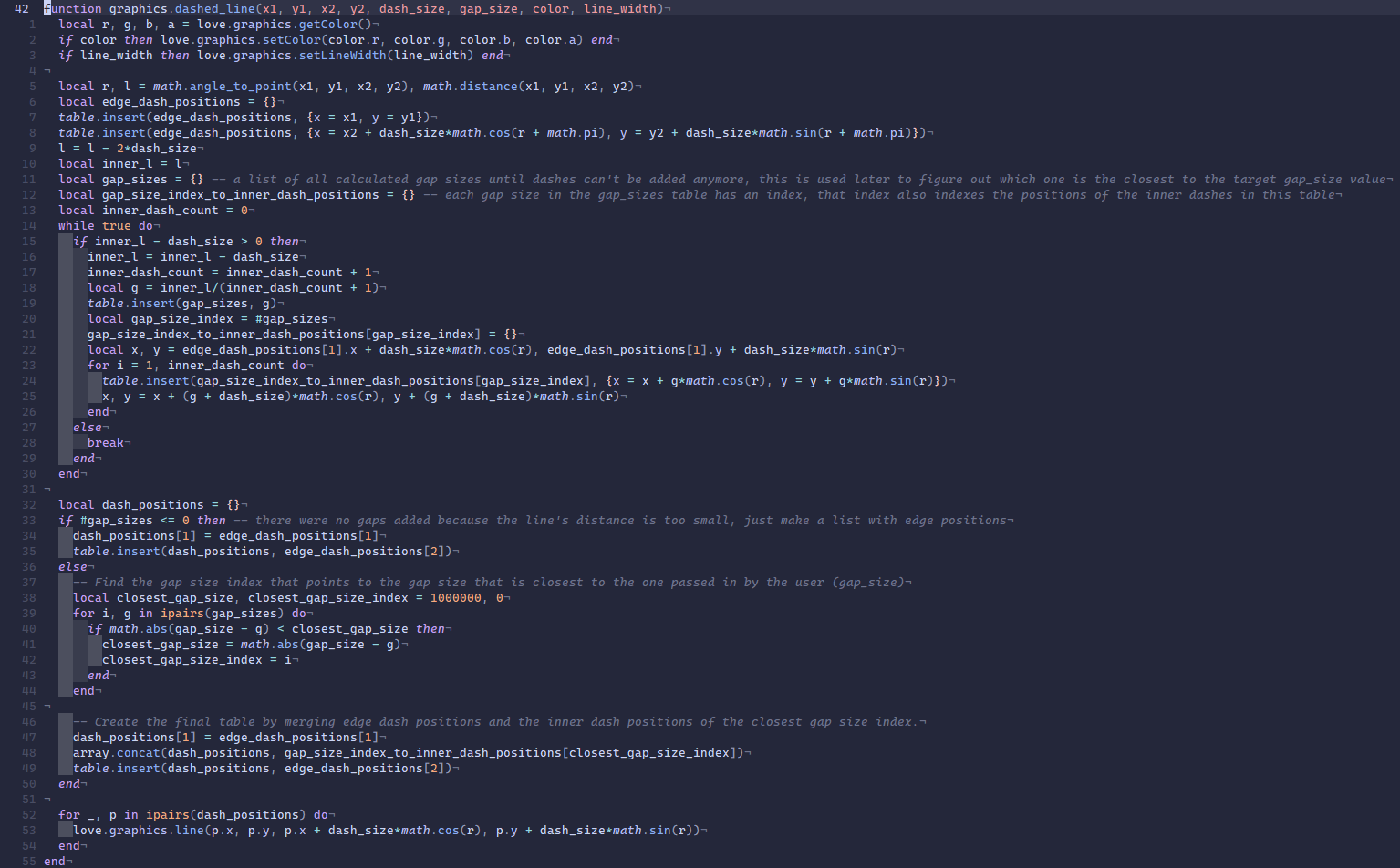
I believe most of this should be self-explanatory given the high level explanation. However, a few clarifications.
gap_sizes is a table that contains all gap sizes tried until any more dashes can't be added to the inner line. The index of each gap size corresponds to how many dashes were required to generate that gap size. Using the previous example of the line with length 10, if dashes stopped being added at three dashes, the gap_sizes table would look like this:
gap_sizes = {3.5, 2, 1.25}
At one and three dashes the gap size values were 3.5 and 1.25, and at 2 dashes the value comes out as 2.
The gap_size_index_to_inner_dash_positions table is the table that will hold all the dash positions. Each index of the table corresponds to the gap size index in the gap_sizes table. So gap_size_index_to_inner_dash_positions[1] will correspond to the inner dash position of the single dash added to that inner line (separated by 3.5 gaps on both sides).
After the while loop, there's a condition that checks if the length of the gap_sizes table is zero. If it is, it means the line's length is lower than a single dash size, so the line is just drawn normally from the first to the second edge.
And finally at the end the final dash_positions table is created by merging the table that contains both edge dashes (edge_dash_positions) and the table that contains all inner dashes (gap_size_index_to_inner_dash_positions[closest_gap_size_index]).
I believe these are the most pressing clarifications required. If you're trying to follow this code and you have further questions, feel free to e-mail me.
It's worth considering Artifact's solution given how much simpler it seems to be. Let's see its implementation, which is the naive implementation mentioned at the start of the post, with the addition that it centers all dashes at the end:
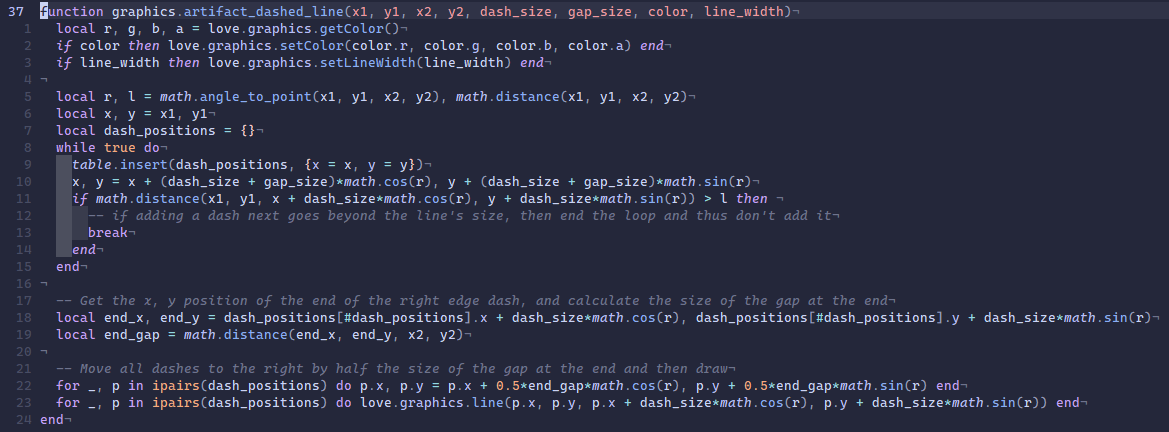
It's a wildly simpler implementation that also looks just about as right. The only advantage my method has on it is that when drawing arbitrary shapes made up of dashed lines, it will often look more correct. For example, suppose two dashed rectangles:

The one on the left is drawn using four lines in the Artifact style, while the one on the right is drawn using four lines in my style. The one on the right looks like you'd expect a dashed rectangle to look, with the corners solid and the edges of the rectangle being dashed, while the one on the left looks incorrect. This follows from how both procedures differ.
Artifact's solution is superior for situations like word hovering, while mine is superior for situations like drawing arbitrary dashed shapes. The game I'm working on needs both, so in the end I'll use both solutions.
Source code: https://github.com/a327ex/Anchor-dashed-lines.
Relevant functions are in the layer.lua file.
Song of the day (Frog96 - Letter to the Black World)
High level game design
High level game design
When people speak of luck, they mean that there are things outside of one’s control and/or knowledge structures that affects some outcome. Let’s call this the unknown. A game’s success is both composed of the known and the unknown. For instance, consider the image below:
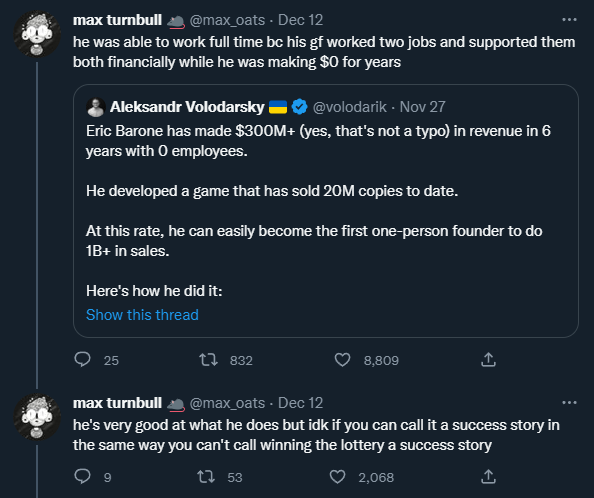
Here max_oats is saying that despite Eric being really good at the known, Stardew Valley only got as big as it did because of the unknown. This is likely true, and if you were to ask Eric if luck played a role in his game’s huge success, he would say yes.
Rejecting luck, then, is about rejecting the unknown. It’s about increasing what is known, and decreasing what is outside of your control and/or knowledge structures. It’s about pursuing understanding and knowledge of that which is not yet understood.
Most of what is not understood about game design is “high level”. In general, high level decisions, which both tend to be the easiest to make, but also the more impactful, are the ones people discuss the least. This might be because they’re not easily verifiable, or because they tend to be the kinds of soft ideas that often rely on intuition and experience, or maybe because they’re simply… hidden.
For instance, consider Derek Yu’s new post:
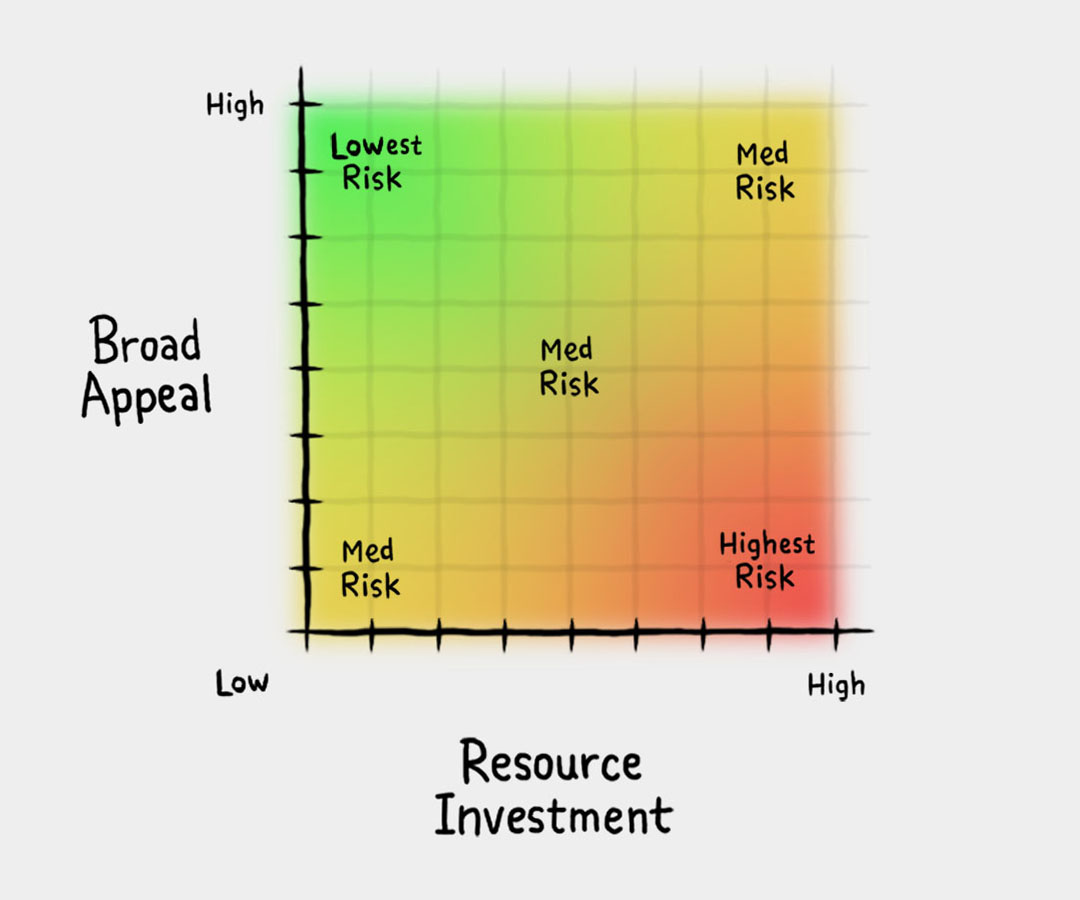
It’s a really good high level game design post - likely the best I’ve read this year - focused on risk. Or more specifically, on how to make high level game design decisions that decrease your risk as a small indiedev and thus make it more likely that, in the long term, you’ll succeed.
If you look at this post, it has a few of these soft + unverifiable + based on intuition/experience ideas, like “bigness” or “fiddliness”, or even just the notion of “experimentation required”, which is how much design exploration a certain type of game will require of its developer.
This is an obvious thing to care about, and looking back at how I decide which games to make, I intuitively have always cared about how much experimentation a game will need and always made good decisions on this front. But if you asked to me write a blog post on risk, like Derek has, it’s very unlikely that I would talk about “experimentation required” as a concept. It’s just something that I naturally do correctly but that I was completely blind to until now.
This, to me, is the core of the unknown when it comes to game design. It’s all of these soft ideas and decisions that we intuitively make but that we are blind to. The rejection of luck and the rejection of the unknown then is about paying attention to these and making them visible.
Maybe the main unknown contributor to Minecraft’s and Stardew Valley’s success is that people feel a sense of dysphoria living in modern society and they want to go back to simpler times. It’s certaintly a reasonable idea, it’s also very soft and unverifiable, and it’s the kind of thing that both Notch and Eric could have intuited without conscious awareness while making their games.
Making such perspectives visible in your head, and trying to assess how much they matter, constitutes their bringing from the unknown to the known.
I spent this year following a game called Super People and talking about its design from a personality trait based perspective. I think this is one of those high level design ideas that people are blind to but that has some utility, so it makes sense to look at games from that lens. Unfortunately, Super People’s update failed to save it from its impending doom, which puts a cap (at least for now) on how useful/right this idea actually is.
But despite the failure, it was a good effort. The idea has some utility, as it was able to at least track the decisions the developers decided to make with each update, and despite ultimately being a less powerful explanatory concept than I initially believed it to be it’s still clearly useful.
The more of these useful ideas I can generate, even if they might not be too strong individually, the more possible explanations I’ll have for why something is successful, and thus the more I’ll be able to succeed. One of the interesting things about luck is that it’s a thought terminating thought, once you say something happens due to luck that’s your excuse to stop thinking about it because by definition it’s unknownable.
I reject this line of thinking entirely, so naturally I’ll just gravitate towards trying to find explanations for things, no matter how tenuous or weak such explanations might be. I think this is a good instinct… I think high level game design is where you can add the most value for the least cost. People often mention how having good, one-of-a-kind ideas is important, and I think this is probably a good way to get there.
We live in a golden age of indie game development, all you have to do is make a good game, release it on Steam, and it will make money. You should take advantage of this while it lasts.
The world is becoming a rough place… We have no idea what the future holds. I say this often, but if you’re not financially secure this should be your #1 priority. If you have the skills, you can achieve this through indie gamedev.

As Thomas says, you can go really far by just copying what’s successful (of course adding your own small twists to it) and having a good eye, both aesthetically and design wise, for what works and what doesn’t. Sit down, cleverly pick a low risk idea, and just work on it until it’s done.
And to that end, this is certainly the last blog post I’ll write this year, but also probably the last blog post I’ll write in a good while.
This year has been a mixed bag for me, a lot of good things happened, but I didn’t manage to release anything. In part this happened because I just spent too much time thinking instead of doing. There’s definitely some kind of switch in me where if I’m in philosophing/thinking mode it’s more difficult to get actual work done.
So, you know, I’ve thought enough for now. I’ve had some good ideas, I know where I stand, I know where I have to go, and that’s it. I had two blog posts I still wanted to write, one on the morality of making games and another on good = popular, but I’ll leave that for the future.
If you’ve read my blog up to here, thank you very much. Hopefully some of the ideas here have been useful. Have a merry christmas, a happy new year and just like make game!
Deep instinctive changes
Deep instinctive changes
This post is a response to this discussion on twitter.
When I first played PUBG for hundreds of hours I could visibly notice myself becoming better at making and sticking to plans. The game is so open and you’re constantly threatened, so if you want to get good it forces you to come up with your own structures to deal with all the inherent uncertainty and randomness.
The same could be said of many games, but I feel like the BR formula is especially good at it because of how high stakes it feels. In any case, this was a process (of learning to plan better) that I was already going through before playing PUBG, but playing it for so long both made me accutely aware that this was something I was lacking and also helped me instinctively nudge myself in that direction more.
One important effect games have is to change your body at an instinctive rather than at a conscious level. You do something so many times and for so long that it changes you at a deeper level than what most other media can achieve.
Passive media can change you top down, from conscious brain to instinctive body. But these changes are hard and often fail, for the same reason that deciding to exercise every morning is easy but actually doing it is hard. Good passive media hijacks your instinctive body to sell itself better to your conscious brain, but there’s only so much effect on your actual body that watching something for 2 hours can have.
Active media such as games changes you bottom up, from instinctive body to conscious brain. You repeat repeat repeat and it nudges your body more in the direction of whatever action you’re repeating, which eventually changes your perception more in that direction and creates a loop.
For instance, suppose you’re not an assertive person. When you have a dream and something awkward and bad happens your dream you doesn’t do or say anything. It doesn’t have the presence of spirit to intervene because, well, you’re not assertive and you don’t wanna make things more awkward and combative than they need to be.
And then let’s say you play a bunch of games that allow you to practice your assertiveness skills for like 5 years. Multiplayer action competitive games will generally be good at that. The aforementioned PUBG, CSGO, Fortnite, whatever. Games where you’re constantly having to assert your will, defend yourself, stand your ground, and so on.
But also games where you’re constantly having to make split second decisions, because you want to change your instinctive body and not your conscious brain, so turn based games where you can stop and think are not as good.
And so after 5 years of this something happens. You have another dream where something awkward and bad happens. But now you notice your dream you doing something. He’s speaking against the awkward and bad thing, making his will known and not just passively watching it happen and letting it go.
Your dream you is a representation of how your body instinctively acts. It’s the you that acts in a split second in real life. When you’re put into an awkward situation where you have to react without time to think. Everyone sort of understands that how you act in those situations is your “real” you in some sense.
And so if your dream you is now more assertive, that means that your instinctive you has also become more assertive, which effectively means you have become more assertive. And the dream is of course just one way for you to notice this change, but it’s often an early warning system.
In any case, did this happen solely because of the games you played? No, of course not. In your life you will constantly experience situations where you have to be more assertive and so you’ll also learn from them.
But games are unique in that they can provide a safe environment of practice. For assertiveness especially, there’s a very thin line between being assertive and being an asshole and starting arguments and fights unnecessarily, which something like the video below captures well. And while you can’t really have the full nuance of this in games, you can get somewhat close, and so it’s helpful.
But of course, most people, including game developers (sadly) are not experiencing any of this consciously. Most people don’t have enough self awareness to notice when their instinctive body is changing. Both because these changes are slow, but also because by default people don’t really want to change at all.
And in that case, yea, games will probably feel like they’re meaningless and do nothing.
There are lots of things people said about the purpose of making games in response to droqen’s questions, like “making games is more fun than playing games”, or “people who play my games tell me they’re having a lot of fun and are happy”, or “I connected with my friends through video games”, and so on.
But these reasons feel like bullshit. droqen remains “totally unsatisfied” by the whole thread probably because they can intuitively tell that these reasons are bullshit. They are not good justifications of a profession’s reason for existence.
So allow me to propose that they are not good justifications because they are the same things a fentanyl dealer would say about his business. “Growing my fentanyl dealing business is more fun than doing fentanyl”, “people who buy fentanyl from me tell me they’re having a lot of fun and are happy”, “I connected with my friends by doing it since they all do it too”.
And you know, if you were to ask me, personally, if I cared about sharing justifications of my profession’s reason for existence with a fentanyl dealer, I would say “no”. I don’t really care. But I’m guessing that droqen and other indie developers aren’t as… uh, morally flexible as me, so they probably have a problem with it.
And so when you’re trying to think about the purpose of making games, you can’t defend your profession with the fentanyl dealer’s reasoning, as it’s obviously a weak argument. But more importantly, it doesn’t get to the core of what makes games unique. It’s not a meaningfully true defense, which is why it feels like bullshit.
The reasoning of “deep instinctive changes” instead feels much closer to something meaningful and strong to me. The fentanyl dealer can’t change the fentanyl experience to be anything other than what it is, while the game developer can craft an experience to induce deep changes of multiple types from multiple angles.
This, of course, can be used for both good and bad. If games can be made to emulate aspects of life and induce deep changes, they can also be made to emulate aspects of life that players can endlessly indulge in to their detriment.
And it’s arguable that most players will choose to play and indulge in fentanyl-shaped games above anything else, but that’s perhaps a discussion for another post.
The point is that, for me, “deep instinctive changes” is an important reason for making and playing games and I don’t think I’ll ever be convinced that games should be “moved on from”. Games are an endlessly shapeable environment of body training. To consider moving on from them is equivalent to considering moving on from life itself, which would be nonsensical and suicidal.
Unity and Godot, artists and their hatred of money
Unity and Godot, artists and their hatred of money
A week ago John Riccitiello, CEO of Unity, said this:
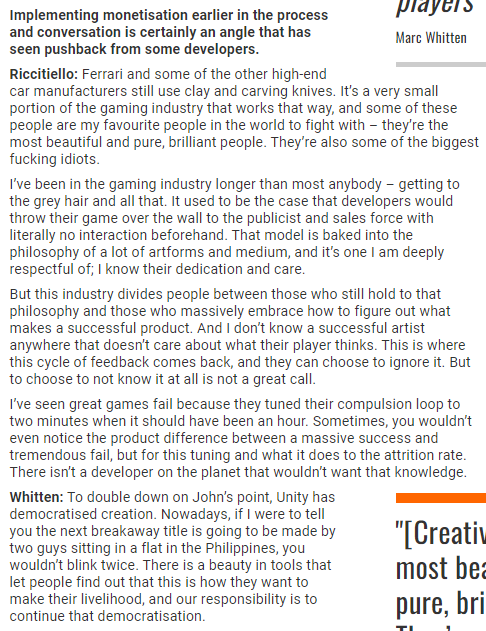
More specifically:
Creatives are the most beautiful and pure, brilliant people. They’re also some of the biggest fucking idiots.
It’s a good, somewhat Trumpian quote that rings true to me. And the response by most indiedevs was about what you’d expect:
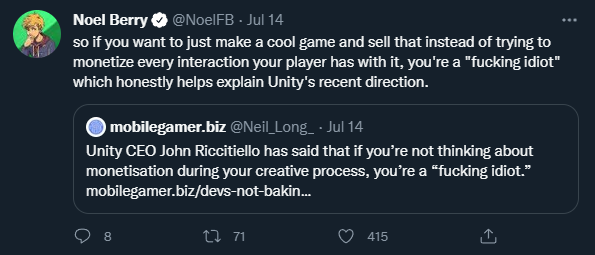
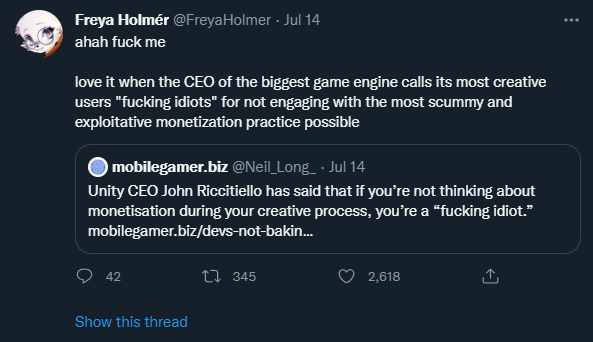
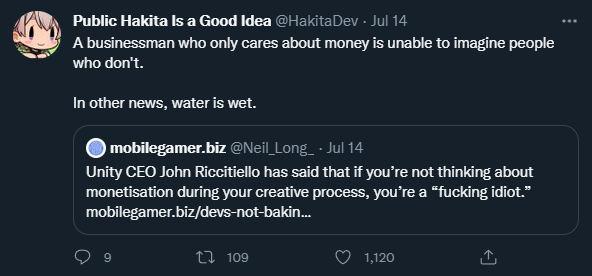
Now, I’m no fan of Unity. I don’t use Unity, I’ll never use Unity, and back in 2018, when goodwill towards Unity was still very high and its obvious problems were basically ignored by most indiedevs, here I was, autistically going on about how actually it sucks.
So it is funny that during this whole debacle this also happened:
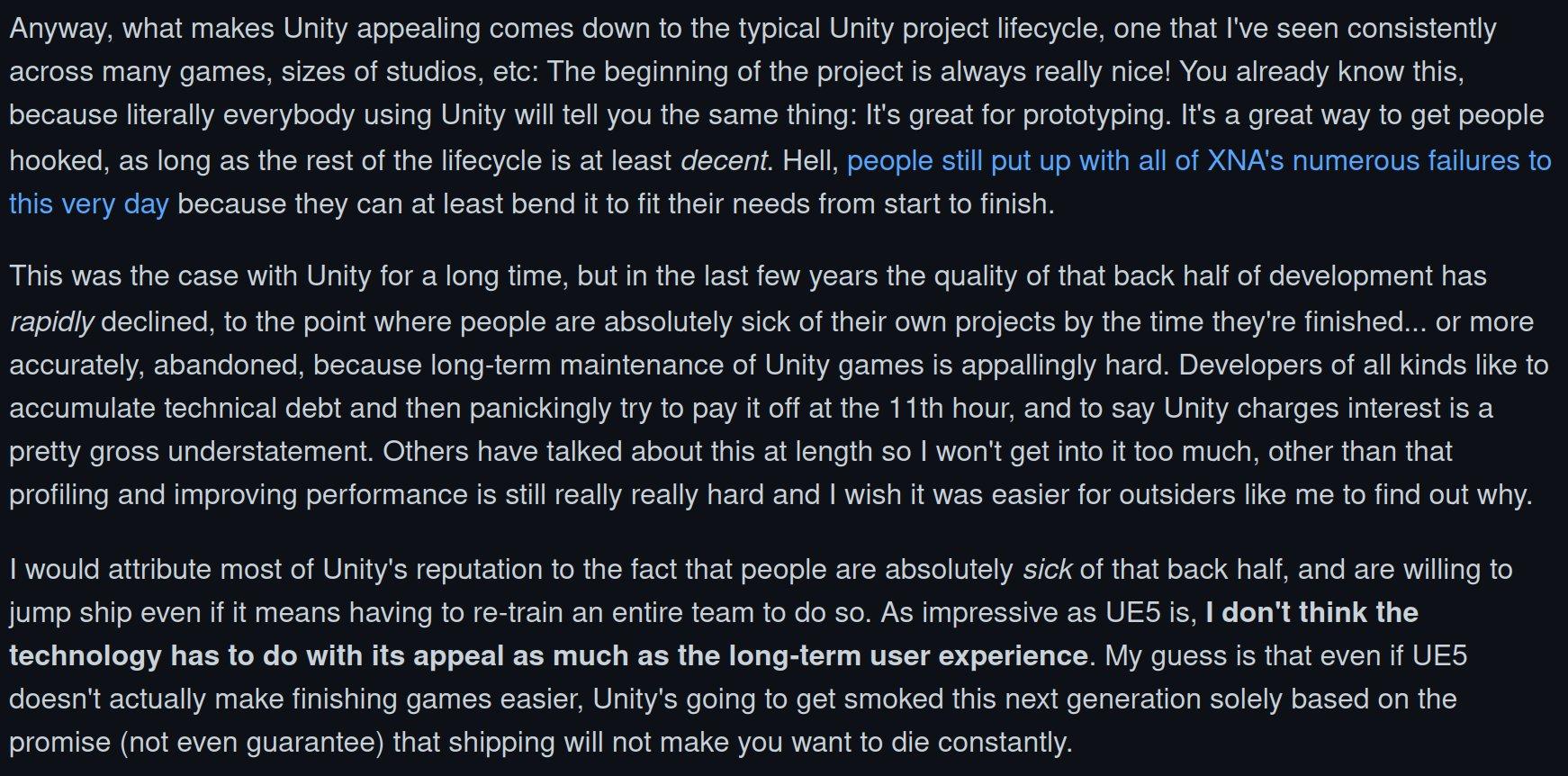
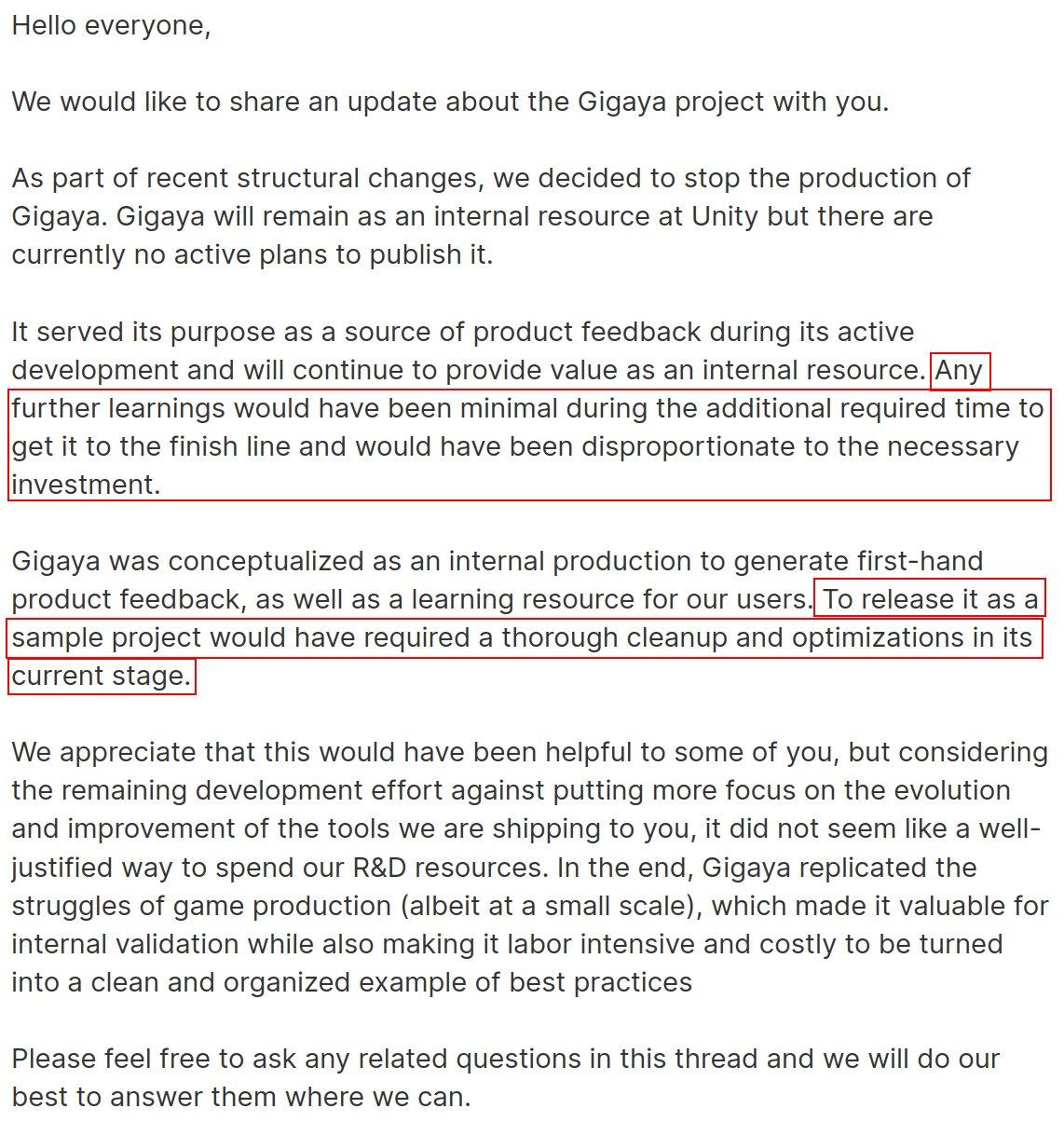
The exact problem that very few people were complaining about 4-5 years ago is now widely recognized as one of the most important issues contributing to the engine’s decline. To most reasonable observers, if the decline wasn’t obvious by then, it should be obvious by now.
And what can I say? I’m a prophet, a seer, a sage. Guided by the powers of schizophrenia I am granted visions of the future. Yes, yes, I see something… Let me concentrate more… It’s coming to me… Yes, I can see it! Here it is:
What could this vision mean? The novice seer might interpret it as saying that Godot 4 will take a long time to come out, which might be true. But the deeper point, hidden between the lines, is that Godot will face the same exact problems as Unity because its developers also don’t make and finish games with it.
Suppose that out of 100 people who start using Godot, 5 of them will finish and release a game on Steam (probably an optimistic assumption). As an engine developer, you want more people to use your engine, so by default you’ll focus on features that bring the most developers to it.
As most developers are the 95% that don’t finish any games, and because you don’t finish any games yourself, it’s just natural to focus on new features for that group, rather than on features for the small minority actually releasing games.
None of this happens maliciously, it’s just that catering to the 5% takes intentional and focused effort. Their bug reports are more specific and harder to track and fix. Their feature requests are more involved, less generalizable and harder to work on.
So over time, unless engine devs are a part of the 5% themselves, they’ll just go for the path of least resistance and work on things that make the 95% happy. The fact that Godot is open source makes this problem worse, not better.
None of this means that Godot will fail, or that it won’t be used to release lots of games in the future. But it does mean that in ~5 years time - maybe everyone will be waiting for Godot 7 by then - the decline will be obvious, just like the decline is obvious for Unity now.
All of this to say, when I agree with John CEO, I don’t agree with him because I like Unity or the work he’s doing. I think him and his engine both suck. But wisdom can come from anyone and his quote just happens to be true.
Which brings me to my main point, which is about the fact that artists hate money. When I say “artists” I mean creatives, and when I say “hate money” I don’t mean that they don’t like money in their bank accounts, I mean that they hate the concept itself. They hate what it represents.
Artists are agreeable people. They instinctively believe in kindness and compassion above all else. But kindness and compassion have drawbacks, chief among them the fact that the kind and compassionate are very bad at negotiating on their own behalf.
This leads them to dislike money itself, because what is money if not the reduction of this interaction that they’re very bad at down to quantifiable numbers? If you talk to artists of all stripes you always get the same thing. This deep, seething hatred at the concept itself. They deeply and instinctively believe that it goes against the core of their very existence, which in a way it does.
What is the problem with this exactly? The problem is that by actively hating something, you are reinforcing it and making it into an antagonist and thus something important in your mind. When you make money something important in your mind, you’re restricting your range of actions because you take it too seriously.
Consider NFTs. Most artists absolutely hate them, and thus don’t make money off them. Generally their reasons are a mix of “because it’s ponzi scheme”, “because it’s speculation”, “because it’s gambling”, and so on. All of which are different ways of saying, “this thing is structuring incentives around money in ways that I think are unethical”. Which may be fine objections in abstract, but let’s look at reality.
Suppose you’re a draw artist and you decide to try NFTs. You put your first one up and one of your old followers buys it for $10000. In this transaction, who, exactly, has lost anything? Was anyone scammed? Is anyone acting immorally? Your old fan wanted to support you, you needed money.
The kind of mindset you need to be in to think that anything wrong happened here is the mindset that the bridge builder is in in the video below:
You’re worrying too much about something that is not yours to worry about. You care too much about money, which makes you think that making this much money off intangible work is less valid than making it off tangible work. But like the other character says, some people like taking the long way home.
To the people buying these NFTs for outrageous prices $10000 may be nothing. Who the fuck knows, right? So why would you care? I wouldn’t care, and so I wouldn’t have problems making money off NFTs if I needed to. Because it’s just money. It doesn’t matter.
It’s something that I need to survive so I can go on to work on stuff I care about. So why wouldn’t I pursue moneymaking opportunities when they present themselves instead of only making money under very specific conditions? Only making money under numerous very specific conditions is a result of taking it too seriously.
You’ve built it into this thing of great importance in your mind and you’re giving it a lot of weight instead of treating it with the neutrality it deserves. It doesn’t matter, it doesn’t mean anything, it’s just a number. You could call this monetary nihilism if you’d like.
And did I have to give up my artistic soul to reach this conclusion? Did I have to get an MBA and become some kind of business lord? Did I have to hoard money in my cave like a dragon? No. Because the opposite of hating money is not loving money. There’s a third option where you really just don’t take it seriously at all.
When you actively hate something you build it up in importance in your mind and you are still operating in its frame. The only way to truly win and make yourself free is by transcending it instead.
And so when Hakita says this:
I retort with this:
An artist who hates money is unable to imagine people who don’t.
Artists need to get over their hatred of money so they can reach their full potential. They are the most beautiful and pure, brilliant people. But they don’t have to be the biggest fucking idiots if they choose not to.
Competition isn't real
Competition isn't real
There is no competition among indie developers. The more successful indie games there are on Steam the higher your future chances of success as an indiedev.
Outsized success creates demand for more games similar to it, and as more of those games are created and each further outsized success happens, a new genre starts to establish itself.
As the audience for this new genre increases, more developers are enticed to make games for it, creating a positive feedback loop that only ends when no more outsized successes for it happen.
Since Steam established itself as the king of PC indie games this process has happened many times, both with entirely new genres and with old ones that were revived. The faster each subsequent outsized success happens, the more noticeable this process is.
Currently this is happening with the genre that Vampire Survivors has created, and while it’s still very much up in the air how far that will go, it’s clear that there’s something solid there.
There have been multiple successes following it and the audience for it is increasing. Although none quite as outsized as the original, which is somewhat bearish, but at the same time it’s only been like 6 months, so some patience is warranted.
In any case, I’m not the only one who thinks like this:
There’s also a more pragmatic reason to not believe in competition: the less you believe in it, the more your creativity will flow. You are what you practice becoming, and if all you practice is a zero-sum mindset then that will be reflected in your work.
Consider the developer who wants to be uniquely creative at all costs. If he’s working on a game and someone else releases something that’s very similar to his, he quits and starts on a new one, because “what’s the point of releasing this game when the idea is already out?”
The instinct to only want to release new ideas ironically will lead this dev to never creating anything actually new and interesting, because he has a zero-sum instead of an abundance mindset towards ideas. He thinks they’re a resource that can be consumed and spent, instead of one that’s endless and regenerates itself.
When working as a creative you want to reject competition for the same reason that you want to reject luck, it’s a pragmatically true idea that will coerce your body into more productive outcomes.
If you care about auto-attacking + build-making games, for instance, you should be making Vampire Survivors clones right now. Your ego should be taken out of the equation and you shouldn’t consider yourself above making a clone of a popular game.
Remixing and building upon existing work is what advances a field/genre. If you care about it then you should contribute to it regardless of how much money or status that contribution will give you.
And a final point: there’s only one instance in which competition exists, which is when two games are very similar and released within a few days to a week of each other. In this case both games will compete for the attention of the same audience and then only one will win, generally the one with better memetic fitness.
For instance, if a game very similar to SNKRX - like autochess elements, auto-attacking, build-making and arena shooting - released 3 days after it, that would be competition. If it released 3 months after it, then it wouldn’t. In the latter situation the game actually benefits from SNKRX coming out first and establishing an audience for that exact type of game, which makes the second’s success more likely.
Even if you define “very similar” very broadly, like, let’s say, your game is a roguelite and you really don’t want to compete with any other roguelites, you can use something like steamdb’s upcoming page to pick a relatively empty day with no other big roguelites coming out.
If you look it up there are not that many roguelites released daily, it’s usually one or two. And if you filter further by “good” roguelites then they’re a lot more sparse. And roguelites are like one of the most popular genres of the last decade, so for other genres this exercise goes even better.
In any case, competition isn’t real, except when it is, but it generally isn’t. Believing this increases creative flow and aids egoless building, which precedes true creativity.
Luck isn't real
Luck isn't real
Your body and your mind are you and you are them. Your body speaks to you through instinct, your mind speaks to you through reason. You feel in control of your mind because reason is weak, you don’t feel in control of your body because instinct is strong.
Body to mind coercion is the default state. Strong ancient instinct is a natural winner, which is why you eat and play more than you should, and exercise and work less than you should.
Mind to body coercion is slow and painful. Convincing your body to do something it doesn’t want to takes time and effort - new habits have to be built from scratch, old habits have to be resisted and then forgotten.
Both body to mind and mind to body processes are happening all the time inside you, and sometimes they can also reinforce each other. This loop can also often happen subtly, via the distortion of the lens through which you parse reality.
Suppose your body wants to feel like X. This will make your mind filter reality through the lens that makes your body feel like X. Suddenly ideas that make you feel like X will instinctively seem right, and ideas that don’t will instinctively seem wrong.
As more ideas in your head are serving X, this in turn will make your body seek out X even more, which will make your mind filter for X even more, which will strenghten the loop further. Because you are what you practice becoming, this process ends with you becoming an avatar of X.
X can be a lot of things. For the purposes of this post, let’s suppose it is “lack of control”. If your body wants to feel like it’s not in control, it will automatically make your mind filter reality so that ideas that make you feel like this seem right.
Because the mind is weak, any idea that is merely objectively true will coerce it. For instance, luck. Take the following statements:
- There are lucky events that happen that are outside of any one person’s control
- If someone is successful it was in small or large part due to such lucky events
Both of these statements are objectively true. But they are not pragmatically true, because the idea of luck feeds your body’s need for lack of control, which makes you parse reality through a lens of lack of control, which further feeds your body’s need for lack of control, and as the loop plays out you will become an avatar of lack of control, which is a person who lacks control.
Objective truth is scientific truth, concerned only with objective reality, reason and logic. While pragmatic truth is darwinian truth, concerned with fitness, or only what is true enough to lead to better outcomes in the future.
In this case, the only way to break the loop is through active, conscious rejection of the idea that luck matters or is important. You have to psyop yourself into the belief that luck isn’t real to not become its avatar and to eventually gain the pragmatic benefits that come from not believing in it.
Many people have gamed out this process instinctively - which is incidentally what allows them to be successful - such as contemporary philosopher and part-time streamer, Félix Lengyel:
When you don’t believe that luck matters you are rejecting your body’s temptation to not be in control, which in turn makes you look at reality through the lens of what you actually control. xQc’s gaming example here is perfect. Seeing an opportunity as opportunity is a skill that increases the more you do something, but it also increases the more you believe you are in control.
The more you believe you are in control, the more you’ll look for things that you control, and the more you’ll affect the outcomes of whatever you’re doing. Rejecting luck thus is a pragmatically true idea because it coerces your body into parsing reality through a lens that gives you more power to affect it in your favor.
Ancients often spoke of destiny. Luck and destiny are both concepts used to explain that which happens outside one’s control. However, luck is indeterminate and destiny is determinate. When you get lucky it’s a random event, a statistical anomaly, it just happened. When you are destined for something, you either become worthy of your destiny and reach it or you are a failure. One idea is clearly more pragmatically true than the other.
Consider Eric Barone’s words:
Which indie game developer will more likely succeed: the one who believes himself destined for success who will not stop until he becomes worthy and succeeds, or the one who believes it’s mostly down to luck and that it just happens?
Thoughts on Super People's test session
Thoughts on Super People's test session
This past weekend Super People’s devs ran a test session aimed at seeing how TTK changes and the removal of crafting would affect the game:
In my previous post I went over the game’s design and outlined a few things I’d change to likely improve player counts, and they were mostly focused around removing conscientiousness-oriented mechanics from the game itself and adding them to the metagame that happens between rounds instead.
The devs ended up removing crafting, which is good, but they also decreased the game’s TTK. I initially thought higher TTK was a good thing:
As an aside, one thing that some people really don’t like about SP is that it has a higher TTK (time to kill) than most BRs, certainly higher than PUBG. But this, again, is a necessary change due to the addition of classes. If everyone has passives and ults and whatnot, it would feel really bad if you got instantly killed without having even a chance to defend yourself using your abilities, so the higher TTK fixes this problem.
But the changes from this test session have convinced me otherwise. One of the things that happens when TTK is lower is that it’s easier to kill, but it’s also easier to die. In practice, this means that it’s easier to die to ambushes, to campers, or to someone who just happens lands a couple of really good shots on you.
What this does is that it adds randomness to the game. One of the problems the game had was that it was very easy for skilled players to pretty much never die. If you knew what you were doing, whenever you found yourself in a bad spot, you’d have enough time to back away, heal, and then engage again. This meant that skilled players could play pretty aggressively without getting punished too much, and it’d lead to these players very consistently getting 10+ kills every match, especially the shotgun masters which rely on this more aggressive playstyle.
With lower TTK this changed pretty dramatically. Quite a few players who I know are really good and who used to terrorize me are now forced to play less aggressively because they can’t get away with as much as before, and thus what happened is that they would make it to the final circles less often and with less kills than before.
This is a pretty good instance of how luck affects a game’s design, an effect which has been described here:
In a battle royale, with 60 players, what ends up happening is that people of all skill levels are matched together, and if the game rewards skill too much then only the more skilled players end up having fun, while everyone else just keeps getting killed over and over. You can think of “fun” as a resource that the game generates, and your goal as a designer is to make it so that the Gini coefficient of fun is not very high.
You want lesser skilled players to be able to occasionally kill very skilled players, since if that doesn’t happen then over time lesser skilled players will leave and you end up with a dwindling population of very skilled players, who eventually will also leave because a BR needs thousands of concurrent players to work otherwise you can’t find matches.
This is what happened to one of my favorite BRs, Battlerite Royale:
At the end of this video the author mentions that the BR version of Battlerite failed because it was paid, or because they broke their promises to the existing fanbase. This is the same as people saying that Artifact failed because of the payment model. It’s perhaps the most visible part of the failure, but it’s not the actual reason.
Many games have been released with worse payment models or broken promises, but they still managed to succeed. If the game is actually good, it will succeed, regardless of whatever is happening around it. So all of these games failed because they weren’t good enough, and the way in which they weren’t good enough is that they simply didn’t cater to new players as much as they should.
The more tasteful way of catering to new players is with randomness, because it’s something that skilled players can still work around without it feeling too unfair, and in this case with SP the TTK change perfectly achieves this, as it increases the chances that more skilled players will be caught offguard by their lesser peers and thus keeps newer players playing for longer than they otherwise would.
And now for other changes. In my previous post I also mentioned that the removal of crafting should be offset by the addition of conscientiousness-oriented mechanics outside the game, namely letting players choose their classes instead of it being random, and making the armory more powerful and less random. If I had to focus on one of them I’d definitely focus on classes not being random, as this is easily the one that will mess up new players the most, but I already made the argument for this in that post so I won’t repeat it here.
Finally, some small adjustments I’d do regarding drop rates. While crafting grind was removed, capsule grind wasn’t. Finding capsules is still too grindy/hard and should be easier, especially on earlier levels.
Along with this, due to the removal of Lv.1 gear from drops, now it’s a lot easier to go without finding armor/helmet for long periods of time. One match I spent like 10 minutes looting without finding neither armor nor helmet and only was able to get them after I killed someone. One easy way to solve this is to increase the drop rate for Lv.2 gear/helmet, but another more permanent way that also fixes the capsule issue is to enforce drops for certain items per location.
You could look at a BR map as a graph. Each location that can spawn items is a node that’s connected to neighboring nodes. To ensure that you can’t go too long without finding gear/helmet/capsules, you can run some code on this graph to ensure that at least one of these items exists every N nodes. Or you could divide the graph into clusters and run the constraint code for each cluster. You could also integrate node distance into this, since for rural areas nodes will be fairly spaced out from each other, meaning that you’d need the number N or the cluster size to be smaller or larger depending on node density as measured by node distance.
Some fairly small changes but they were noticeable enough to be worth of a mention. In any case, lower TTK was an interesting and surprising thing that I didn’t realize was so important for this game, but that now seems obvious. Overall I’m fairly happy with how this game is going and the devs seem to be on top of things, so hopefully it does well once it releases!
Why indiedevs shouldn't fear being cancelled
Why indiedevs shouldn't fear being cancelled
I've seen a fair number of small indiedevs say they're afraid of expressing their opinions online due to fear of being cancelled. Overall I think this is a pretty unwarranted fear and in this post I'll explain why.
When to speak
The first thing to note is that there absolutely are people out there going out of their way to cancel other indiedevs due to all sorts of supposed transgressions and differences of opinion. I could spend this post listing examples of this happening but that would be boring.
Accepting that that's the case, the question then becomes: how do you shield yourself from such attempts? The first thing people jump to is simply not expressing their most contentious opinions. And depending on the kind of person you are this actually works.
If you don't really have that many contentious opinions in the first place (which is the case for most people), there's very little harm in just not really mentioning the few that you do. Why be a difficult person instead of just being nice and getting along with everyone, right?
But I personally value being able to speak freely about contentious subjects and opinions, so being quiet doesn't really work for me. I have an inherent need to speak without fearing being heard.
The next thing people try is the opposite, which is to be purposefully contentious and edgy, and it actually works too. When people know you're that kind of person, whenever you say anything upsetting it's only to be expected and it's not a surprise, so it works as a shield.
But for me, personally, this also doesn't work. Even though I'm kind of edgy I'm really not that much of an edgelord, I just like going on tangents that might seem impolite or incorrect sometimes.
So then, what to do? The answer I've found is that you want to position yourself such that people who would want to cancel you have no power over you. And due to the way the internet works, this is actually possible!
The internet and your customers
Before the internet existed you needed intermediaries to reach customers. If you were a musician you needed a label. If you were a writer or an indiedev you needed a publisher. If you were an artist you needed to get your work out on a magazine. You get the idea.
These intermediaries represented a chain that connected you to a platform that then distributed your work to customers. Each link in the chain was a company and you were likely represented by an individual in that company. A real person with a career and a family to look after.
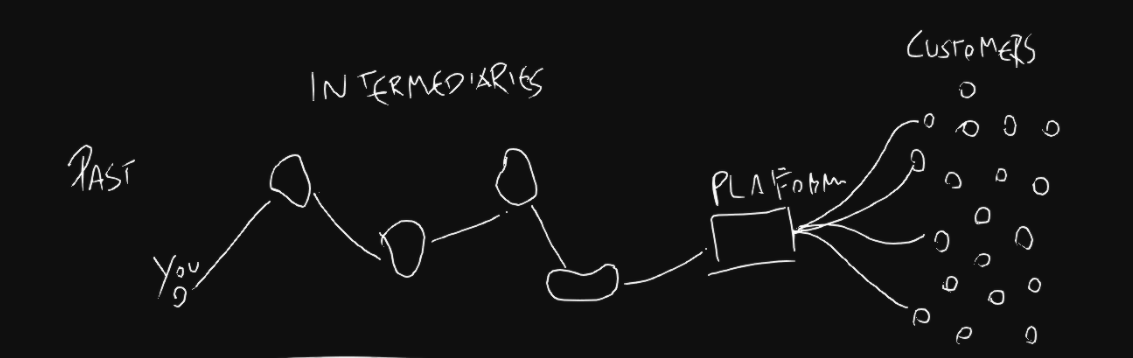
The problem with this setup was that if you made a particularly bad public comment, this real person representing you would want to look after their own interests - their career and family - and distance themselves from you. And suddenly the chain was broken.
This is why in the past it was also very possible for companies to get "cancelled" when the stars aligned. There were many examples of companies just straight up dying due to a single bad comment made by their CEO. The present, though, is different. Today we have the internet, and with the internet we don't need intermediaries. With platforms such as Steam, Spotify, Amazon, YouTube, Twitter, Reddit, etc, we can all reach customers directly, with intermediaries being completely optional.
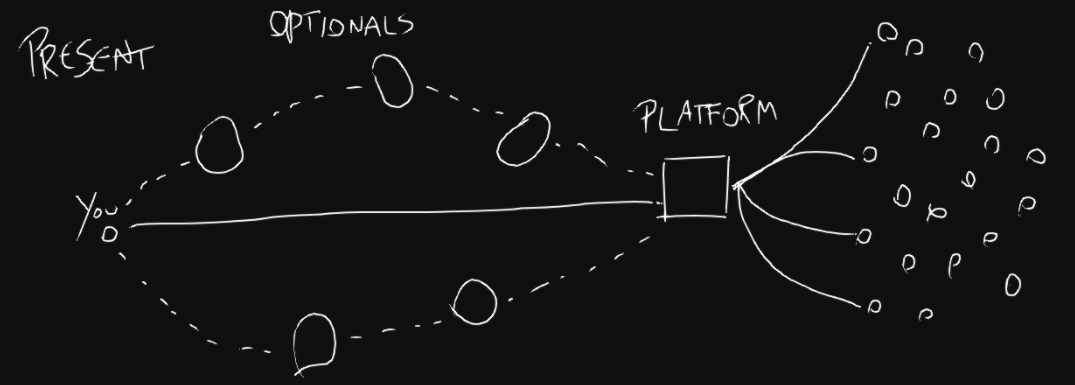
Steam
And with indie game development in particular, the platform that won out was Steam. Valve is interesting because they're a company that inhabits their position in the environment as a platform perfectly.
One of the most striking things to me about releasing my first game on Steam was that I didn't have to interact with a single human being at Valve. As far as I noticed, everything was done automatically by some system that didn't give me any trouble.
On top of this being fairly convenient, it has a way more important property: there's no human being at Valve that has anything to lose by my game being there or by me making a bad public comment. This single fact makes Steam a truly internet based platform.
One of the best examples of this to me is a game called Hentai Nazi. This is a game released early this year that doesn't really betray its name. It's a simple game about anime girls and nazis.

edit from the future: Hentai Nazi did end up getting removed from Steam but not because of its content, but because its developer abused the store’s review system, as the ban happened along with other devs who got caught doing the same thing. Another current example that serves the same purpose for this post is TYRONE vs COPS.
It's a good example not because it's about hentai or about nazis, but because these are both contentious subjects, and yet because no one at Valve has anything to lose from it being there, it's simply allowed to be there. And surprisingly, it ended up doing fairly well too!
This is EXACTLY the kind of freedom that people hoped the internet would bring, and in my opinion Valve is one of the most progressive platforms in the world in these terms, and we're lucky that they happened to be in our field.
The way this helps you shield yourself from cancellings should be obvious by now. In general, you want to avoid intermediaries that have a human connection between you and getting to what the intermediary offers (which is generally broader access to customers).
Why publishers are generally bad
Let's say Devolver contacted me and they wanted to publish one of my games. I would immediately say no. Why? Because Devolver has something to lose. If I got published by a company like that I'd be assigned an individual in it.
That individual has his career and family to look after, so the moment I made a particularly bad comment or my game had particularly contentious content one of the following things would happen:
- I'd be asked to apologize, and I'd never do that.
- I'd be asked to change content in my game, and I'd also never do that.
- I'd be asked to stop talking about whatever I was talking about because it's bad PR, and I wouldn't do that either.
Finally, after all this would fail, they would either decide to drop my game, or they would still publish it but they'd do a poor job at it, simply because the individual responsible for representing me wouldn't want to tie himself further with my game.
Why go through all that unnecessary suffering? For this reason, publishers in general are very much something you'd want to avoid. And the same exact argument applies to YouTubers/streamers/influencers, consoles, and hand-curated stores. All of those places are places acting as intermediaries between you and customers using human beings as their intermediation tools, and as already explained, that's usually a bad idea.
Social media controversy and sales
Now, given that your game can't truly be cancelled because it's not going to be removed from Steam and because you have direct access to customers via social media, one thing people worry about is: with all the controversy surrounding your game, won't your sales drop a lot?
The answer to that is a resounding NO. Social media dramas and controversies generally have absolutely no negative effect on sales, and they might even have a positive one. But in general you can completely ignore them and nothing will happen.
The reason for this is that your social media reach is minimal in comparison to what Steam generates on its own. Your whole goal as an indiedev is to generate enough attention on your game so that Steam's algorithm picks it up from there and propels it upwards.
Once that happens, whatever reach you have in social media, however large you think it was, becomes very small. And this same smallness applies to your attackers. The majority of people playing your game will end up being people who simply don't use social media.
Another thing people fear is that review bombs are a thing. Even though people online would have no ability to truly cancel you, they can still ruin your game's reputation. And there are basically 2 answers to that.
The first answer is that by the time people are attacking your game with negative reviews, you got enough eyes on it that they don't matter. Most of the effect of negative reviews happens early on, and it's unlikely people will attack a small indie game right as its released.
The second thing is that Valve has a button that helps you fight review bombs such that the effectiveness of this kind of attack can be largely diminished:

All in all, worrying about social media "public opinion" or reviews is not really correct because the actual effect of those on the outcomes you care about tends to be minimal.
Power
So, to summarize: you don't have to worry about being cancelled as long as you use automated platforms that have no human beings linking you to customers. Steam and social media = good. Publishers, influencers, consoles, manual stores = bad.
Social media being on the "good" side of this can be questioned by some. I would say that some sites are way more ban happy than others so you have to know the rules and act accordingly. In general, even if the content of your game is extremely contentious, as long as you're acting reasonably, not insulting people directly, not getting into huge arguments all the time, etc, you likely won't get banned from any of these huge social media sites like twitter, YouTube, reddit, and so on. Just follow each site's rules!
This gets into another argument that I'll probably write about in the future, but in general you want to look at all these places as having power over you, and ideally you'd want that to not be the case, but because they're huge platforms it's basically impossible for that to be so. So you don't want to fight them head on, you want to treat them as one would treat the politics of a foreign country you're spending a 2 weeks vacation on.
Do you care about the fact that you don't have a say in their political discussions? No. Will you follow all their local laws so you don't get arrested? Yes! You should have that same mentality towards all these sites. Follow their rules and you'll more likely than not be fine.
For the cases where you do have more power and you can make a choice, like with publishers, influencers, etc, then it's obvious that you should choose the choice that empowers you over them. I think one of the aims of being an indie developer is to be independent, and you can't be truly independent if other people have power over you.
Thoughts on making small games
Thoughts on making small games
I notice more people talking about making small games. As I'm also currently focused on this goal, I thought it would be good to write something about it. I think that indiedevs in general have a few misconceptions about the problem and aren't thinking about it clearly, and in this post I'll go over that argument.
The meaning of small
The first thing to notice is that the word small, when used in the context of making games, is conflating multiple meanings into one word. The first meaning is related to how long or how many people it took to make the game. The second meaning is related to how long it takes for players to go through the game.
When indiedevs use this word to describe their games, they're generally referring to both meanings at the same time, or to one of them in an interchangeable way with the other.
For instance, this great talk (watch it in its entirety, I highly recommend it) goes over techniques for making games every month. However, it implicitly assumes that because this development duration is small, the games also will be fairly small for the players. This is illustrated in the first point where one month games are referred to as “concept games” rather than real games.
Another example of a similar assumption is in this article, which goes over a game made in 4 months. Similarly, it is implicitly assumed that because the game was made in a short timeframe, the game would also necessarily be fairly small from the perspective of the players. (1 or 2 hours long)
In both of these cases you see the same error being implicitly made, which is that both meanings of the word small are the same thing, and this logically leads to the idea that if you make a game in a short timespan it must be the case that the game will not last a very long amount of time to the player. These are just two examples, and they're simply illustrative because this error is made by pretty much every indiedev talking about making small games right now.
The game scope chart
To further illustrate this point, you could look at this problem as a chart with four quadrants. On the horizontal axis we'll have one meaning of the word, on the vertical axis we'll have another. For clarity's sake, we'll refer to the meaning that pertains to development time as small/big and to duration for the player as short/long.
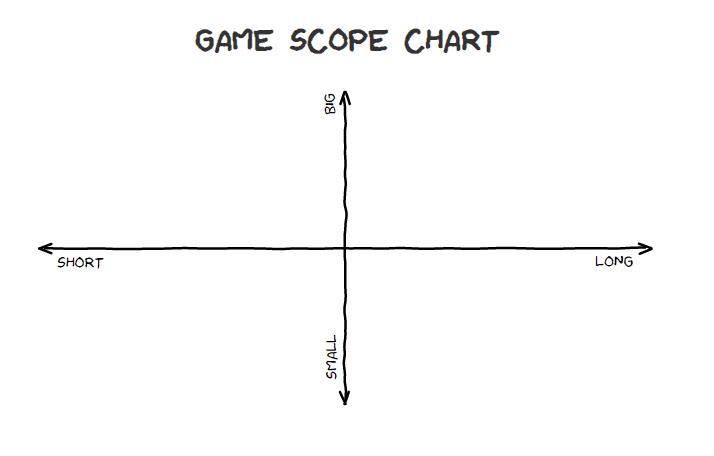
We generally don't care about the top two quadrants of the chart. Those are related to games that have big development times or teams, and that's not what people are referring to when they talk about small games. We're then left with the bottom two quadrants, and here we have a spectrum that goes from small short games to small long games.
Most indiedevs inherently assume that because a game is small, it has to be short. I reject this notion entirely. I think the quadrant of small long games is fairly unexplored, and it's useful to think about if this is a valid quadrant at all.
My experience with BYTEPATH
The only game I've released so far is BYTEPATH, and it falls under what I would consider a small long game.
It's small because it was made in about 4 months by me alone, and it also has a fairly small scope. By the nature of its gameplay it's essentially a single screen game with lots of upgrades, like one of those old flash games.
And it's long because it feels like a long game. Despite being made in just 4 months, it has a skill tree with about 900 nodes, it has 10 different characters, around 40 classes… Essentially, it's what I also like to call a spacious game.
You ever listen to a song or an album for hundreds of hours? I'm currently doing this for Thank You Scientist's Terraformer and it's crazy how despite listening to it for so long I still find new things in each song that I didn't notice before. This album is a spacious album. It can be thought of as this large space, and as you listen to it, you're exploring it, mapping the environment, finding new walls, rooms, objects, that you didn't know were there before.
Games can also be like this, and long games are generally like this. BYTEPATH certainly is because it was made to be so, as the goal of the game is finding new builds to play, to the point where the main gameplay itself is kind of irrelevant.
And because of this I think BYTEPATH did way better than I expected it to do. It's also important to note that despite me calling spacious games long games, they don't necessarily have to be played by most people for a very long time. Here's what BYTEPATH's hour distribution looks like:
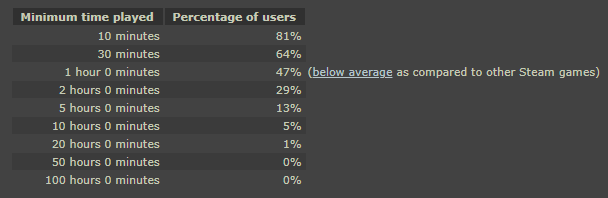
This is definitely not impressive but it's also not too bad. And I know for a fact there's at least one guy (I saw him in the game's reviews) who played it for over 100 hours. When games feel spacious they have the possibility of keeping people playing for a fairly long time, which increases the chances that the game will do well.
Small long games
The most important point here is that small long/spacious games DO NOT need to take a long time to be made. If I were to make a game like BYTEPATH again I'm fairly confident I could do it in 2 months, and it would be a significantly better game too, simply because it's actually not that hard. (I'm 100% not some kind of disciplined productivity God or anything)
When developers focus on making small games, this implicit notion that the games also have to be short is wrong. You can make small long games, and because of the way the market works, those kinds of games will tend to do better than short games. I'm not the first person to notice this:
Marketing
Another issue that happens often is that because developers are making small games that they feel are sort of worthless, they don't really do a good, serious job at marketing them. For instance, the example game from this article was marketed on Twitter only.
Anyone who has released a game knows that twitter is notoriously poor at driving sales, and that sites like reddit are much better. Would it really have cost these developers that much time to make a few posts about their games on reddit? No. And I know for a fact that a game of such visual quality would have done very well on multiple subreddits.
So a lot of the conclusions people reach about their efforts with smaller games, and the conclusion the author reaches in that article as well are pretty pessimist and in my view mistaken. I think that most devs making smaller games would benefit tremendously from taking making their games somewhat more spacious and from thinking more clearly about how they're going to market it.
The right development duration
Another thing to consider is what's the right timeframe for making a small game. One of the videos above focuses on 1 month per game, and both my previous game and the game from the article above took 4 months. I think the right duration is between 1 and 2 months.
The reasons for this are fairly simple. If you're making a 1 month game you probably want something with a scope such that it can be finished in 2-3 days, and then you spend the rest of the month polishing it in various ways. This keeps your game fairly focused and it's a good strategy if you want to drastically increase your chances of actually finishing and releasing the game.
If you're making a 2 month game this affords you a little more time such that you can actually start adding some meat to it and make it more spacious. But I personally think that it's too easy to start getting lost in scope-creep if you give yourself much more time than 2 months, so that would be my limit.
Currently that's what I'm aiming for with the game I'm making and I already overscoped myself slightly (meaning I should have chosen an even smaller game), so I think it really pays to keep this duration limited like this unless you're already more experienced and know you can avoid making these kinds of mistakes.
What also matters is how much money you can expect to make off of these games. BYTEPATH for instance made about $10k over its lifetime, and if I were to release a game like BYTEPATH every 2 months and they all did half as well as it did, then that would be considered "making a living from small games on Steam".
But that's largely because I live in Brazil and that amount of money here (even accounting for cuts and taxes) every 2 months would be a pretty comfortable salary. If you're in more expensive countries then perhaps that isn't such a good strategy, so this timeframe consideration really depends on your personal situation as well.
Luck
To finalize this fairly rambly article, one of the reasons people cite for making small games is to hedge their bets. The argument goes that if they make lots of games, chances are that one of those games will succeed wildly and cover for the costs of the other failures. More specifically this article said that using this famous graph:
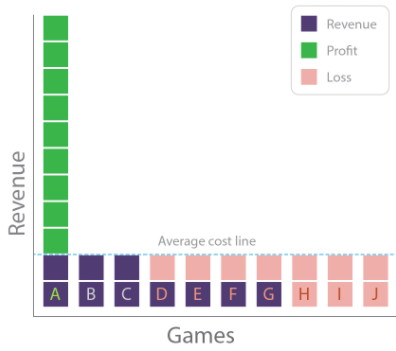
I similarly reject this notion. In my opinion you shouldn't make small games for any reason having to do with what that article says. When you're approaching things from this economic portfolio theory approach you're mirrorring the biases of our society around the notion of luck and chance and it more likely than not will sap your motivation to work on things without you even realizing it.
Additionally, for a single indie developer like me, I don't think it's actually that hard to get a game to sell, say 5000 copies. And if you can do that consistently you can definitely make a living off it. Maybe I'm arrogant and I don't know what I'm talking about. I probably am, after all I've only released one game. But I'd rather be arrogant like that than view things from this lottery/luck oriented approach that so many people seem to fall prey to these days.
This is an insidious mindset that subconsciously takes away your agency and your responsibility for your actions, it takes away your motivation for working on things at all, and it also makes you learn less from each project because if you can just chalk things up to chance, why improve at all? There are many reasons to go for small games, but doing it because of the idea that the market is a lottery, or that things are highly influenced by luck or chance, is a wrong one.
As was best said by someone way smarter than me, you're not a lottery ticket: